Showcase your capabilities
If you design, build or supply Law Enforcement USVs, create a profile to showcase your capabilities and connect with visitors who have an active requirement for your solutions.




Procure law enforcement USV platforms from global manufacturers and suppliers engineered for port security, coastal surveillance, and maritime enforcement operations. These systems integrate advanced sensor payloads, autonomous navigation, and secure communications to meet mission requirements in complex operational environments.
Read the Technology Overview
Crewed & Uncrewed Vessels for Naval Defense, Coast Guard & Humanitarian Missions

Cutting-Edge Defense Technologies Empowering The Warfighter On The Modern Battlefield

If you design, build or supply Law Enforcement USVs, create a profile to showcase your capabilities and connect with visitors who have an active requirement for your solutions.

Law enforcement USVs are unmanned surface platforms designed to support maritime security, harbor patrol, and coastal surveillance operations. These systems operate in complex operational environments where persistent ISR operations, rapid response, and force protection are critical. Configured for modular payload integration, law enforcement USVs enable deployment across a wide range of mission requirements, including maritime border security, fisheries enforcement, and critical infrastructure protection.
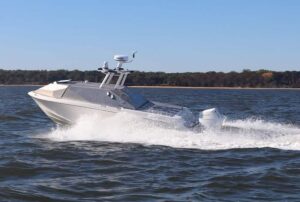
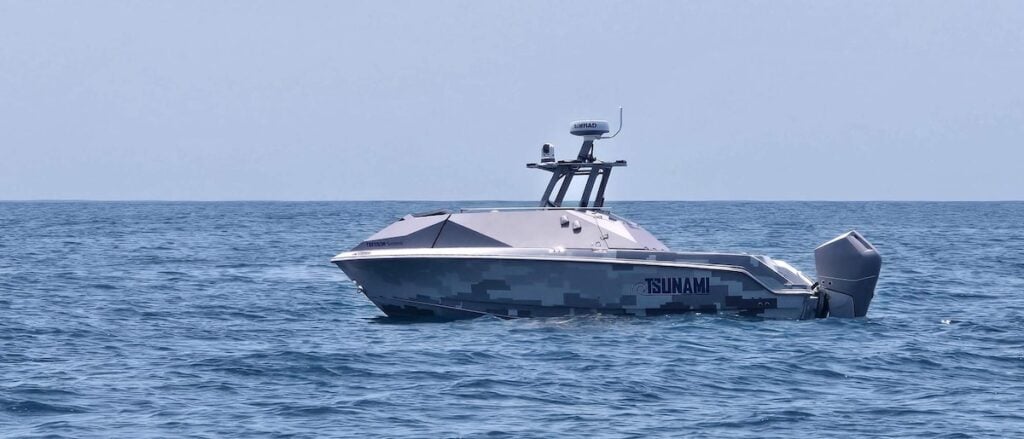
TSUNAMI™, fully autonomous attritable USVs, from Textron Systems
Law enforcement USVs conduct persistent harbor patrol operations to support port protection and security requirements in congested maritime environments. These platforms provide continuous ISR operations without increasing personnel exposure. Integration with radar and EO/IR camera systems enhances situational awareness in real time.
USVs enable wide-area coastal surveillance across littoral zones, supporting maritime border security and coastal monitoring missions. Autonomous navigation and satellite communication systems allow extended deployment beyond line of sight. These capabilities support the detection, tracking, and interdiction of unauthorized vessels.
Law enforcement USVs support maritime search-and-rescue operations by enabling rapid deployment and persistent coverage in hazardous conditions. Sensor payloads, including thermal imaging camera systems, enhance the detection of individuals in low-visibility environments. Deployment reduces risk to manned assets in high-threat or adverse weather scenarios.
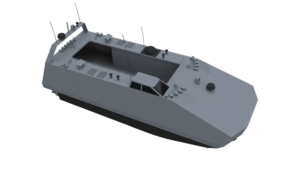
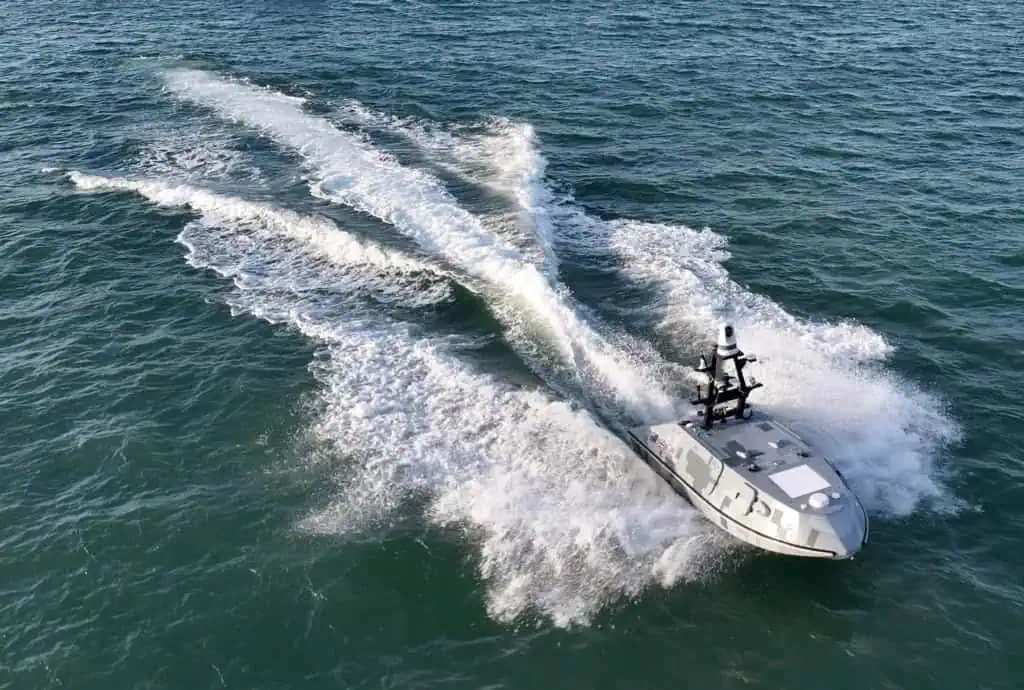
AIRCAT Panther, autonomous surface vessel, from Eureka Naval Craft
USVs are deployed for fisheries enforcement and monitoring of illegal fishing across territorial waters. Persistent ISR operations enable the identification and tracking of non-compliant vessels. Integration with communication systems supports coordination with manned enforcement units.
Law enforcement USVs protect the security of offshore platforms, naval bases, and other maritime infrastructure assets. Continuous patrol and anomaly detection support force protection in sensitive operational environments. Autonomous systems enable scalable coverage across large maritime areas.
Small USV platforms are optimized for agility, rapid deployment, and close-range surveillance missions. These systems operate effectively in harbors, rivers, and confined waterways. Limited payload capacity is offset by high maneuverability and low operational cost.
Medium USV platforms balance endurance, payload capacity, and operational flexibility. These systems support multi-mission deployment, including coastal surveillance and law enforcement patrol. Integration of multiple sensor payloads enhances ISR operations.
Large USV platforms are designed for extended endurance and offshore deployment scenarios. These systems support complex mission requirements, including maritime border security and long-duration ISR operations. Increased payload capacity enables integration of advanced sensor suites and communication systems.
Equipped with advanced navigation and positioning technologies such as GNSS and inertial navigation systems (INS), these platforms maintain precise maneuverability in congested waterways. Collision avoidance system architectures, combined with marine radar, lidar, and sonar, ensure safe autonomous operation in contested environments and high-density maritime traffic zones.
Secure communication architectures are central to the deployment of law enforcement USVs. Systems integrate satellite communications (satcom), RF data links, and emerging 5G communication technologies to support beyond-line-of-sight control and real-time data transmission. Mission computer and onboard data-processing unit configurations enable edge processing, execution of autonomy software, and rapid decision-making in dynamic deployment scenarios.
Payload configurations are tailored to ISR operations and enforcement missions. Electro-optical sensor systems, EO IR camera payloads, thermal imaging camera units, and infrared camera technologies provide persistent surveillance capability across day and night conditions. Additional payloads such as loudspeaker systems and siren system components support law enforcement patrol and interdiction operations.
Propulsion system design directly impacts endurance, speed, and operational flexibility. Electric, hybrid, and diesel propulsion configurations are selected based on mission duration, acoustic signature requirements, and fuel system constraints. Waterjet propulsion and propeller propulsion architectures provide maneuverability for harbor patrol and coastal operations, while energy management systems and battery systems integration support extended mission profiles.
Hull design and platform size influence deployment scenarios and mission capability. Small USV platforms are optimized for rapid deployment and close-range harbor monitoring, while medium USV and large USV configurations support extended coastal surveillance and offshore enforcement missions. Catamaran and mono-hull designs are selected based on stability, payload capacity, and sea-state performance.
Launch and recovery system (LARS) integration enables deployment from shore, patrol vessels, or larger naval platforms. Ground control station (GCS) and control station architectures provide command-and-control system capabilities, supporting remote operation, autonomy supervision, and mission planning across distributed ISR operations.
Cybersecurity system integration and encryption system protocols are essential for secure operation in contested environments. These systems protect command-and-control links, sensor data integrity, and mission-critical communications against interference and exploitation.
Law enforcement USVs provide persistent ISR operations without the personnel risk associated with manned patrol vessels. Compared to aerial systems, USVs offer longer on-station endurance and direct surface-level interaction for interdiction and inspection tasks. Compared with static surveillance infrastructure, USVs provide dynamic coverage and rapid redeployment in evolving operational environments.
Law enforcement USVs are specifically configured for enforcement missions, with loudspeaker and siren systems and evidence-grade sensor payloads. These systems are optimized for deployment scenarios requiring interaction, deterrence, and compliance enforcement.
Law enforcement USVs are developed in alignment with relevant defense and maritime standards to ensure interoperability and operational reliability. Compliance considerations include MIL-STD requirements for environmental durability, STANAG frameworks for communication and data interoperability, and ISO standards for maritime safety and system integration.
Cybersecurity frameworks and encryption standards are critical for protecting ISR operations and command-and-control systems. Navigation and positioning systems must align with international maritime regulations to ensure safe operation in shared waterways. Integration with existing C2 system architectures supports seamless deployment within broader maritime security networks.
Law enforcement USVs continue to evolve as critical assets for maritime security, delivering scalable, autonomous capability aligned with modern mission requirements and contested operational environments.


 Searching Companies & Products