Showcase your capabilities
If you design, build or supply Drone Delivery Systems, create a profile to showcase your capabilities and connect with visitors who have an active requirement for your solutions.




Drone delivery systems offer unmanned solutions for transporting critical payloads across contested or inaccessible terrain. With delivery methods ranging from parachute airdrops to tethered rope systems and high-altitude low-opening (HALO) techniques, defense operations are increasingly relying on autonomous and semi-autonomous delivery drones.
Read the Technology Overview

In modern combat and support operations, the ability to rapidly deploy supplies while minimizing human risk is crucial. Drone delivery systems allow military forces to conduct payload drops in environments that are too dangerous, remote, or logistically complex for manned missions.
Whether supplying forward-operating units, delivering emergency medical equipment, or deploying sensors into enemy territory, military cargo drones equipped with specialized delivery systems have become indispensable to the military. These systems form the backbone of next-generation drone logistics, supporting real-time resupply, autonomous operations, and scalable missions across multiple theaters of operation.
Military drone delivery systems are defined by how they deploy their payloads. Each system is tailored for specific mission profiles, offering various levels of precision, stealth, and operational efficiency.
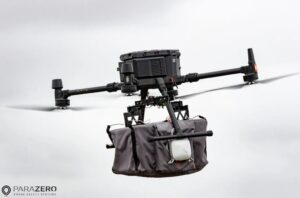
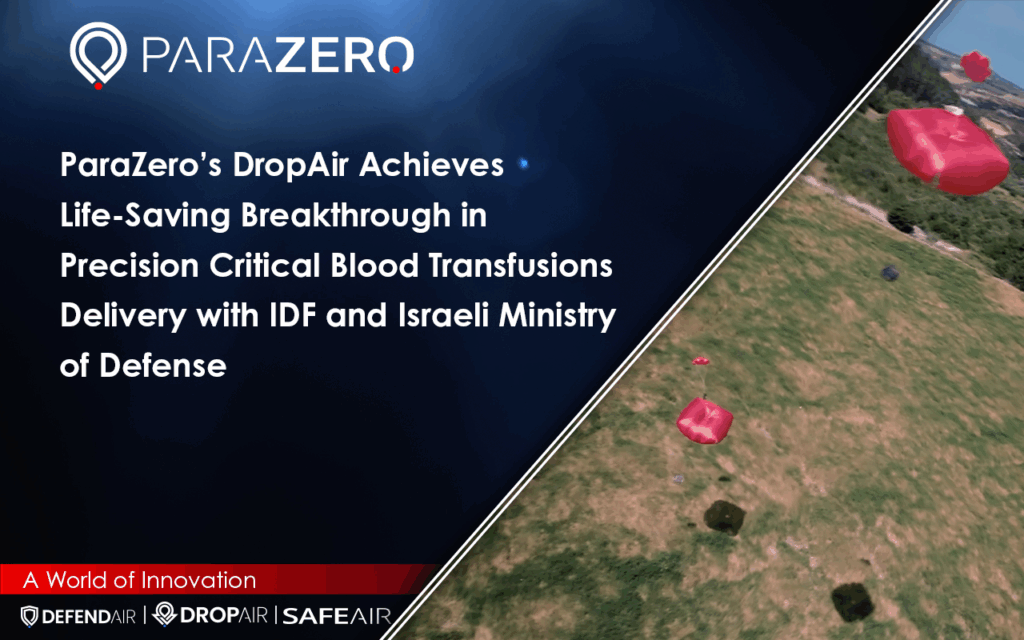
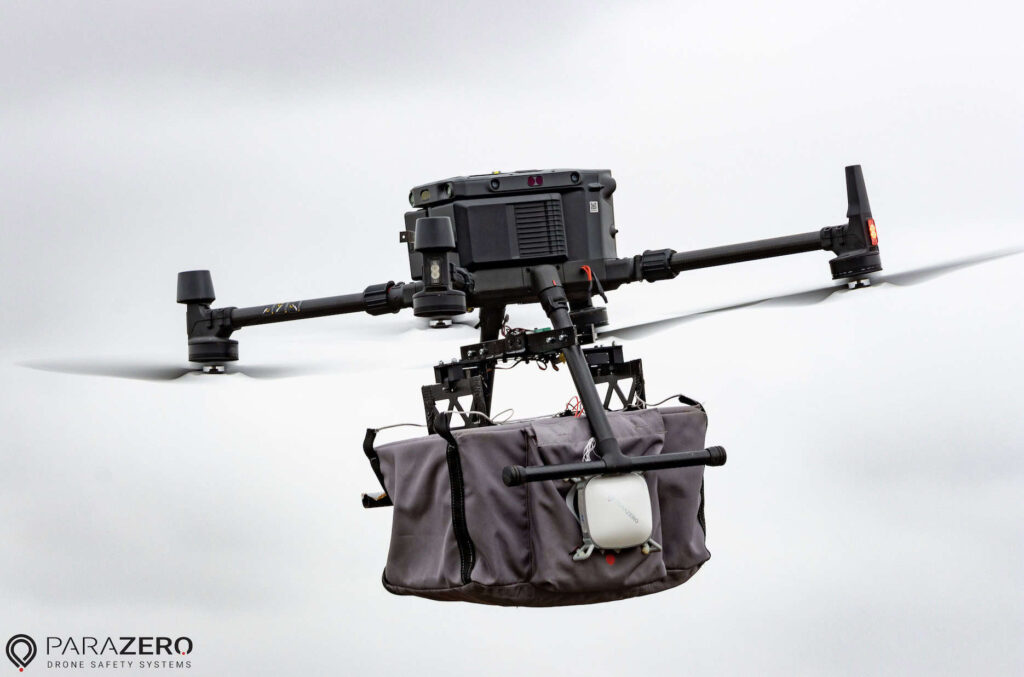
Drone airdrop system, DropAir, by ParaZero Technologies.
One of the most versatile delivery methods, the parachute drop involves releasing the payload mid-air and allowing it to descend gently using a cargo parachute. This approach is ideal when drone landing is impractical due to terrain, threat level, or mission urgency.
High-altitude low-opening (HALO) delivery is a specialized variant of the parachute drop. In HALO drone delivery, the payload is released from a high altitude, often above enemy detection or engagement range, with the parachute deploying only at low altitude, just seconds before ground contact. This technique minimizes exposure to air defenses and allows for greater delivery accuracy in hostile environments.
Military cargo drones using HALO and standard parachute systems can deliver a wide range of payloads, including ammunition, food, equipment, and emergency medical supplies. Advanced systems may employ GPS-guided cargo parachutes that can autonomously steer toward specific coordinates, further increasing precision.
Tethered or rope-based drone delivery systems use a winch or cable mechanism to lower the payload to the ground while the drone remains airborne. This method is commonly used when precision is required, and landing is undesirable due to space constraints or threats on the ground.
Drone airdrop systems with tethered payloads are particularly useful for urban operations, maritime resupply, and forward medical drops. They ensure a controlled descent and accurate placement while allowing the drone to ascend and exit the area rapidly after release.
Tethered drop systems can be automated or remotely operated, making them compatible with both autonomous drone delivery systems and semi-autonomous missions.
In free-fall delivery, the payload is released directly from the drone without the use of parachutes or cables. This method is suitable for rugged items where soft landing isn’t critical or where mission speed is prioritized over delivery delicacy.
Common in drone shipping of durable gear or disposable supplies, free-fall systems require precise altitude control and are often integrated with shock-resistant packaging to protect the contents. Military drones may use this method to drop non-fragile equipment, test devices, or decoy packages into operational zones.
Mechanical release systems utilize latches, claws, or grippers to secure and release the payload at the designated time. These mechanisms can be adapted for both parachute and free-fall deliveries, depending on mission configuration.
Controlled via remote or autonomous triggers, mechanically released payload systems are used in missions that demand high precision and reliability. They are commonly integrated into automated drone delivery systems and modular drone platforms.
In some missions, drones land directly at the delivery site, where payloads are either manually offloaded or ejected via automated systems. Although this method lacks the tactical speed of an airdrop, it enables the secure transfer of larger or more sensitive cargo.
Landing-based systems are helpful in low-threat environments or where interacting with other systems, such as ground robots or autonomous vehicles, is required.
Advanced systems use autonomous gliders or guided wings to extend the reach and control of drone delivery missions. After release, these gliders navigate themselves to the target zone using onboard sensors and GPS.
This method combines the benefits of parachute and powered flight delivery, offering stealth, range, and mid-air guidance. Guided gliders are primarily used in high-tech defense operations, such as covert surveillance drops or precision equipment placement.
Drone delivery systems are employed in a variety of military missions:
These diverse applications reflect the growing reliance on drones for tactical and strategic logistics.
Various military standards (MIL-STD) apply to drone delivery systems:
These standards address secure and interoperable communication systems used across military platforms. For autonomous drone delivery systems, compliance with the MIL‑STD‑188 series ensures that drones can operate securely within networked defense architectures and support joint operations.
As technology advances, drone delivery systems are evolving to support even more complex operations. Key trends include:
Military planners envision drone delivery as a cornerstone of autonomous battlefield logistics, enabling sustained operations with minimal human input.
As drone technologies continue to evolve, their role in defense logistics will expand toward greater autonomy, precision, and scalability. These systems not only reduce risk and cost but also ensure rapid, flexible support in even the most complex operational environments.
If you design, build or supply Drone Delivery Systems, create a profile to showcase your capabilities and connect with visitors who have an active requirement for your solutions.


 Searching Companies & Products