Showcase your capabilities
If you design, build or supply Anti-Drone USVs, create a profile to showcase your capabilities and connect with visitors who have an active requirement for your solutions.




Read the Technology Overview
Crewed & Uncrewed Vessels for Naval Defense, Coast Guard & Humanitarian Missions

Cutting-Edge Defense Technologies Empowering The Warfighter On The Modern Battlefield

If you design, build or supply Anti-Drone USVs, create a profile to showcase your capabilities and connect with visitors who have an active requirement for your solutions.

USVs configured for counter-UAS operations provide a surface-based layer for detecting, tracking, and neutralizing aerial threats across maritime operational environments. They extend ISR operations into littoral and offshore zones, enabling persistent surveillance and rapid response against low-signature targets.
As distributed ISR and engagement nodes, they integrate radar, RF, EO/IR, and electronic warfare systems for multi-domain detection and targeting. Modular payloads support both soft-kill disruption and hard-kill interception.
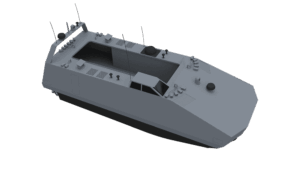
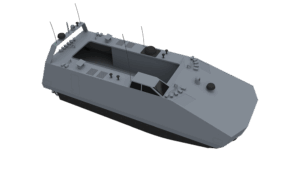
AIRCAT Panther from Eureka Naval Craft
Security USVs provide persistent patrol and detection coverage for port security and harbor protection. They enforce exclusion zones and support drone detection and mitigation without exposing personnel. Integration with coastal surveillance and radar drone detection enhances layered defense.
These platforms protect offshore infrastructure, including energy installations, by maintaining continuous ISR operations. They detect, track, and neutralize aerial threats approaching critical assets. Their deployment supports offshore asset protection in remote operational environments.
Deployed in fleet protection and convoy protection roles, USVs extend defensive perimeters against aerial threats. They operate as forward ISR nodes supporting interception and engagement. Integration with remote weapon stations, missile systems, and electronic warfare counter-UAS capabilities enables a layered response.
Optimized for complex coastal environments, these systems support maritime security, border enforcement, and coastal surveillance. They provide persistent monitoring and rapid interception capability in constrained and high-traffic zones. Their deployment enhances situational awareness in dynamic operational environments.
USVs support the protection of high-value maritime infrastructure, including military bases and commercial ports. They enable drone neutralization and deterrence within broader defense frameworks. Autonomous deployment ensures continuous coverage aligned with mission requirements.
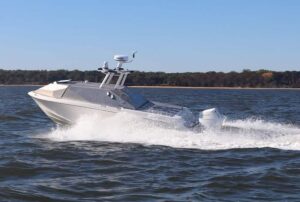
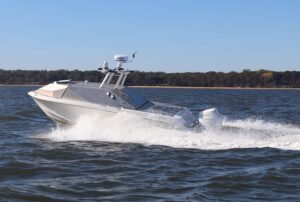
TSUNAMI™, a fully autonomous attritable USVs for naval operations, from Textron Systems
Compact platforms designed for rapid deployment and short-range missions prioritize maneuverability and low SWaP to operate in confined environments. Payloads typically include RF detection systems and lightweight EO IR systems.
Medium USVs balance endurance and payload capacity for extended ISR operations. They integrate radar and electronic warfare systems, with optional directed-energy payloads. Suitable for both coastal and offshore deployment scenarios.
Larger USVs provide long endurance and high payload capacity for sustained operations. They support complex mission systems, including laser weapons and kinetic interceptors. These vessels are deployed in offshore and fleet-protection roles that require persistent ISR operations.
Counter-UAS USVs are engineered around mission systems optimized for detection latency, tracking accuracy, and engagement effectiveness. Core subsystems include:
Sensor fusion systems integrate multi-domain inputs into a unified operational picture, enabling automated tracking algorithms and real-time threat prioritization. Onboard computers and mission control software support autonomous patrol operations and rapid engagement decisions.
Propulsion systems, including diesel engines, electric propulsion, and hybrid propulsion systems are selected based on endurance, acoustic signature, and mission profile. Energy storage and battery systems enable sustained ISR operations and support high-demand payloads, such as directed-energy counter-drone systems.
Compared to fixed anti-drone systems, USVs provide mobility and dynamic coverage across operational environments. This enables rapid repositioning and adaptive deployment in response to evolving threats.
Compared with airborne platforms, USVs offer longer endurance and reduced vulnerability in contested environments. They maintain continuous ISR operations without dependence on airspace access or sortie cycles.
Compared to crewed patrol vessels, unmanned platforms reduce operational risk while enabling scalable deployment. Their modular architecture supports rapid integration of emerging counter-drone technology and mission systems.
USVs for counter-UAS operations are developed in accordance with established defense and maritime standards to ensure interoperability and operational resilience:
These standards ensure compatibility with command-and-control systems, ISR networks, and electronic warfare systems across joint and coalition operations.
USVs operate as distributed nodes within layered counter-unmanned-aerial-systems architectures. Integration with command-and-control systems and mission-control software enables a coordinated response across multiple domains.
Sensor fusion systems aggregate inputs from radar, RF, and EO/IR sensors into a unified operational picture. This supports rapid decision-making and automated engagement workflows aligned with mission requirements.
Data links and satellite communications enable interoperability with ground-based systems, airborne ISR assets, and broader C4ISR systems. This creates a resilient and scalable defense network capable of operating in degraded or denied environments.
As aerial threats continue to evolve, USVs provide a flexible and persistent capability for maritime counter-UAS operations, supporting ISR operations, interception, and force protection across diverse deployment scenarios.


 Searching Companies & Products