Showcase your capabilities
If you design, build or supply Target Towing USVs, create a profile to showcase your capabilities and connect with visitors who have an active requirement for your solutions.



Source manufacturers and suppliers of Target Towing USV systems. These unmanned surface vehicles provide a recoverable, high-performance platform for deploying towed targets. They are engineered for realistic naval threat simulation, capable of high speeds and complex maneuvers to support live-fire exercises and weapons system validation. Core functions include threat simulation, live-fire training, and operational testing, providing a critical asset for modern fleet readiness.
Read the Technology Overview
Crewed & Uncrewed Vessels for Naval Defense, Coast Guard & Humanitarian Missions

Cutting-Edge Defense Technologies Empowering The Warfighter On The Modern Battlefield

If you design, build or supply Target Towing USVs, create a profile to showcase your capabilities and connect with visitors who have an active requirement for your solutions.

A target towing USV is an integrated system designed for operational reliability in harsh maritime environments. The platform’s performance is defined by its speed, maneuverability, and payload capacity, which are dictated by the hull design, engine power, and propulsion system. These vehicles operate semi-autonomously on pre-programmed routes or under the direct control of a remote operator, allowing for both repeatable testing parameters and dynamic scenario adjustments.
The vehicle’s primary function is to deploy and recover a variety of towed targets at safe standoff distances. These targets can range from simple radar-reflective shapes to sophisticated systems that mimic the electronic and thermal signatures of enemy craft. This flexibility allows a single USV platform to support a wide spectrum of training and testing requirements, making it a cost-effective force multiplier for naval forces.
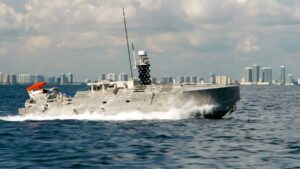
CUSV by Textron Systems
A target towing USV provides a moving target for gunnery and missile system validation during a live-fire exercise. This application enables end-to-end testing of a ship’s combat systems in a realistic scenario without risking personnel. The platform’s unmanned nature permits more challenging and dynamic engagement profiles.
During multi-ship fleet training operations, these USVs can simulate coordinated attacks to test the collective response of a naval group. This enhances crew proficiency in managing complex engagements and validating tactical procedures. The use of multiple USVs can replicate swarm tactics for high-fidelity scenarios.
For the formal evaluation and certification of new munitions, a target-towing USV offers a consistent and repeatable test bed. The platform can execute precise maneuvers to test the tracking and guidance systems of missiles and other smart weapons. Data collected during these tests is critical for system development and validation.
These USVs are a key tool for threat simulation, capable of mimicking the tactics and signatures of potential adversaries. Equipped with specific payloads, the vehicle can present a realistic challenge to a ship’s sensors and electronic warfare suites. This tests the readiness of both the systems and the operators.
In air defense training exercises, a USV towing a low-profile, high-speed target can simulate a sea-skimming anti-ship missile. This provides an exceptionally challenging target for a vessel’s close-in weapon systems (CIWS) and air defense missile systems. It allows crews to practice engagements against one of the most difficult threat types.
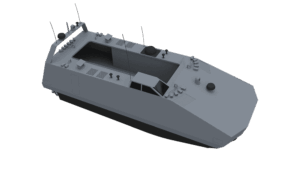
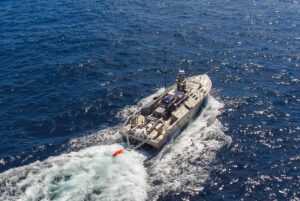
AIRCAT Panther by Eureka Naval Craft
Maneuverable target drones can perform evasive, unpredictable maneuvers. These systems are used to train personnel to engage agile threats that do not follow a simple linear path. This type of training is essential for developing proficiency against sophisticated adversaries.
A remotely operated target towing USV allows a human controller to guide the target’s path in real time. This adds a dynamic element to training exercises, enabling the operator to test a crew’s reaction to unexpected maneuvers. This model is ideal for creating adaptable and challenging training scenarios.
Autonomous Surface Vehicles towing targets follow a pre-programmed route without direct operator intervention. This ensures a high degree of consistency and repeatability for formal weapons testing and system certification. The use of autonomous targets is standard for exercises where precise, documented parameters are required.
High-speed target drones are designed to replicate the velocity of fast attack craft or incoming missiles. Towed by a powerful USV, these systems test the rapid-response capabilities of a naval vessel’s defensive systems. Their use is critical for validating tracking systems and engagement timelines.
Effective operation requires seamless system integration of all core components. The navigation system must fuse data from a global navigation satellite system (GNSS), such as GPS, with an onboard inertial navigation system (INS) to provide precise positioning, even during periods of satellite signal denial. This integrated navigation data is fundamental for both autonomous route-following and accurate remote piloting.
A robust communications system is required for command and control, providing a reliable data link between the ground control station and the USV. Payloads, such as an electronic warfare suite or specialized sensor packages, must be fully integrated with the vehicle’s power and control systems. All subsystems are managed through a central control system that allows a single operator to manage navigation, engine output, and payload functions.
When comparing target towing USVs, key performance indicators include maximum speed, range, and sea state tolerance. A higher sea state rating indicates the vehicle can operate in more adverse weather conditions, increasing operational availability. The payload capacity and modularity of the design determine the platform’s mission flexibility, with superior models offering quick-change payload bays for different training scenarios.
Another critical point of comparison is the level of autonomy. More advanced systems offer sophisticated autonomous capabilities, such as collision avoidance and complex route planning, which reduce operator workload and enhance safety. The integration of advanced sensor suites, like high-resolution radar and electro-optical/infrared (EO/IR) cameras, also differentiates platforms, providing enhanced situational awareness and data collection capabilities.
Target towing USVs intended for military use are engineered to meet stringent durability and performance standards. Systems are typically designed to comply with MIL-STD-810 to ensure survivability and operational reliability under extreme environmental conditions, including shock, vibration, and temperature extremes. This standard certifies that the equipment is fit for the harsh realities of maritime deployment.
Electromagnetic compatibility is governed by MIL-STD-461, which ensures the USV’s electronic systems do not interfere with the host vessel’s own sensitive equipment and are not susceptible to external electromagnetic interference. For systems sourced by U.S. defense agencies, compliance with the National Defense Authorization Act (NDAA) is often required, restricting the use of certain foreign-made components. Adherence to these standards is a critical indicator of a system’s quality and suitability for military applications.


 Searching Companies & Products



