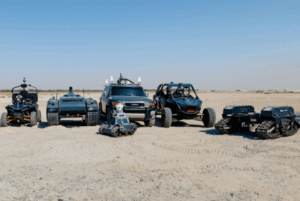
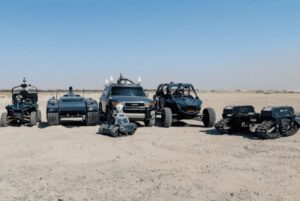
Military Autonomous Driving Systems (ADS) are integrated hardware and software architectures that enable ground vehicles to perceive terrain, make mission-aware decisions, and execute movement with reduced human input. Designed for off-road, urban, and contested environments, these systems operate without reliance on lanes, signage, or assured GNSS and communications.
This page features suppliers of military autonomous driving solutions for convoy automation, logistics resupply, reconnaissance, route clearance, and manned-unmanned teaming.
If you design, build or supply Autonomous Driving Systems, create a profile to showcase your capabilities and connect with visitors who have an active requirement for your solutions.
Introduction to Military Autonomous Driving Systems
Military Autonomous Driving Systems (ADS) are the integrated hardware and software architectures that enable military ground vehicles to perceive their environment, make tactical decisions, and execute motion with minimal human intervention. Unlike commercial automated driving systems, military variants must operate where there are no lanes, no signs, and often no reliable communication infrastructure. Autonomy is not a binary switch but a spectrum of capabilities selected based on the mission phase, threat level, and command intent.
Key Applications of Military ADS Solutions
Military autonomous driving systems are deployed across a range of operational roles where automation directly supports force protection, sustainment, and tactical effectiveness, particularly in high-risk or manpower-constrained missions.
Force Protection and Risk Reduction
The primary driver for military ADS adoption is the preservation of life. Automating high-risk tasks such as route clearance or movement through exposed terrain minimizes personnel exposure to IEDs and ambushes. Autonomous vehicles can be utilized to probe routes ahead of manned formations, absorbing initial contact and operating in environments deemed too hazardous for human crews.
Logistics, Resupply, and Convoy Operations
Logistics operations are particularly well-suited to autonomous mobility. Leader-follower systems allow for sustained resupply missions with a smaller personnel footprint, reducing driver fatigue and increasing operational tempo. In contested areas, autonomous logistics vehicles maintain vital supply lines while minimizing the exposure of support personnel.
CoreX Autonomous Driving Solution by SteerAI
Reconnaissance, Surveillance, and Route Clearance
ADS-equipped platforms support reconnaissance by enabling persistent movement through uncertain terrain while carrying specialized sensors. Autonomous driving allows these platforms to operate at standoff distances and execute repeatable search patterns that improve detection reliability for mines or hostile activity.
Combat Support and Manned-Unmanned Teaming
In combat support roles, ADS enables uncrewed vehicles to accompany armored formations to provide resupply or sensor extension. Within Manned-Unmanned Teaming (MUM-T) frameworks, autonomous vehicles act as force multipliers that extend the reach and resilience of the unit without removing human command authority over the mission intent.
Urban, Off-Road, and Contested Environment Operations
Military ADS must perform across environments that defeat most civilian solutions. Urban terrain introduces clutter and unpredictable actors, while off-road environments demand robust perception of vegetation and soil composition. Contested environments impose electronic warfare and GNSS denial, which are treated as standard operating conditions rather than edge cases.
Core Components of Military Autonomous Driving Systems
A robust military autonomous driving system is only as capable as its weakest sensor or algorithm. In the defense sector, redundancy and fail-functional design are non-negotiable requirements.
Perception and Environmental Awareness:Sensors are positioned to minimize blind spots while surviving shock, vibration, and thermal cycling. Key modalities include LiDAR for 3D geometry, Radar for robust detection in smoke or dust, and EO/IR cameras for night operation and thermal contrast.
Localization and Mapping: While GPS is a useful input, tactical autonomy must assume it will be unavailable. Systems utilize SLAM (Simultaneous Localization and Mapping) to build maps in real-time and high-precision Inertial Navigation Systems (INS) to maintain position data when external signals are lost.
Path Planning and Decision-Making: This function converts perception data into safe, mission-appropriate motion. Military planning balances mobility with tactical intent, embedding doctrinal limits such as dispersion and exposure management.
Vehicle Control and Actuation:Control systems execute planned trajectories by commanding steering, braking, and propulsion. Drive-by-wire systems enable electronic control while preserving manual override paths for safety.
Together, these components form a tightly coupled architecture in which sensing, navigation, decision logic, and control must remain coherent and predictable despite damage, degradation, or contested operating conditions.
Levels of Autonomy in Military Ground Vehicles
The defense industry utilizes a modified understanding of the SAE levels, often focusing on the relationship between the human and the machine. These levels range from Driver Assistance (ADAS), which maintains human control, to Full Autonomous Navigation, where the system conducts movement without continuous operator input within defined mission constraints. The balance between scalability and accountability is managed through human-on-the-loop and human-in-the-loop configurations.
Artificial Intelligence & Machine Learning in Autonomous Driving
Military AI autonomous driving solutions differ from consumer software in their focus on Edge Processing. High-latency cloud computing is not an option on the battlefield.
Computer Vision for Unstructured Terrain: AI models are trained to recognize drivability in environments that lack predictable features like lanes or signage.
Terrain Classification: Machine learning assesses sensor data such as LiDAR point clouds and radar returns to estimate mobility risk based on slope and surface composition.
Edge AI Processing: All processing is performed onboard the vehicle to meet strict latency and power constraints. Military systems favor smaller, tightly controlled models that deliver consistent inference times.
Validation and Datasets: Training is constrained by a lack of operational data for hazardous environments. Validation focuses on demonstrating consistent behavior across a wide range of conditions rather than peak performance in ideal circumstances.
Rather than maximizing autonomy for its own sake, military AI is evaluated on its ability to behave consistently, degrade gracefully, and support mission objectives without introducing opaque or uncontrollable behavior.
Cybersecurity & Safety Considerations
The expansion of software complexity increases the potential attack surface of military vehicles. Cyber-resilient architectures isolate autonomy functions to ensure that compromised components cannot trigger unsafe behavior. Furthermore, functional safety ensures that hardware or software faults lead to a controlled halt rather than a loss of control. Trust is established through transparent behavior and rigorous testing in realistic operating conditions.
Standards, Compliance & Qualification
Military autonomous driving programs are shaped by qualification frameworks that govern safety, environmental survivability, software assurance, and interoperability across allied forces.
Functional Safety Standards: These define predictable behavior, failure modes, and recovery mechanisms for both military and automotive contexts.
Environmental Ruggedization: Requirements ensure reliable operation under extreme shock, vibration, temperature, and moisture.
Software Assurance: Independent verification validates safety-critical behavior, including the outputs of AI-enabled functions.
Interoperability: NATO and national defense compliance considerations support exportability and joint operations with allied forces.
Compliance with these frameworks provides the assurance that autonomous driving systems can be fielded, sustained, and integrated within existing force structures without compromising safety or operational trust.
Emerging Trends in Military Autonomous Driving
Ongoing developments in military autonomous driving reflect a shift toward greater operational trust, tighter human oversight models, and improved resilience in contested and multi-domain environments.
Increasing Autonomy Under Human Command: Functional capabilities are expanding while preserving human authority and legal accountability.
Electronic Warfare Resilience: ADS development is focusing on systems that recognize degraded states and switch to purely passive sensing the moment jamming is detected.
Multi-Domain Integration: Ground autonomy is increasingly designed to share data seamlessly with aerial drones and satellite assets to create a unified tactical picture.
Swarm Intelligence: Cooperative ground vehicle concepts explore how multiple platforms can coordinate movement to improve coverage and resilience in the field.
Collectively, these trends indicate a measured progression toward wider adoption of autonomy that prioritizes resilience, accountability, and doctrinal alignment over rapid but uncontrolled capability expansion.
In a partnership to innovate driverless operations for advanced terrains, Kodiak will integrate its ‘Kodiak Driver’ autonomous driving system into a Textron Systems uncrewed military ground vehicle
The latest defense technology news, straight to your inbox.
Get our weekly roundup of technology developments, new products and industry news.
THANK YOU FOR SIGNING UP
Thanks for joining us. Check your inbox.
We've sent you an email. Click the confirmation link to complete your subscription to the weekly eBrief. In the meantime, explore the latest news, suppliers and technologies on DA.
Advancing Defense Capability Through Strategic Collaboration
Defense Advancement works with major OEMs to foster collaboration and increase engagement with SMEs, to accelerate innovation and drive defense capabilities forward.