
Showcase your capabilities
If you design, build or supply Fuel Level Sensors, create a profile to showcase your capabilities and connect with visitors who have an active requirement for your solutions.



Military spec fuel level sensors are engineered to deliver accurate, real-time data in harsh environments, ensuring that vehicles such as main battle tanks, infantry fighting vehicles, and unmanned aerial vehicles (UAVs) can operate without disruption.
This page showcases leading fuel level sensor manufacturers built to MIL-STD-461G and MIL-DTL-38999 standards, supporting a wide range of applications from reconnaissance to combat logistics.
Read the Technology Overview
If you design, build or supply Fuel Level Sensors, create a profile to showcase your capabilities and connect with visitors who have an active requirement for your solutions.

Military spec fuel level sensors are high-precision devices used to monitor fuel quantities in defense vehicles and other military platforms. Designed for operation in demanding environments, these sensors may be engineered and qualified to withstand shock, vibration, electromagnetic interference, temperature extremes, moisture, dust, and exposure to fuels and other operating fluids.
Accurate fuel level information supports range estimation, mission planning, logistics management, maintenance, and the detection of abnormal fuel consumption. The required sensor technology depends on factors such as tank geometry, fuel type, platform movement, available installation space, electrical interfaces, and environmental qualification requirements.
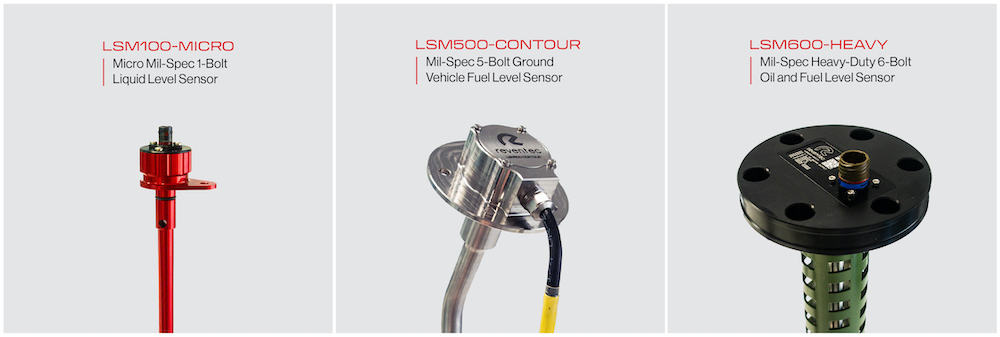
Military fuel level sensors are deployed across a wide array of platforms, with manufacturers offering rugged solutions for different tank designs, operating conditions, and integration requirements.

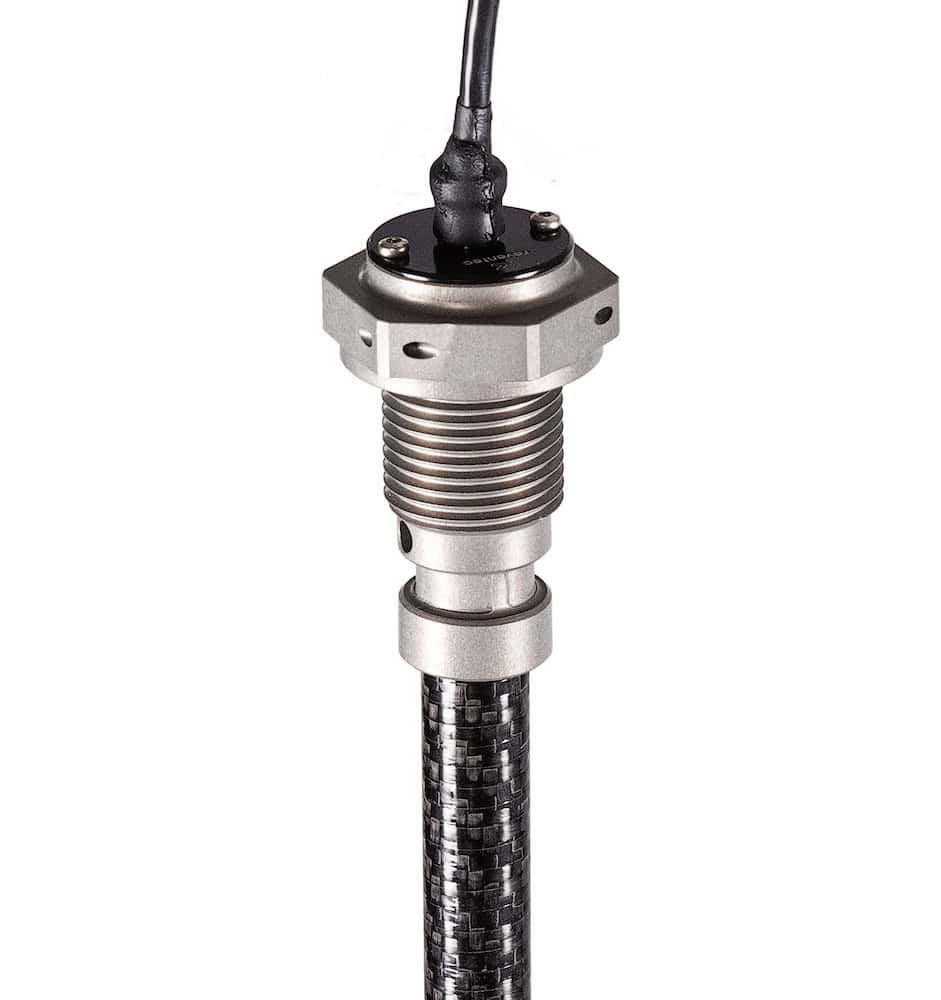
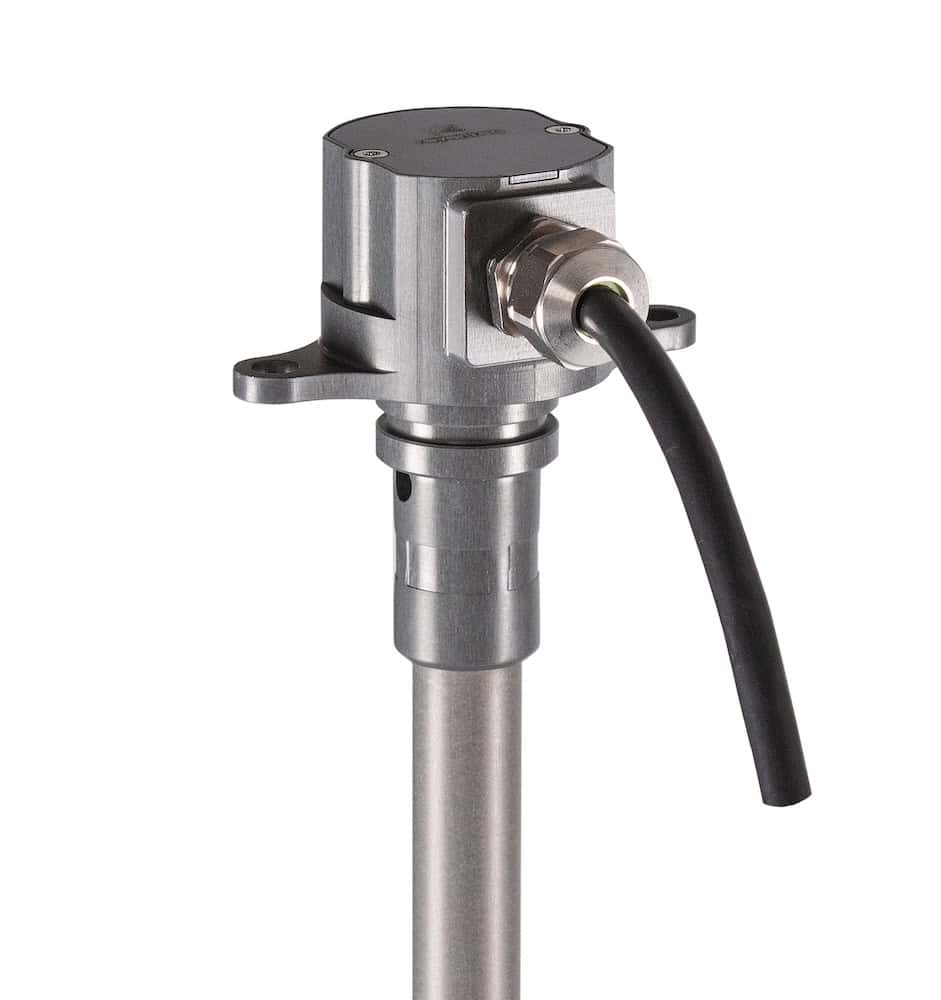
LSM200-38999 Military Spec Fuel Level Sensor by Reventec
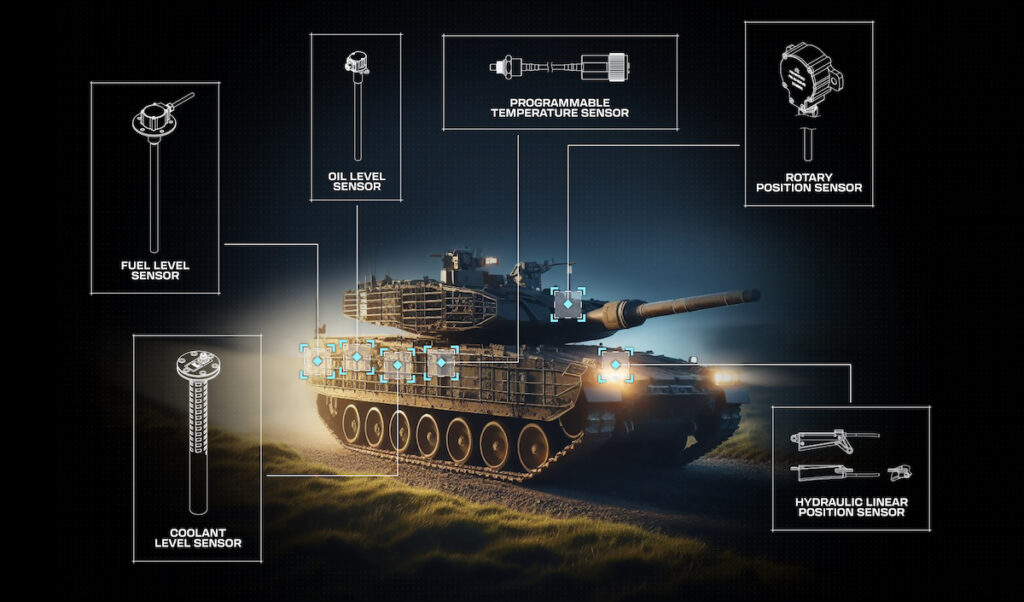
Main battle tanks, armored personnel carriers, infantry fighting vehicles, reconnaissance vehicles, and light utility vehicles require fuel level sensors that can operate under continuous vibration, mechanical shock, steep gradients, and rapid changes in vehicle attitude. Sensor systems may also need to account for fuel slosh and irregularly shaped tanks to provide reliable readings while the vehicle is moving.
Military bulldozers, combat engineering vehicles, heavy equipment transporters, and armored recovery vehicles often have large fuel tanks and extended operating cycles. Fuel level monitoring helps operators manage consumption, schedule refueling, and identify unexpected fuel loss during demanding engineering, recovery, and logistics operations.
Amphibious assault vehicles, military ambulances, hovercraft, and other specialized platforms may require sensors with enhanced environmental sealing and resistance to corrosion, moisture, saltwater, and contamination. The sensor must also remain accurate when the platform operates at changing angles or experiences substantial movement.
Unmanned Aerial Vehicles (UAVs), Unmanned Ground Vehicles (UGVs), Unmanned Surface Vehicles (USVs), and liquid-fueled Unmanned Underwater Vehicles (UUVs) rely on remote fuel information because an onboard operator is not available to inspect conventional gauges. Fuel data can be transmitted through the vehicle control system to support mission planning, range calculations, return-to-base decisions, and low-fuel warnings.
Military spec fuel level sensors are available in several configurations. Each technology offers different levels of accuracy, durability, cost, installation complexity, and resistance to mechanical wear.
| Sensor Type | Operating Principles | Advantages | Disadvantages |
| Capacitive level sensor | Measures changes in electrical capacitance as fuel rises or falls around a probe. Normally contains no moving parts, reducing mechanical wear. | Compact, lightweight, low power, and suitable for irregular tanks. Provides continuous measurement and can be highly reliable when correctly calibrated. | Accuracy can be affected by fuel properties, contamination, water content, and incorrect calibration. Installation may be more complex than with basic float sensors. |
| Magnetostrictive sensor | Uses a magnetic float moving along a probe and a magnetostrictive sensing element to determine fuel level. The sensing element has no mechanical contact, although the float moves. | Offers high accuracy, repeatability, and vibration resistance, making it suitable for demanding military vehicle installations. | Typically more expensive and requires sufficient installation space. Tank geometry, baffles, or contamination may restrict float movement. |
| Ultrasonic sensor | Transmits an ultrasonic pulse towards the fuel surface and calculates the level from the return time. Usually provides non-contact measurement with no moving parts inside the tank. | Eliminates mechanical floats and arms, reducing wear. It can be mounted above the fuel and may suit tanks containing contaminating fluids. | Foam, vapour, condensation, fuel slosh, temperature changes, obstructions, and steep platform angles can interfere with measurements. |
| Resistive sensor | Uses a float and mechanical arm to move a variable resistor as the fuel level changes. Moving components may wear, stick, bend, or be damaged by vibration or contamination. | Simple, cost-effective, widely understood, and relatively easy to integrate with conventional gauges and vehicle electrical systems. | Mechanical components can wear, and readings may be less precise than capacitive or magnetostrictive sensors. Fuel slosh and vehicle inclination can cause fluctuations. |
Capacitive and ultrasonic technologies may be preferred where eliminating moving parts is important. Magnetostrictive sensors provide high accuracy but still rely on a moving float, while traditional resistive sensors offer a cost-effective solution for many land platforms at the expense of greater mechanical wear and potentially lower precision.
Selection depends on platform design constraints, required accuracy, tank shape, fuel characteristics, environmental exposure, maintenance requirements, available budget, and the interfaces used by the wider vehicle management system.
Military fuel level sensors may be subject to several different standards, depending on the platform, installation, power system, and operating environment:
Incorporating rugged fuel level sensors into military fleets can provide several operational and maintenance benefits:
These benefits apply across military mobility platforms, from frontline armored vehicles and unmanned systems to engineering, logistics, recovery, and transport units. Overall performance will depend on selecting a sensor technology and qualification level appropriate for the tank design, fuel type, platform, and operating environment.


 Searching Companies & Products



 Subscribe to the Weekly eBrief
The latest engineering and technical developments straight to your inbox - join thousands of engineers who receive it.
Subscribe to the Weekly eBrief
The latest engineering and technical developments straight to your inbox - join thousands of engineers who receive it.