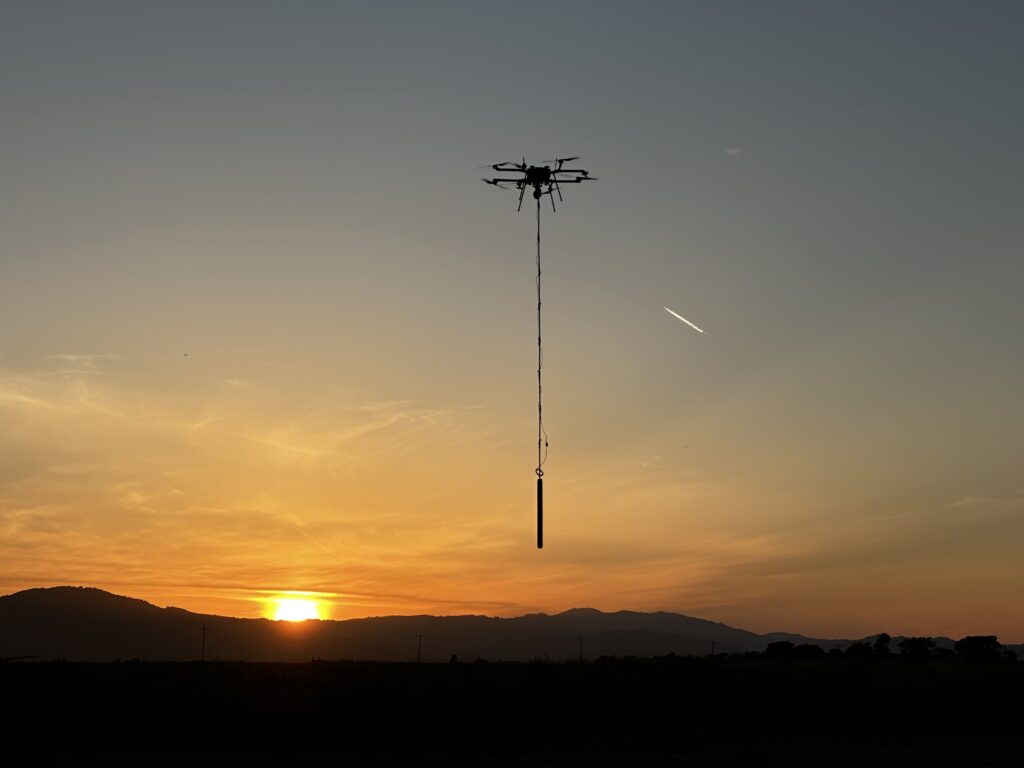
Showcase your capabilities
If you design, build or supply Drone Magnetometers, create a profile to showcase your capabilities and connect with visitors who have an active requirement for your solutions.




Drone magnetometers are precision instruments integrated into UAV payloads to measure and analyze magnetic field variations. In defense and security operations, they are deployed for magnetic anomaly detection, navigation in GPS-denied areas, and identification of concealed ferromagnetic threats across land and sea.
This guide showcases leading suppliers of UAV magnetometers, providing reliable, high-resolution magnetic data essential to reconnaissance, countermeasures, and tactical mapping missions.
Read the Technology Overview
State-Of-The-Art Flight Control & GNSS-Denied Navigation Technologies for Tactical UAV Platforms

State-Of-The-Art NDAA-Compliant Electronic Hardware Components for Mission-Critical Drone & Robotics Platforms. Made in the USA.

If you design, build or supply Drone Magnetometers, create a profile to showcase your capabilities and connect with visitors who have an active requirement for your solutions.

Modern drone magnetometers are precision sensing instruments that detect and quantify magnetic field strength, direction, and fluctuation.
In defense and security contexts, these sensors form a critical component of UAV payloads for identifying concealed ferrous objects, subsurface anomalies, and naval mines. Drone magnetometers function by measuring the vector components of the magnetic field, typically utilizing fluxgate or optically pumped magnetometers to achieve sub-nanotesla resolution.
Defense-grade magnetometer sensors are designed for low noise, temperature stability, and high sampling rates, and are often ruggedized to meet MIL-STD-810 and MIL-STD-461 environmental and electromagnetic compatibility standards. These attributes ensure reliable operation in dynamic flight environments and during high-velocity maneuvers. To maintain precision, magnetometers are commonly paired with Inertial Measurement Units (IMUs) and MEMS gyroscopes, providing attitude correction and accurate spatial correlation of magnetic readings.
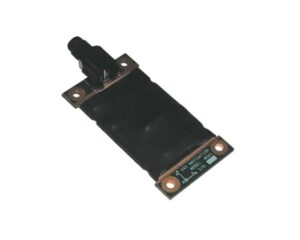
UAV magnetometer to measure magnetic field, the MG01, from UAV Navigation.
Integrating magnetometers into UAV platforms presents several engineering challenges. The drone’s electric motors, power systems, and communication electronics can introduce magnetic interference, distorting measurements. To mitigate this, defense sensor developers employ magnetic shielding, remote sensor booms, and advanced calibration algorithms to isolate the magnetometer from onboard electromagnetic sources.
Modern UAV magnetometer systems also feature sensor fusion, such as the real-time combination of data from magnetometers, accelerometers, and gyroscopes, to improve flight stability and orientation. This enables precise geo-referencing, which is vital for applications such as Magnetic Anomaly Detection (MAD) in anti-submarine warfare or locating Unexploded Ordnance (UXO) in combat zones.
Compact MEMS-based magnetic field sensors are increasingly used in lightweight UAVs, while high-sensitivity fluxgate and optically pumped magnetometers remain the standard for long-endurance fixed-wing drones.
Modern UAV magnetometers rely on advanced data processing to transform raw readings into usable intelligence. During flight, sensor data is influenced by both geomagnetic variation and interference from the drone’s power and communication systems. Pre-flight calibration and real-time compensation routines correct for these effects, while magnetic gradiometer configurations use paired sensors to measure differential field strength and remove background noise.
Post-processing techniques such as Kalman filtering, Fourier analysis, and wavelet-based smoothing enhance signal quality and spatial resolution. These methods allow operators to identify weak or spatially complex anomalies within high-noise environments. Accurate synchronization with GPS and IMU data ensures that each magnetic measurement is correctly geo-referenced for mapping drones and threat detection.
Artificial Intelligence (AI) is increasingly explored to automate magnetic data interpretation. Neural network classifiers can distinguish target signatures from environmental background patterns, while reinforcement learning can optimize UAV flight paths for efficient anomaly localization. When linked to cloud or edge-based analytics, AI processing enables near real-time detection and classification of magnetic anomalies, improving the speed and precision of defense reconnaissance missions.
Drone magnetometers serve a variety of mission-critical roles within defense, homeland security, and intelligence operations. Typical use cases include:
In maritime operations, marine magnetometers are deployed on UAVs, Autonomous Underwater Vehicles (AUVs), and Remotely Operated Vehicles (ROVs) for magnetic signature mapping of naval vessels, supporting stealth assessment and counter-detection strategies. ROV magnetometers can provide detailed, close-range magnetic field measurements around underwater structures, pipelines, and ship hulls in security operations.
Several magnetometer sensor designs are implemented in UAV payloads, each with unique performance characteristics:
Defense integrators often customize magnetometer configurations to balance sensitivity, weight, and power requirements depending on mission objectives and flight endurance.
Leading developers of aerospace magnetic sensors and drone magnetometer systems supply a broad range of airborne and portable units tailored for military operations. These include fluxgate magnetometer arrays, high-precision optically pumped sensors, and survey-grade magnetometer probes integrated with GPS and telemetry modules.
Manufacturers serving the defense and aerospace sectors focus on rugged enclosures, Electromagnetic Compatibility (EMC), and calibration stability under high-altitude or extreme temperature conditions. Custom sensor suites are also offered for aerial magnetometer surveys, combining magnetic field sensors with LiDAR, photogrammetry, and hyperspectral cameras to produce multidimensional situational awareness data.
Recent advances in quantum magnetometry and AI-based signal interpretation are enhancing research efforts toward more sensitive and autonomous UAV magnetic detection. New materials and optical pumping techniques enable lower noise floors and improved vector accuracy in experimental systems. These developments are expected to allow defense operators to detect smaller magnetic signatures more effectively as quantum technologies mature.
As autonomous and semi-autonomous systems become more prevalent across defense operations, magnetometer-equipped UAVs are increasingly relied upon for persistent magnetic surveillance, threat detection, and strategic mapping, essential for modern electronic warfare and reconnaissance missions.


 Searching Companies & Products