Advanced Battery Manufacturing Technology for the Defense & Aerospace Industry
Source manufacturers and suppliers of sovereign battery manufacturing technologies for defense and aerospace. Find partners to develop and produce high-reliability power systems for mission-critical applications, including silent watch, unmanned systems, and electric combat vehicles.
If you design, build or supply Battery Manufacturing Technology, create a profile to showcase your capabilities and connect with visitors who have an active requirement for your solutions.
Advanced Battery Manufacturing Technology for the Defense & Aerospace Industry
Overview by
Olivia Hannam
Updated:
The power requirements for modern defense systems are highly diverse, dictated by the specific mission profile of each platform. A system requiring massive bursts of energy, such as a laser weapon, has fundamentally different needs from a long-endurance unmanned aerial vehicle (UAV) that prioritizes energy density for maximum flight time. Similarly, a soldier’s wearable power system must balance low weight with rugged durability.
To meet this spectrum of requirements, a range of advanced battery technologies and cell designs is employed. Each chemistry and format, from high-power lithium-ion variants to next-generation solid-state designs, offers a unique performance profile. Consequently, the manufacturing process for each is highly specialized, tailored to optimize the specific attributes required for the intended defense application.
Key Battery Technologies & Chemistries
The selection and manufacturing of specific battery chemistries determine the performance, safety, and logistical profile of the final power system.
Solid-State Batteries
Representing a leap in battery technology, solid-state batteries offer enhanced safety by eliminating flammable liquid electrolytes and promise significant gains in energy density. For defense, this translates to longer operational endurance and reduced risk, making them a high-priority technology for future soldier power systems and vehicle electrification.
Silicon Anode Technology
The integration of silicon into battery anodes allows for a substantial increase in energy capacity compared to traditional graphite anodes. Manufacturing processes that master the challenges of silicon expansion are key to producing lighter, more compact batteries that can extend mission duration without increasing size or weight.
Lithium-Ion Variants
Proven and versatile, various lithium-ion chemistries are manufactured to prioritize specific performance traits. For example, some are optimized for the high power output required for engine start or weapon systems, while others are built for the long, slow discharge needed for persistent surveillance sensors or backup power.
Thermal Batteries
Thermal batteries are single-use power sources with an exceptionally long, inert shelf life, activated instantly by a pyrotechnic charge. Their manufacturing is tailored for extreme reliability, making them the ideal technology for munitions, missile guidance systems, and emergency power in aerospace platforms.
Lithium-Sulfur (Li-S)
A promising next-generation chemistry, Li-S offers a theoretical energy density significantly higher than Li-ion, which is ideal for weight-critical applications. The manufacturing focus is on stabilizing the sulfur cathode and managing the charge cycle to unlock its potential for high-altitude UAVs and future aerospace platforms.
Core Defense Applications for Advanced Battery Technology
Advanced battery manufacturing enables critical capabilities across air, land, and sea domains, directly impacting mission effectiveness and strategic advantage.
Naval platforms rely on advanced batteries for a range of functions, including powering “silent watch” capabilities in submarines to avoid detection. High-capacity submarine batteries and robust power systems for surface combatants are crucial for propulsion, sensors, and weapon systems.
Soldier Power Systems
Modern dismounted soldiers carry a suite of electronic gear, creating a significant power burden. Manufacturing focuses on creating lightweight, durable, and energy-dense batteries for wearable power systems, ensuring soldiers can operate effectively for extended mission durations without needing frequent resupply.
High-Energy Weapon Systems
Directed Energy Weapons (DEWs) and laser weapon systems require power sources capable of delivering massive, instantaneous energy discharges. Manufacturing specialized high-power batteries with advanced cathodes, anodes, and thermal management systems is fundamental to making these next-generation weapons viable for tactical use.
Electric Combat Vehicles
The move towards hybrid-electric and fully electric combat vehicles demands robust, scalable battery systems for propulsion and onboard electronics. Production technologies must focus on creating shock-proof, high-capacity battery packs that can survive the rigors of the battlefield while providing silent mobility.
Space and Satellite Systems
Satellites and other space assets require highly reliable, long-life batteries that can withstand extreme temperature cycles and radiation. Manufacturing processes for space-grade cells prioritize exceptional quality control and material purity to ensure mission success over decades of operation.
Key Manufacturing Technology & Equipment Areas
Achieving the precision, consistency, and reliability required for military-grade batteries demands specialized equipment that goes beyond commercial standards. Suppliers in this sector provide advanced solutions that optimize every stage of the production line to improve performance and quality.
Advanced Material Processing & Mixing
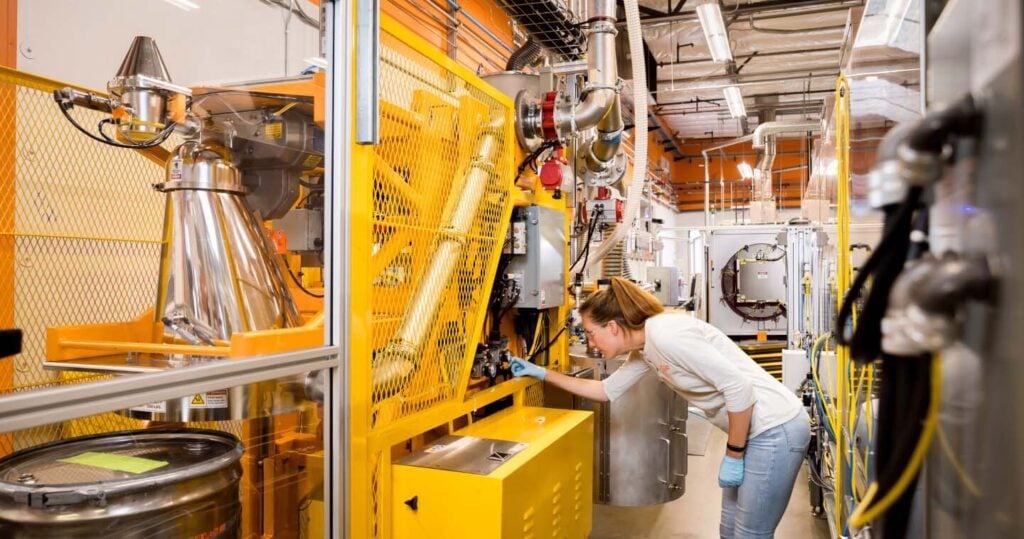
A key area of innovation is in high-precision mixing and dispersion systems for creating perfectly homogenous electrode slurries. For manufacturers, the quality of this initial step is critical as it directly affects the cell’s final energy density and stability. Developments in this field focus on automation, environmental control, and the ability to handle next-generation materials.
Precision Coating & Electrode Engineering
Another major focus is on advanced coating machines capable of achieving exceptionally tight tolerances in material thickness and density. This field also includes innovations in electrode engineering, such as laser patterning or notching. These techniques allow for complex electrode designs that can improve a cell’s power characteristics and safety profile.
Automated Cell Assembly & Welding
To ensure the repeatable quality essential for military use, the industry is moving towards greater automation in cell assembly. Key developments center on high-speed robotic systems for stacking and enclosing cells. Advances in laser and ultrasonic welding are also critical for creating the robust, hermetic seals needed to survive shock and vibration.
Formation, Testing, and Quality Control
The final stages of production are a significant area of technological development. This includes more efficient and effective battery formation and aging systems to improve throughput and cell stability. Furthermore, there is growing emphasis on advanced, non-destructive inspection equipment, such as CT scanning, to identify internal defects and ensure the highest levels of quality control.
Defense & Supply Chain Standards
Batteries and their manufacturing processes must adhere to strict defense-specific standards. Compliance with regulations such as ITAR (International Traffic in Arms Regulations) is crucial for supply chain security, while performance standards such as MIL-PRF-32383 (for Li-ion cells) and MIL-STD-810 (for environmental testing) ensure the equipment is combat-ready.
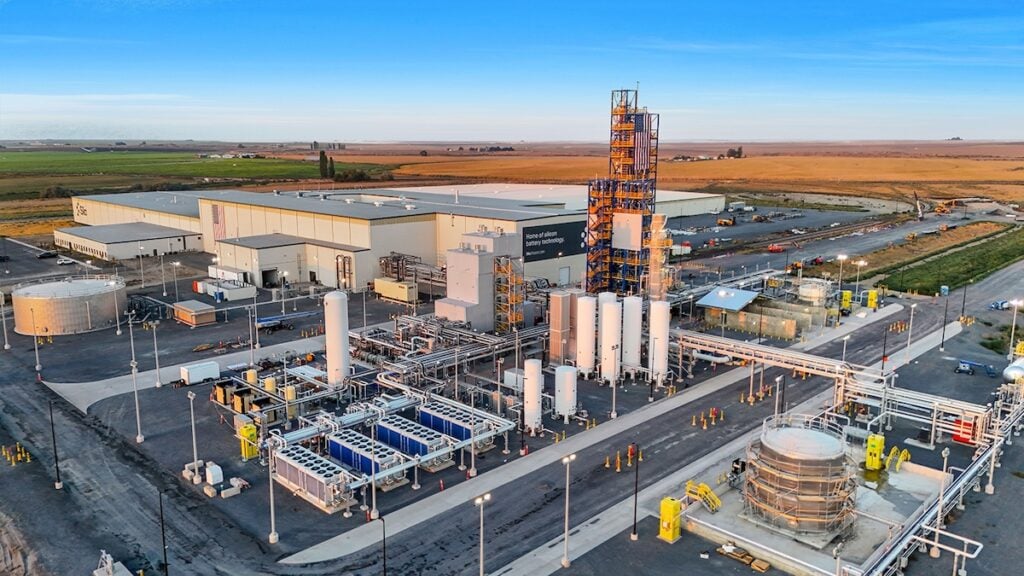
Sila’s conditional Department of War financing would expand silicon-carbon anode capacity and support lithium-ion cell manufacturing at the company’s Moses Lake facility
Sila has secured $300 million in private funding to scale U.S. production of its silicon-carbon anode technology, support a planned Phase 2 expansion at its Moses Lake facility, and strengthen domestic battery supply chains for critical industries
Sila Nanotechnologies delivers revolutionary silicon anode lithium-ion batteries, boosting energy capacity, performance, and operational endurance for mission-critical military and defense applications
The latest defense technology news, straight to your inbox.
Get our weekly roundup of technology developments, new products and industry news.
THANK YOU FOR SIGNING UP
Thanks for joining us. Check your inbox.
We've sent you an email. Click the confirmation link to complete your subscription to the weekly eBrief. In the meantime, explore the latest news, suppliers and technologies on DA.
Advancing Defense Capability Through Strategic Collaboration
Defense Advancement works with major OEMs to foster collaboration and increase engagement with SMEs, to accelerate innovation and drive defense capabilities forward.