Aircraft Generators for Military Aviation and UAV Power Systems
Aircraft generators supply both manned and unmanned platforms with reliable electrical energy. Designed to meet the rigorous demands of military and UAV operations, these systems ensure continuous onboard power for mission-critical avionics, flight control systems, and electronic warfare support.
If you design, build or supply Aircraft Generators, create a profile to showcase your capabilities and connect with visitors who have an active requirement for your solutions.
Aircraft Generators for Military Aviation and UAV Power Systems
Overview by
Summer James
Updated:
Aircraft generators serve as the core of power generation systems in manned and unmanned aerial vehicles (UAVs), including drones. These generators convert mechanical energy from jet turbines or engines into electrical power, supplying energy for avionics, sensors, communication systems, and emergency backup systems. Unlike general-purpose power generators, aviation generators are engineered for lightweight, high-performance, and vibration-resilient operation. They work with inverters, converters, rectifiers, and voltage regulators to maintain stable electrical output across varying flight conditions.
Role of Aircraft Generators in Defense Aviation
Aircraft generators are mission-critical components in military aviation. Their primary function is to produce electrical power to operate various onboard systems, including avionics, flight controls, navigation modules, surveillance sensors, weapons platforms, and environmental control systems. In many combat aircraft, these systems must operate under extreme environmental conditions such as high-G maneuvers, electromagnetic interference, and temperature fluctuations, necessitating ruggedized, military-grade power generation solutions.
1-Megawatt Generator & Motor by Honeywell Aerospace.
In UAVs and drones, power systems must be miniaturized without compromising output quality. Lightweight and high-efficiency generators are required to ensure minimal payload impact while supporting continuous data transmission, propulsion control, and onboard processing.
Redundancy is a critical requirement in military-grade aircraft generators. Most advanced aircraft employ multiple generator systems or include automatic switchover mechanisms to backup generators in the event of a primary system failure. This ensures mission continuity and enhances survivability in hostile environments.
Types of Aircraft Generators
Defense aircraft use various types of generators based on platform requirements:
AC Generators: These supply alternating current, typically at 115/200 V and 400 Hz, suitable for modern digital avionics. AC generators are efficient, especially at high RPMs, and ideal for jet-powered aircraft.
DC Generators: Used primarily in legacy or specialized systems, DC generators produce direct current, often at 28 VDC or 270 VDC. They are sometimes retained for simplicity in smaller UAVs or for powering legacy subsystems.
Starter-Generators: Combining the functionality of a starter motor and a generator, these systems reduce weight and complexity, especially in UAVs, helicopters, and small military aircraft. The generator initially acts as a starter and switches roles once the engine runs.
Permanent Magnet Generators (PMGs): Found in UAVs and high-speed aircraft, PMGs offer a lightweight, high-reliability solution with fewer moving parts. These are typically used in conjunction with power electronic modules for voltage regulation.
Jet Turbine Generators: These are integrated directly with turbine engines to extract mechanical energy for conversion. These compact units are often optimized for variable-speed operation using power electronics.
Components of a Power Generation System
An aircraft’s power system comprises more than just the generator. These systems are often composed of the following components:
Inverters: Convert DC output to AC for compatibility with AC-driven systems. Used extensively in UAVs and electronic warfare payloads.
Converters: Adjust voltage levels to match system demands. Step-up or step-down DC converters are common in both manned and unmanned aircraft.
Rectifiers: Transform AC into DC power where required, especially for battery charging systems and DC-only subsystems.
Voltage Regulators: Maintain output within narrow voltage tolerances despite variations in RPM or load. Stability is essential to prevent data corruption or subsystem failure.
Excitation Systems: Provide controlled current to the generator’s field winding, affecting voltage output.
Cooling Systems: Essential in high-performance generators, particularly in combat aircraft, where extended operation at high loads generates significant heat.
Rotor and Stator Assemblies: Central to the energy conversion process. High-speed rotation and precise engineering are required to maximize efficiency and minimize wear.
Drive Shafts and Bearing Units: Transfer mechanical input from the engine and support rotational components. Must be resistant to vibration and thermal expansion.
Applications in Manned and Unmanned Platforms
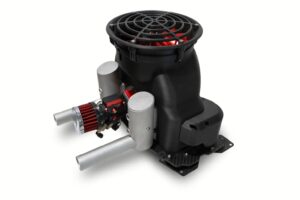
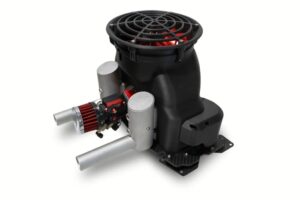
iHE7 Hybrid Generator by Honeywell Aerospace.
Aircraft generators are employed across a wide spectrum of defense platforms:
Combat Aircraft: Multirole fighters, bombers, and electronic warfare aircraft demand robust power systems to support avionics, targeting pods, radar systems, and survivability equipment.
Transport and Reconnaissance Aircraft: Require continuous power for sensors, communications, and long-duration surveillance missions.
Helicopters: Use compact generator systems integrated with turbine engines. Must support navigation, weapons control, and communication in low-altitude, variable-speed flight.
Drones: Often operate on modular power systems with embedded generators powering propulsion, telemetry, and stabilization.
Hybrid Electric Aircraft: Newer military platforms experiment with hybrid propulsion systems, requiring integrated generator and battery management units.
Backup Power and Emergency Systems
Redundant and backup systems are integrated to ensure electrical availability during generator failure:
Auxiliary Power Units (APUs): Small turbine generators providing emergency or supplemental power, particularly on the ground or during generator maintenance.
Battery Systems: Provide limited-duration power in emergencies, often maintained by rectifiers and regulated DC outputs from the generator.
Emergency Power Supplies: Independently powered modules that activate during total system failure. Essential for flight recovery and safe landing.
Onboard Monitoring and Control Units: These manage generator performance, monitor health parameters, and coordinate failover protocols to backup systems.
MIL-STD-704: Specifies aircraft electric power characteristics such as voltage, frequency, and transient response for AC and DC systems.
MIL-STD-461: Defines limits on electromagnetic interference (EMI) emissions and susceptibility, critical for preventing cross-system disruption.
STANAG 3458: NATO standardization agreement covering electrical interface standards for UAVs.
MIL-STD-810: Environmental engineering considerations, including temperature, vibration, humidity, and shock for generator durability.
DO-160: Although a civil standard, often referenced in military projects for environmental and EMI testing.
Compliance ensures interoperability, safety, and mission reliability across multinational defense programs.
Generator vs. Alternator in Military Context
Though closely related, aircraft alternators and generators serve different roles:
Generators: Broader term covering both AC and DC systems, including starter-generators. Common in both legacy and modern aircraft systems.
Alternators: A Subset of generators that produce only AC power, typically using a rotating magnetic field and a stationary armature. Often used in high-RPM, turbine-powered aircraft.
Alternators generally offer better performance at high altitudes and speeds, while generators provide more versatility across mixed systems.
Trends and Technological Advancements
The next generation of aircraft generators is being shaped by evolving defense needs:
High-Power Density Designs: Meeting increased electrical demand without proportional weight gain.
Modular and Scalable Systems: Enabling quick replacement or upgrade across diverse platforms.
Integrated Starter-Alternators: Reducing system weight and enabling regenerative energy capture.
Digital Power Management: Allowing real-time diagnostics, power distribution optimization, and health monitoring.
Cooling Innovations: Incorporating liquid cooling and phase-change materials for high-performance systems.
Electrification of Aircraft Propulsion: Driving the need for multi-megawatt generator systems and energy storage integration.
Advanced Materials: Including composite housings and nanostructured stator windings for improved heat resistance and durability.
These developments support the increasing electrification of military aviation, including directed energy weapons, next-gen radar systems, and hybrid propulsion platforms.
UAV Propulsion Tech outlines the main factors involved in selecting motors and generators for Unmanned Aerial Vehicle (UAV) propulsion systems, addressing engineering requirements, system integration, and sourcing challenges
The latest defense technology news, straight to your inbox.
Get our weekly roundup of technology developments, new products and industry news.
THANK YOU FOR SIGNING UP
Thanks for joining us. Check your inbox.
We've sent you an email. Click the confirmation link to complete your subscription to the weekly eBrief. In the meantime, explore the latest news, suppliers and technologies on DA.
Advancing Defense Capability Through Strategic Collaboration
Defense Advancement works with major OEMs to foster collaboration and increase engagement with SMEs, to accelerate innovation and drive defense capabilities forward.










 Searching Companies & Products




