
Showcase your capabilities
If you design, build or supply Achromatic Lenses, create a profile to showcase your capabilities and connect with visitors who have an active requirement for your solutions.




Achromatic lenses are optical assemblies designed to reduce chromatic aberration by bringing selected wavelengths to a common or closely matched focal position. In defense systems, they support consistent imaging and beam control across defined spectral ranges in weapon sights, electro-optical sensors, surveillance equipment, laser assemblies, and targeting systems.
This page covers leading achromatic lens manufacturers, supporting tactical imaging, sensors, lasers, and targeting applications.
Read the Technology Overview
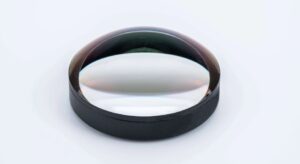
Precision Optics & Photonics Solutions for Defense Imaging, Sensing & Targeting Systems

If you design, build or supply Achromatic Lenses, create a profile to showcase your capabilities and connect with visitors who have an active requirement for your solutions.

An achromatic lens is an optical assembly designed to reduce chromatic aberration by bringing two selected wavelengths of light to approximately the same focal position while reducing focal variation across the intervening spectral band. Most achromatic lenses combine optical elements made from glasses with different refractive and dispersion properties, allowing wavelength-dependent focusing errors to be corrected more effectively than with a single-element lens.
In defense optical systems, achromatic lenses are used where consistent image quality or beam control is required across a defined spectral range. They can form part of weapon sights, electro-optical imaging systems, surveillance equipment, laser assemblies, sensor optics, and targeting systems where chromatic aberration could otherwise reduce sharpness, contrast, or focusing accuracy.
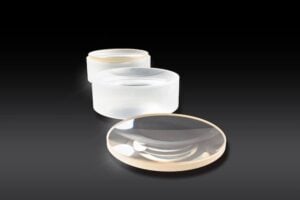
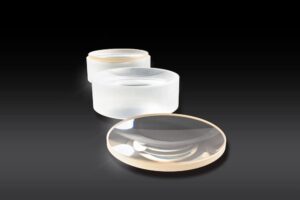
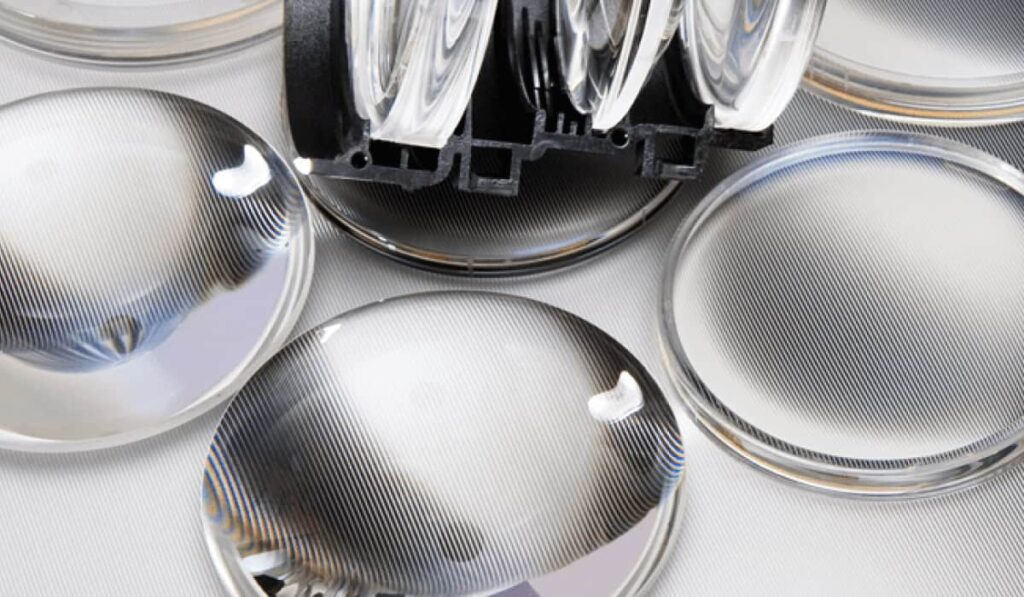
Aspherized Achromatic Lenses from Torrent Photonics
Chromatic aberration occurs because different wavelengths of light are refracted by different amounts as they pass through an optical material. An achromatic lens reduces this wavelength-dependent focal shift by combining elements with complementary dispersion characteristics. Conventional achromats are typically designed to bring two wavelengths to a common focus while reducing residual chromatic error across the operating band. This helps limit visible color fringing and improves focus consistency.
Achromatic lenses are particularly useful when an optical system must handle more than one wavelength or a relatively broad spectral band. By bringing selected wavelengths into a common or closely matched focus, an achromatic design can improve imaging performance in systems combining visible illumination, near-infrared sensitivity, multiple laser wavelengths, or other optical signals.
Reducing chromatic focal errors helps preserve edge definition, fine detail, and image contrast. This can be important in surveillance cameras, weapon sights, target acquisition systems, and other imaging equipment where small features must remain distinguishable across the intended spectral range and varying illumination conditions.
Achromatic lenses can focus divergent light or collimate light into a more parallel beam while reducing wavelength-dependent changes in focal position. These functions are useful in multi-wavelength laser rangefinding, illumination, beam expansion, sensing, and other optical systems where different wavelengths may pass through the same lens assembly.
Achromatic lenses can be incorporated into magnifying optics and relay assemblies to transfer or enlarge an image while limiting chromatic degradation. This makes them suitable for optical trains used in sights, viewing systems, sensor assemblies, and other equipment containing multiple lens stages.
In sensor systems, achromatic lenses can collect and focus incoming optical energy onto image sensors, photodiodes, or other detectors. Reduced variation in focal position across the designed spectral band helps maintain consistent focusing where a detector responds to multiple wavelengths rather than a single narrow wavelength.
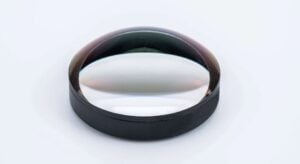
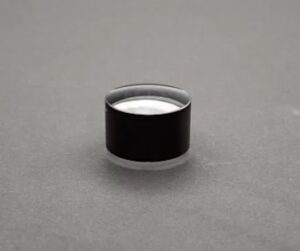
Achromatic Doublets from Torrent Photonics
Achromatic lenses can be classified by element arrangement and optical power, with some categories overlapping. For example, an achromatic doublet may be cemented or air-spaced and may have positive or negative optical power. The appropriate design depends on wavelength range, focal length, aperture, optical performance, and integration requirements.
| Type | Configuration | Key Characteristic | Typical Use |
| Achromatic doublet | Two optical elements | Common approach to chromatic correction | Imaging, sensing, and multi-wavelength laser optics |
| Cemented doublet | Two bonded elements | Compact construction with reduced air-glass interfaces | General-purpose optical assemblies |
| Air-spaced doublet | Two separated elements | Additional spacing variable for aberration control | Optical systems requiring additional design flexibility |
| Achromatic triplet | Three elements | Greater flexibility for aberration correction | More demanding imaging assemblies |
| Positive achromat | Positive net optical power | Converges light | Focusing and imaging |
| Negative achromat | Negative net optical power | Diverges light | Beam expansion and compound optical systems |
Material selection directly affects dispersion, transmission, thermal behavior, and overall optical performance.
These characteristics must be considered alongside focal length, aperture, size, coatings, and system-level environmental requirements.
Achromatic lenses occupy a middle ground between simple single-element optics and optical assemblies designed for more extensive aberration correction.
The optimum approach depends on wavelength range, image quality requirements, packaging constraints, environmental conditions, and manufacturing complexity.
An achromatic lens must be selected and installed as part of the complete optical train rather than considered only as an isolated component.
Achromatic lens manufacturers may therefore supply standard components for integration into existing systems or develop custom optical configurations around required wavelength bands, apertures, focal lengths, environmental conditions, and mechanical constraints.


 Searching Companies & Products