Showcase your capabilities
If you design, build or supply Laser Optics, create a profile to showcase your capabilities and connect with visitors who have an active requirement for your solutions.




Laser optics are precision optical components used to transmit, reflect, focus, split, shape, and control laser radiation in defense systems. These optics include lenses, mirrors, beamsplitters, filters, prisms, windows, polarizers, waveplates, and beam expanders.
This category showcases suppliers of military laser optics for targeting, designation, ranging, sensing, imaging, countermeasure, and directed-energy applications.
Read the Technology Overview

Precision Optics & Photonics Solutions for Defense Imaging, Sensing & Targeting Systems

If you design, build or supply Laser Optics, create a profile to showcase your capabilities and connect with visitors who have an active requirement for your solutions.

Laser optics are optical components designed to transmit, reflect, focus, divide, shape, or otherwise control laser radiation. Compared with optics intended primarily for broadband imaging, they are commonly optimized for defined laser wavelengths, polarization states, beam geometries, and optical power levels, with material selection, surface quality, wavefront performance, and laser optic coatings all influencing how effectively the system preserves and controls the beam.

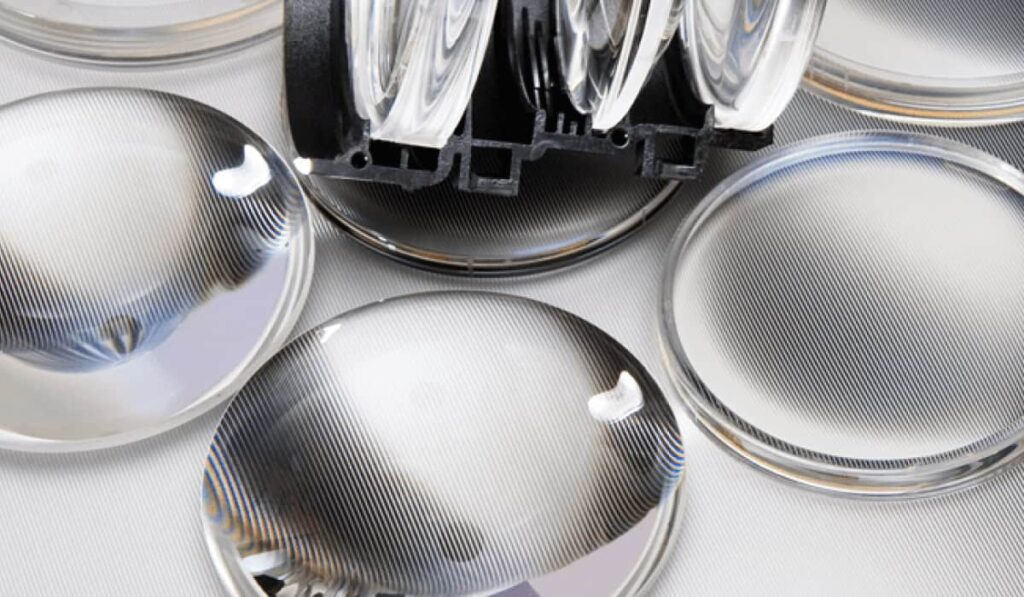
Laser Optics by Torrent Photonics
Within a complete laser system, light from the source may pass through collimating, shaping, filtering, splitting, steering, and focusing optics before reaching a target, detector, or another optical subsystem. Military laser optics are used in targeting, designation, ranging, sensing, imaging, countermeasure, and directed-energy systems, where they may need to maintain precise alignment and stable optical performance despite vibration, temperature changes, contamination, and other operational stresses.
In higher-power applications, the optics may also be exposed to substantial peak or continuous-wave power, making Laser-Induced Damage Threshold (LIDT) an important specification for optical surfaces and coatings.
A laser focusing lens concentrates a beam into a smaller spot at a defined working distance, allowing optical energy to be delivered with greater spatial precision. Focusing optics are therefore used where high irradiance, accurate spot placement, or efficient coupling into a detector or another optical component is required, including in laser rangefinding, designation, sensing, and high-power beam-delivery systems.
Laser collimator lenses reduce beam divergence by converting expanding light into a more nearly parallel beam, helping to maintain a controlled beam diameter over distance. This is important where a laser must propagate through a targeting or sensor system, enter another optical assembly with a defined geometry, or maintain predictable beam dimensions along an extended optical path.
Beam expanders alter the diameter and divergence of a laser beam using combinations of refractive or reflective optics, allowing the beam geometry to be matched to the requirements of the wider system. Increasing the beam diameter can reduce divergence and lower optical intensity on downstream components, while beam reduction may be used to match the beam to apertures, detectors, scanners, or other optical elements.
Mirrors, prisms, scanners, and other optical elements are used to redirect laser beams along controlled paths and toward defined points within an optical system. In military applications, these components support functions such as pointing, tracking, line-of-sight control, scanning, and alignment between laser transmitters, receivers, and electro-optical channels.
A laser beamsplitter divides incident light into separate transmitted and reflected paths, while a beam combiner merges two or more beams or spectral channels into a shared optical path. These functions are used in transmit-receive architectures, multi-wavelength systems, targeting assemblies, interferometric systems, and integrated sensor arrangements where multiple optical channels must be separated or combined.
Optical filters control which wavelengths are transmitted through an optical train or allowed to reach a detector, helping isolate the spectral region relevant to the system. Laser-line and narrowband filters can increase selectivity around a specified laser wavelength while suppressing unwanted background radiation or light from other sources, improving the separation of the desired optical signal.
Polarizers, waveplates, and polarization-sensitive beamsplitters control the orientation and state of polarization within laser systems, allowing the beam to be matched to downstream optical components or processing requirements. Polarization management can be particularly important in beam combining, optical isolation, sensing, interferometry, and systems whose coatings or other components respond differently to different polarization states.
Optical windows and filters can protect internal laser sources, detectors, and precision optics from dust, moisture, abrasion, and other forms of environmental exposure while maintaining the required optical transmission. Depending on their design, protective optics may also provide wavelength-selective filtering or reduce the amount of unwanted radiation reaching sensitive components.
Different laser optics perform distinct functions within beam generation, delivery, steering, sensing, and protection systems, with the appropriate component depending on the required wavelength, beam characteristics, and overall optical architecture.
| Laser Optic Type | Primary Function | Typical Wavelength Coverage | Typical Defense Applications |
| Laser Lenses | Focus, collimate, or reshape laser beams | Ultraviolet (UV) through infrared, depending on material and coating | Rangefinders, designators, sensors, and beam-delivery systems |
| Laser Mirrors | Reflect and redirect laser beams along defined optical paths | Wavelength-specific or broadband | Beam steering, directed-energy systems, and targeting equipment |
| Beamsplitters | Divide incident light or combine separate optical paths | UV, visible, and infrared | Transmit-receive systems and sensor integration |
| Optical Prisms | Redirect, disperse, or otherwise manipulate laser beams | Material-dependent | Beam routing, targeting optics, and compact optical assemblies |
| Optical Windows | Protect internal optical systems while transmitting the required wavelengths | UV through long-wave infrared | Apertures, sensors, and laser transmitters |
| Laser Filters | Select desired wavelengths or suppress unwanted spectral content | Application-specific | Laser receivers, imaging systems, and countermeasure equipment |
| Polarizers and Waveplates | Control the orientation and state of polarization | Wavelength-specific | Beam combining, sensing, and interferometry |
| Beam Expanders | Modify beam diameter and divergence | Laser-specific | Designation, ranging, and directed-energy systems |
| Diffractive Optical Elements | Shape, split, or redistribute laser beams | Typically wavelength-specific | Beam shaping, structured illumination, and sensing |
Laser optic materials are selected according to factors such as spectral transmission, refractive properties, thermal behavior, mechanical durability, manufacturability, and resistance to laser-induced damage. Because these characteristics interact with coatings, optical power, and component geometry, material selection must be considered as part of the complete optical design rather than in isolation.
The final material choice should therefore be evaluated together with the coating system, optical power, component geometry, thermal environment, and other operating conditions.
Laser rangefinders, laser designators, and fire-control systems depend on precisely aligned optics to transmit and receive laser energy along controlled lines of sight. Their optical chains may include focusing lenses, collimators, beamsplitters, filters, mirrors, and protective windows, while alignment with associated imaging sensors helps maintain the pointing accuracy and optical geometry required for ranging and designation.
High-energy laser optics control and transport high-power beams from the laser source toward the target while attempting to preserve the required beam quality throughout the optical path. These systems may use high-reflectivity mirrors, beam expanders, adaptive optics, beam combiners, and high LIDT optics designed to tolerate elevated optical loading while limiting absorption, wavefront distortion, and thermally induced changes in the beam.
Laser optics support active illumination, laser-gated imaging, Light Detection and Ranging (LiDAR), scanning systems, and laser receivers by controlling both outgoing illumination and returned optical signals. Components can shape transmitted beams, separate transmit and receive channels, filter returned light, and focus reflected laser energy onto detectors, while integration with infrared and electro-optical sensors allows imaging, ranging, and other sensing functions to operate within a coordinated optical architecture.
Developments in coatings, materials, manufacturing, and optical control are expanding the performance and integration options available for military laser systems, particularly where higher power levels or tighter size and beam-quality requirements must be accommodated.
Together, these developments are supporting more compact, higher-power, and more precisely controlled military laser systems, while placing greater emphasis on thermal stability, wavefront quality, coating performance, and environmental robustness across the complete optical assembly.


 Searching Companies & Products