
Showcase your capabilities
If you design, build or supply Aspheric Lenses, create a profile to showcase your capabilities and connect with visitors who have an active requirement for your solutions.




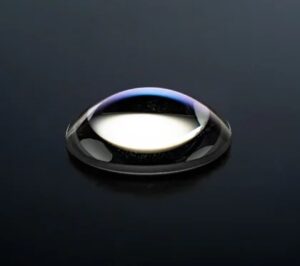
Aspheric lenses are optical elements with at least one non-spherical surface, providing greater control over light paths and helping reduce aberrations in defense imaging and laser systems. They are used in weapon sights, surveillance sensors, thermal imaging assemblies, laser beam shaping, collimation, and other compact optical systems.
This page features aspheric lens suppliers offering rotationally symmetric, acylindrical, molded glass, polished glass, polymer, infrared diamond-turned, and hybrid refractive-diffractive designs.
Read the Technology Overview
Precision Optics & Photonics Solutions for Defense Imaging, Sensing & Targeting Systems

If you design, build or supply Aspheric Lenses, create a profile to showcase your capabilities and connect with visitors who have an active requirement for your solutions.

Aspheric lenses have at least one surface with a profile other than a sphere, allowing the surface to change how light rays are refracted as they pass through the lens. This gives optical designers greater control over the path of the light, particularly near the edge of the aperture, where a spherical surface can produce significant aberration.
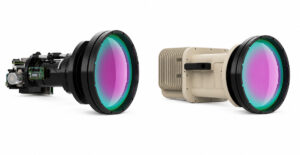
In defense optical systems, aspheric elements are used in imaging assemblies, weapon sights, surveillance sensors, and laser optics, where the lens material, surface profile, and coatings work with other optical elements to direct light toward a sensor or shape a laser beam. The resulting design depends on factors including the operating wavelength, required image or beam quality, available space, and the environmental conditions the equipment must withstand.
An aspheric lens can bring light passing through different parts of its aperture into closer focus on an image sensor, helping to control spherical aberration that would otherwise reduce image sharpness. Optical designers may combine aspheric and conventional elements to achieve the required resolution and maintain suitable performance across the intended field of view.
An aspheric collimator lens can collect light from a laser source and produce a beam with reduced divergence, while aspheric surfaces can also be incorporated into focusing assemblies where beam shape and quality are important. In these applications, the lens material and coatings must be selected to suit the laser wavelength, operating power, and other system requirements.
A single aspheric element can sometimes provide corrections that would otherwise require several spherical elements, potentially reducing the number of components needed in an optical assembly. This can shorten the optical path and lower system weight, which is particularly useful in handheld equipment and space-constrained sensor payloads, although the overall benefit depends on the complete optical design, including its mounts and required tolerances.
Wide-angle systems and lenses with large apertures can be difficult to correct using spherical surfaces alone, particularly where aberrations increase toward the edges of the field. Incorporating an aspheric surface gives designers additional control over these aberrations, although the design and placement of the remaining optical elements are still important for managing off-axis performance and distortion.
Aspheric lenses can be classified according to both their surface geometry and the manufacturing process used to produce them, so the configurations below can overlap. A rotationally symmetric aspheric lens, for example, may be manufactured by molding, polishing, or turning depending on its material and performance requirements.
| Configuration | Surface Geometry and Fabrication | Suitable Materials | Optical Benefits and Defense Uses |
| Rotationally symmetric aspheric lenses | The surface profile varies from the center to the edge around a common optical axis and can be produced by molding, polishing, or turning. | Optical glass, polymers, and selected infrared materials. | Provide aberration correction for imaging, sighting, and laser optical systems. |
| Acylindrical lenses | An aspheric profile provides optical power primarily along one axis rather than symmetrically around a common axis. | Glass and selected polymers. | Shape or focus light differently along two axes, including in laser beam-conditioning systems. |
| Molded glass aspheric lenses | Heated glass is formed against a precision mold to create the required aspheric surface profile. | Glasses compatible with the molding process. | Provide repeatable optical elements for compact imaging and illumination assemblies. |
| Polished glass aspheric lenses | The specified aspheric surface profile is generated and finished using precision polishing processes. | Suitable optical glasses. | Support demanding surface accuracy requirements and custom aspheric lens designs. |
| Diamond-turned infrared aspheric lenses | A precision tool cuts the aspheric profile directly into a material that is suitable for diamond turning. | Germanium and other compatible infrared materials. | Support thermal imaging systems and infrared beam-control applications. |
| Molded polymer aspheric lenses | Optical polymer is formed in a precision mold to reproduce the required aspheric profile. | Optical polymers. | Can reduce weight in suitable visible or near-infrared optical assemblies. |
| Hybrid refractive and diffractive aspheric lenses | An aspheric refractive surface is combined with a diffractive optical structure within the same design. | Materials suited to the required fabrication process and spectral band. | Provide additional control over aberrations in compact optical systems. |
Aspheric lenses form part of a wider range of optical design approaches, each of which addresses different aspects of system performance.
The most suitable approach therefore depends on the aberrations that need to be corrected, the available packaging space, and the required performance across the operating spectral band.
An aspheric lens specification should account not only for the characteristics of the individual element, but also for its role within the complete optical system.
For custom aspheric lenses, clearly defined measurement methods and acceptance criteria help ensure that manufactured components meet the tolerances and performance requirements established by the optical design.
Advances in manufacturing and optical system design continue to broaden the ways in which aspheric surfaces can be incorporated into defense optical systems.
These developments are most valuable when the selected surface geometry and manufacturing process address a clearly defined optical requirement within the complete system.


 Searching Companies & Products