Showcase your capabilities
If you design, build or supply Reticles, create a profile to showcase your capabilities and connect with visitors who have an active requirement for your solutions.




Reticles are aiming and measurement references used within optical and electronic sighting systems to support target alignment, ranging, ballistic compensation, wind holds, and fire-control functions. Defense optics may use wire, etched glass, illuminated, projected, or digitally generated reticles across rifle scopes, sniper optics, reflex sights, thermal weapon sights, and digital sights.
This page features leading military reticle suppliers offering crosshair, duplex, mil-dot, graduated grid, ballistic, horseshoe, chevron, and rangefinding designs.
Read the Technology Overview

Precision Optics & Photonics Solutions for Defense Imaging, Sensing & Targeting Systems

If you design, build or supply Reticles, create a profile to showcase your capabilities and connect with visitors who have an active requirement for your solutions.

Reticles are aiming and measurement references positioned within, projected into, or electronically generated by an optical sighting system. In defense optics, they provide a defined point of aim and may also support angular measurement, range estimation, ballistic compensation, wind holds, target tracking, and other fire-control functions across rifle scopes, sniper optics, reflex sights, thermal weapon sights, digital sights, and other targeting systems.
Optical reticles may be formed from fine wire, etched into glass, illuminated, projected into the sight picture, or generated electronically, with the chosen design depending on factors such as magnification, focal-plane position, engagement distance, required measurement units, lighting conditions, and the amount of information that must remain visible without obscuring the target. Scope reticles can therefore range from simple crosshairs intended primarily to provide a clear aiming reference to complex graduated patterns designed for precision shooting and integrated fire-control systems.
Wire reticles use fine metallic wires positioned within the optical system to form crosshairs or other relatively simple aiming patterns. They have traditionally been used in rifle scopes and other direct-view optics because they provide a permanent aiming reference without requiring electrical power, although their physical construction makes them better suited to simpler patterns than to dense or highly detailed graduations.
Etched glass reticles place the aiming pattern directly onto a glass optical element, allowing much finer and more complex markings than conventional wire construction. Precision etching can produce detailed crosshairs, milliradian scales, rangefinding marks, and ballistic reference points, while the pattern remains visible without illumination, making this approach well suited to precision scope reticles, sniper reticles, and other military optical sights.
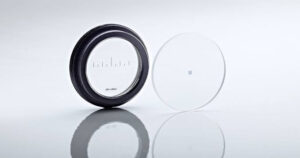
Illuminated Reticles for military optical systems by Torrent Photonics.
Illuminated reticles improve the visibility of selected markings against dark, complex, or low-contrast backgrounds by highlighting a central dot, crosshair, horseshoe, or another portion of the pattern. Brightness control is important because excessive illumination can obscure fine target detail or reduce visual performance in low-light conditions, while insufficient illumination may make the aiming reference difficult to distinguish.
Projected and electronic reticles create an aiming reference using an optical or electronic source rather than relying solely on a physical pattern positioned in the viewing path. Red dot reticles and some gun sight reticles use a collimated light source to create a virtual aiming mark that appears at an optically distant position, while holographic sight reticles use laser illumination and a recorded holographic element to reconstruct the reticle image within the sight.
Digital reticles are generated electronically and overlaid on imagery from thermal, low-light, or other electro-optical sensors, allowing their position, pattern, brightness, and displayed information to be adjusted through software. This makes it possible for targeting reticles to incorporate range information, ballistic calculations, sensor modes, or platform configuration data, while also allowing multiple custom reticles to be stored within a single sighting system.
Crosshair reticles use intersecting horizontal and vertical lines to establish a clear central aiming reference. Simple reticle crosshairs minimize visual clutter and are particularly useful where rapid alignment and an unobstructed sight picture are more important than extensive ranging or ballistic information.
Duplex reticles use heavier outer lines that transition into finer central crosshairs, helping guide the eye quickly toward the center of the sight while preserving a relatively precise aiming reference. This balance between visibility and precision makes the pattern suitable for situations where rapid target acquisition and accurate central alignment are both required.
Mil-dot reticles incorporate regularly spaced reference points based on milliradian angular measurements, allowing the pattern to support target measurement, range estimation, holdover, and wind correction. These functions depend on the operator understanding the relationship between target dimensions, angular subtension, and the corresponding corrections represented by the reticle markings.
Graduated grid reticles provide horizontal and vertical scales for measuring elevation and lateral corrections, giving the operator multiple reference points within the sight picture. More complex grid designs can support rapid holds without adjusting the sight’s turrets, particularly where repeated elevation and windage corrections may be required.
Ballistic reticles incorporate markings corresponding to expected projectile drop or other firing corrections, while Bullet Drop Compensation (BDC) reticles typically provide predefined hold points for different ranges. Their effectiveness depends on how closely the ammunition, weapon configuration, atmospheric conditions, and other ballistic factors match the assumptions used to design and calibrate the pattern.
Horseshoe and circle-dot designs combine a prominent outer aiming feature with a smaller central reference, helping the operator acquire the target quickly while retaining a more precise point for final alignment. This combination makes them useful where rapid target acquisition must be balanced with a clearly defined central aiming point.
Chevron reticles use an angled or inverted-V-shaped aiming mark, with the tip providing a relatively precise reference and the wider lower portion remaining easy to acquire visually. This allows a single pattern to combine a fine aiming point with a more prominent shape that remains visible during faster target acquisition.
Rangefinding reticles incorporate calibrated scales or reference marks that allow the apparent size of a known target dimension to be converted into an estimated distance. Depending on the sight and intended application, these graduations may use milliradian, Minute of Angle (MOA), or application-specific measurement systems.
Reticle manufacturing must preserve fine feature geometry, positional accuracy, optical clarity, and stability under operational conditions, particularly where the markings are also used for measurement, range estimation, or ballistic correction.
Inspection during reticle manufacturing may therefore include dimensional verification, optical inspection, and alignment checks using dedicated reticle inspection tools and alignment reticles to confirm that both the pattern and its position meet the required specification.
The most appropriate reticle depends on the sight architecture, weapon system, expected engagement conditions, and the amount of measurement or ballistic information that needs to be presented without making the sight picture unnecessarily complex.
| Selection Factor | Key Consideration |
| Engagement Distance | Short-range optics often prioritize rapid target acquisition and a clear central aiming reference, while longer-range systems may require more detailed elevation, windage, and ranging graduations. |
| Magnification Range | Variable-power sights must account for whether the reticle is positioned in the First Focal Plane (FFP) or second focal plane. FFP reticles change apparent size with the target image as magnification changes, while second focal plane reticles remain visually constant in size. |
| Required Angular Measurement System | Mil-dot reticles use milliradian references, while MOA reticles use minute-of-angle graduations, and matching the reticle and turret units can simplify measurement and correction. |
| Target Size and Visibility | Fine markings support precise aiming and measurement but may be more difficult to acquire quickly, while larger dots, horseshoes, or bold crosshairs improve visibility at the cost of covering more of the target. |
| Day, Night, and Thermal Operation | Optical sights require suitable reticle contrast and illumination for the expected lighting conditions, while thermal and digital sights can use electronically generated patterns optimized for the sensor imagery being displayed. |
| Ballistic Compensation Requirements | Ballistic reticles may include holdover, windage, or BDC markings, while digital systems can generate or reposition aiming references using calculated firing solutions and sensor inputs. |
| Illumination Requirements | Illuminated reticles can improve visibility against difficult backgrounds, but brightness range, power consumption, and compatibility with low-light viewing equipment must also be considered. |
For variable-power rifle reticles, focal-plane position is particularly important because it determines how the reticle subtensions behave as magnification changes. The angular subtensions of an FFP reticle remain proportional to the target throughout the magnification range, while those of a Second Focal Plane (SFP) reticle correspond to their specified angular values only at the magnification for which the reticle has been calibrated.
Reticle development increasingly combines the passive reliability of conventional optical designs with electronic sensing, digital processing, and configurable sight symbology, allowing the aiming reference to become more closely integrated with the wider fire-control system.
These developments are expanding the role of the reticle from a fixed aiming reference into an increasingly integrated element of optical and digital fire-control systems, where it can present both traditional aiming information and dynamically generated data from other sensors and processors.


 Searching Companies & Products



