
Showcase your capabilities
If you design, build or supply Coolant Level Sensors, create a profile to showcase your capabilities and connect with visitors who have an active requirement for your solutions.




Coolant level sensors help to ensure the operational readiness and safety of tactical ground vehicles in defense operations. Designed to function in extreme environments and meet stringent military standards, these sensors provide accurate real-time monitoring of engine coolant levels. From main battle tanks to unmanned ground vehicles, military-grade coolant level sensors help prevent engine damage, minimize maintenance requirements, and support mission-critical vehicle uptime.
Read the Technology Overview
If you design, build or supply Coolant Level Sensors, create a profile to showcase your capabilities and connect with visitors who have an active requirement for your solutions.

Military spec coolant level sensors are purpose-built to deliver reliable fluid monitoring in military ground vehicles operating under extreme thermal, mechanical, and electromagnetic conditions.
These sensors detect and report the engine coolant level in real-time, alerting operators to low-fluid conditions that could lead to overheating or engine failure. Their integration into military fleets enhances preventative maintenance, improves engine longevity, and reduces the risk of mission failure due to cooling system issues.
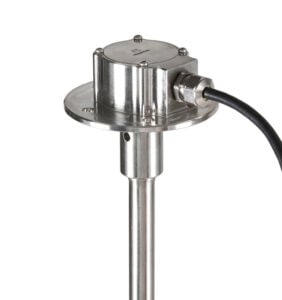
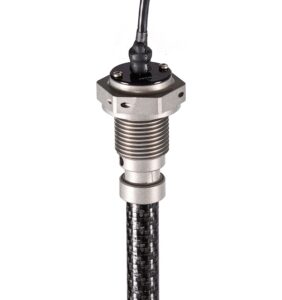
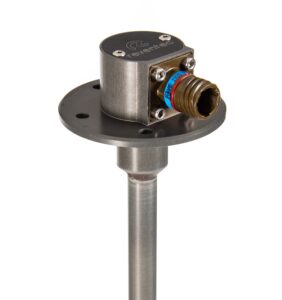
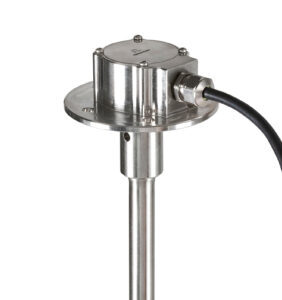
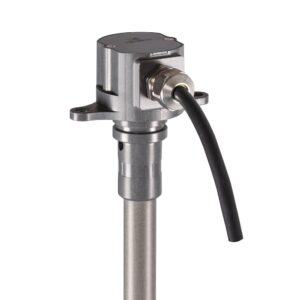
Military spec coolant level sensor from Reventec.
Military ground vehicles, including main battle tanks, light armored vehicles (LAVs), armored personnel carriers (APCs), infantry fighting vehicles (IFVs), and unmanned ground vehicles (UGVs), require robust and precise engine coolant monitoring systems. These platforms often operate in high-dust, high-vibration, and wide-temperature environments, making durability and accuracy critical.
Coolant level sensors are embedded within coolant reservoirs or engine compartments, providing continuous feedback to vehicle control systems or maintenance crews. In UGVs and other autonomous platforms, coolant monitoring becomes even more vital due to limited operator oversight and the need for predictive maintenance based on sensor feedback.
Military coolant level sensors use various technologies, including capacitive, resistive, and ultrasonic sensing methods. Capacitive sensors measure changes in dielectric properties as coolant levels vary, while resistive sensors rely on conductivity. Ultrasonic sensors offer non-contact measurement, ideal for applications where contamination or mechanical wear must be minimized.
These sensors are enclosed in ruggedized housings resistant to corrosion, vibration, and thermal cycling. Many units are equipped with built-in diagnostics, self-testing capabilities, and fail-safe modes to ensure dependable operation in mission-critical scenarios.
Military-spec coolant level sensors are designed to meet electromagnetic interference (EMI) shielding requirements to ensure consistent performance in electronic warfare and high-interference environments. Compliance with MIL-STD-461G, which defines EMI performance for military equipment, is a common baseline for these components. This ensures that sensors can operate reliably without introducing or succumbing to signal disruptions in the battlefield’s dense electromagnetic spectrum.
Many coolant level sensors are also designed to meet additional military standards for shock, vibration, moisture ingress, and temperature extremes. These certifications ensure the sensor’s reliability across the operational lifecycle of a military vehicle.
Reliable coolant monitoring directly supports military vehicle maintenance protocols. By integrating coolant level sensors into diagnostics systems, operators can be alerted to leaks or coolant loss early, reducing the likelihood of engine damage. For high-mobility and expeditionary forces, this helps avoid unscheduled downtime and ensures tactical vehicles remain fully operational.
Moreover, sensors that offer digital output or integration with vehicle control units (VCUs) enable automated logging and analysis, helping maintenance teams identify trends and optimize service intervals.
As military platforms evolve with increased digitization and autonomy, coolant level sensors are being developed with enhanced data interfaces, including CAN bus compatibility and smart diagnostics. This enables seamless integration with other vehicle health monitoring systems and supports remote maintenance operations for unmanned and manned platforms alike.
With vehicle electrification on the horizon for some military ground fleets, sensor manufacturers are also adapting to monitor new types of coolants used in hybrid or electric powertrains. Whether for internal combustion or electric systems, precise fluid level detection remains essential.
Military spec coolant level sensors provide an essential line of defense against overheating and engine failure in tactical ground vehicles. Built to endure the rigors of battlefield environments, these sensors support engine health, extend vehicle service life, and reduce maintenance costs through reliable, real-time monitoring. From conventional trucks and APCs to unmanned systems, these sensors are a critical component of modern military vehicle architecture.


 Searching Companies & Products