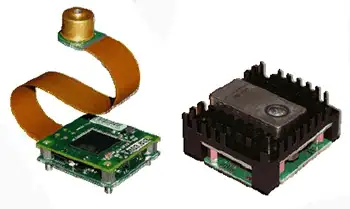
Laser rangefinder receiver modules are the optoelectronic subsystems that detect and precisely time returned laser pulses to calculate target distance using Time-of-Flight (ToF) measurement. Within military fire control, targeting, and ISR systems, the receiver determines ranging accuracy, sensitivity, and reliability under extended engagement distances and high background noise.
This category features global laser rangefinder receiver manufacturers with solutions for armored vehicles, airborne pods, naval EO systems, soldier-worn devices, and unmanned platforms.
If you design, build or supply Laser Rangefinder Receivers, create a profile to showcase your capabilities and connect with visitors who have an active requirement for your solutions.
Compact time-of-flight laser receivers for mission-critical rangefinding
Compact time-of-flight laser receivers for mission-critical rangefinding
...nd lightweight laserrangefinderreceivers are ideal for military and defense ranging and... ......ludes a range of different receiver options to meet numerous requirements for cost vs...
Overview of Laser Rangefinder Receivers for Defense Platforms
A laser rangefinder receiver is the specialized optoelectronic subsystem responsible for detecting and precisely timing the return pulse from a transmitted laser signal. By calculating the distance using Time-of-Flight (ToF) measurement, the receiver acts as the critical sensing element that determines the accuracy, sensitivity, and reliability of a military laser ranging system.
In defense applications, engagement ranges often extend several kilometers. Because environmental conditions are rarely ideal, the receiver must be capable of detecting extremely weak optical reflections against high background noise. The performance of the laser rangefinder receiver directly influences fire control accuracy, targeting confidence, and the overall survivability of armored vehicles, airborne platforms, naval vessels, and dismounted soldier systems.
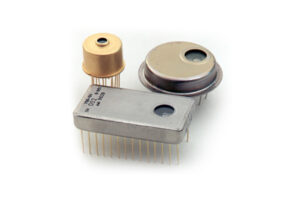
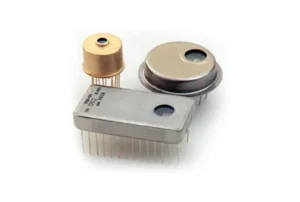
Laser rangefinder receiver solutions by Analog Modules, Inc.
Applications of Laser Rangefinder Receivers Within Defense Platforms
Fire Control Systems for Armored Vehicles
In main battle tanks and armored fighting vehicles, laser rangefinder receivers are embedded within stabilized fire control systems. They provide precise slant range data to ballistic computers, enabling accurate gun laying during high-speed maneuvers. These receivers are designed to operate reliably despite the intense vibration, shock, and electromagnetic interference typical of tracked platforms.
Naval platforms utilize receivers within stabilized sensor masts. Maritime environments introduce specific challenges, including salt fog, high humidity, and constant platform motion. Receivers must maintain alignment stability and consistent detection performance under these corrosive and high vibration conditions.
Soldier-Worn and Handheld Systems
Dismounted forces use compact receivers integrated into binoculars, weapon sights, and handheld locators. These systems demand aggressive Size, Weight, and Power optimization while still delivering kilometer-scale ranging. Compatibility with eye-safe wavelengths is a primary requirement for training and operational safety.
UAV and UGV Payload Integration
Unmanned systems incorporate receivers for autonomous navigation, obstacle avoidance, and target geolocation. UAV and UGV payloads require lightweight modules capable of withstanding high altitude temperature swings or ground level mechanical shock.
Integration with Laser Designators and Warning Receivers
Receivers are frequently co-located with laser designators to confirm target distance prior to illumination. In advanced architectures, they operate alongside Laser Warning Receivers, allowing the system to distinguish between friendly laser emissions and hostile ranging activity.
Wavelength Bands & Detector Materials
The heart of the receiver is the photodetector. The choice of semiconductor material primarily determines spectral sensitivity, noise performance, gain characteristics, and operating temperature behavior, all of which directly influence ranging performance.
Silicon PIN Photodiodes
A silicon PIN photodiode uses a p-type, intrinsic, n-type semiconductor structure. These diodes are widely deployed in systems operating from the visible spectrum up to approximately 1100 nm, most commonly at 850 nm and 905 nm. They provide no internal gain, so sensitivity depends on low-noise transimpedance amplification. However, they offer excellent linearity, fast response, robustness, and simple biasing. Silicon PIN devices are frequently selected for short- to medium-range systems or applications where dynamic range and saturation recovery are priorities.
Silicon APDs
Silicon Avalanche Photodiodes (APDs) operate over a similar spectral range but incorporate internal avalanche multiplication gain. This internal gain improves sensitivity to weak return pulses and extends maximum operational range, particularly in 905 nm systems. The trade off is higher bias voltage, excess multiplication noise, and tighter design constraints around temperature stability and gain control.
InGaAs PIN Photodiodes
Indium Gallium Arsenide (InGaAs) PIN photodiodes are used for infrared systems operating around 1550 nm. Like silicon PIN devices, they provide no internal gain but offer good linearity and stable performance. They are suitable for moderate range 1550 nm systems or applications where signal amplitude measurement and robustness are more important than maximum sensitivity.
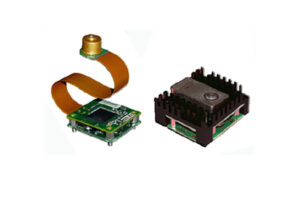
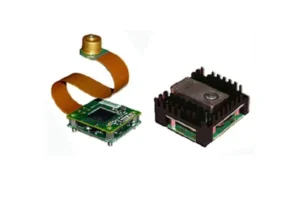
Laser rangefinder receiver modules with range processors by Analog Modules, Inc.
InGaAs APDs
InGaAs Avalanche Photodiodes operate at 1550 nm in eye-safe laser rangefinder systems where higher sensitivity is required. The 1550 nm wavelength enables higher permissible transmit energy under eye-safety regulations, and the internal gain of the APD improves detection of weak long range returns. These devices typically exhibit higher excess noise and temperature sensitivity compared to silicon APDs and may require more sophisticated bias and thermal management.
SPADs
Single Photon Avalanche Diodes (SPADs) operate in Geiger mode and are capable of detecting individual photons. Available in silicon for visible to near-infrared systems and in InGaAs variants for 1550 nm applications, SPADs provide extremely high sensitivity at reduced transmit power. However, they require careful management of dark count rate, afterpulsing, and solar background susceptibility to avoid false triggers, particularly in high ambient light environments.
Signal Conditioning & Timing
Once the optical signal is converted into an electrical current, precise amplification and timing extraction circuitry determine the ultimate ranging accuracy of the receiver.
Transimpedance Amplifiers: The photodetector output current is converted into a voltage signal by a high-speed TIA. The TIA design is crucial for managing bandwidth and noise; a poorly matched TIA can introduce jitter that ruins range accuracy.
Time to Digital Converters: High-resolution TDCs operate in the picosecond domain, enabling sub-meter resolution. Modern systems often integrate TDCs into FPGAs for deterministic timing control.
Defense Standards & Qualification for LRF Receivers
Military receivers must demonstrate resilience to temperature extremes, shock, and humidity as defined under MIL-STD-810. Furthermore, compliance with MIL-STD-461 ensures the receiver is not susceptible to electromagnetic interference from on-board radios or radar.
Compliance with MIL-STD-883 validates the reliability of microelectronic components under thermal cycling and mechanical stress. Additionally, systems must meet international laser safety standards such as IEC 60825 and ANSI Z136 to ensure they are eye-safe for operators and bystanders during multi-domain operations.
Countermeasure Environments & Survivability
In contested environments, adversaries use dazzling or optical jamming to saturate sensors. Advanced laser rangefinder receivers incorporate narrowband spectral filtering and dynamic gain control to maintain operation under these conditions.
Furthermore, modern battlefields are light-congested. Receivers must discriminate between valid return pulses and other friendly or adversarial laser sources. This is achieved through:
Temporal Gating: Only listening for a return pulse at specific micro-intervals.
Coded Pulse Sequences: Using unique digital signatures to ensure the receiver only recognizes its own laser reflection.
Hardening: Using optical limiters to prevent permanent detector damage from directed energy threats.
Advancing Technologies in MIL-SPEC Laser Rangefinder Receivers
AI-Assisted Signal Discrimination
Machine learning algorithms are now being integrated to assist in pulse discrimination. This allows the system to distinguish a true target from clutter like smoke, dust, or heavy rain with much higher confidence than traditional threshold based detection.
Flash LiDAR and 3D Imaging
Rather than a single point, Flash LiDAR architectures use detector arrays to capture three-dimensional scene information in a single pulse. This is becoming important for high-speed UAV navigation and sophisticated target recognition.
Frequency Modulated Continuous Wave
While more complex than ToF, FMCW laser systems measure range and velocity simultaneously. These architectures require coherent detection and are highly resistant to traditional pulse based jamming.
Integrated CMOS SPAD Arrays
The push toward miniaturization has led to CMOS integrated SPAD arrays. These provide a scalable, compact solution with timing circuitry embedded directly on the chip, ideal for space constrained seeker heads and small unmanned systems.
Analog Modules, Inc.’s AMI Series rangefinder receivers and processors deliver highly accurate, corrected range data for defense laser rangefinding and targeting systems
Analog Modules Inc. provides laser range receiver and spot tracker modules informed by operational feedback, supporting integration into defense platforms operating under challenging environmental and countermeasure conditions
The latest defense technology news, straight to your inbox.
Get our weekly roundup of technology developments, new products and industry news.
THANK YOU FOR SIGNING UP
Thanks for joining us. Check your inbox.
We've sent you an email. Click the confirmation link to complete your subscription to the weekly eBrief. In the meantime, explore the latest news, suppliers and technologies on DA.
Advancing Defense Capability Through Strategic Collaboration
Defense Advancement works with major OEMs to foster collaboration and increase engagement with SMEs, to accelerate innovation and drive defense capabilities forward.