Military-grade heavy-lift drone propellers are engineered to convert motor or engine torque into controlled thrust for UAVs operating at high gross weights and under demanding defense conditions. Designed to deliver high static thrust and cruise efficiency, these propellers support tactical resupply, ISR sensor carriage, medevac, and autonomous cargo missions.
This page showcases manufacturers of heavy-lift drone propellers featuring large diameters, optimized blade pitch distributions, and composite constructions to balance disk loading, acoustic signature, and structural integrity.
If you design, build or supply Heavy-Lift Drone Propellers, create a profile to showcase your capabilities and connect with visitors who have an active requirement for your solutions.
Military-grade COTS & custom carbon fiber propellers for UAVs
Military-grade COTS & custom carbon fiber propellers for UAVs
...ent operation, heavy payload lift, or ISR drones with diameters exceeding 1.5 meters. All components... ...s carbon fiber dronepropellers engineered for tactical UAVs across multirotor, fixed-wing, and...
Heavy-lift drone propellers are primary structural and aerodynamic components that directly govern payload capacity, endurance, and reliability. For defense platforms tasked with tactical resupply, ISR payload carriage, or casualty evacuation, propeller performance determines whether the aircraft meets mission objectives under operational stress.
In tactical roles, these UAVs transport ammunition, medical supplies, or mission-critical equipment. Propeller efficiency influences lift margin and power consumption, which dictates range and loiter time. For platforms operating in austere environments, propellers must withstand debris ingestion, rapid throttle changes, and extended high-power operation without structural degradation.
At scale, heavy-lift propulsion is a systems engineering challenge. The propeller converts motor or engine torque into controlled thrust under variable density altitude, thermal loading, and crosswind conditions. For defense integrators, propeller specification affects the overall aircraft performance envelope, acoustic signature, and lifecycle cost.
Operational Requirements for Heavy-Lift UAV Propellers
Payload Capacity and Thrust Demands
Defense platforms often operate at maximum gross takeoff weights that require high static thrust while maintaining efficiency at cruise power. This necessitates large disk areas and optimized propeller blade pitch distributions. In multirotor architectures, thrust-to-weight ratios must provide sufficient margin for vertical takeoff under full load, while hybrid VTOL systems must sustain peak loads during transition phases.
Endurance and Efficiency Considerations
Efficiency at partial throttle is critical for long-endurance missions. Propeller geometry must balance static thrust with forward-flight efficiency to prevent excessive current draw in electric systems or increased fuel burn in hybrid platforms. Engineers evaluate propulsive efficiency across the entire mission profile, utilizing optimized airfoil sections to maintain lift coefficients without inducing early stall.
High-Altitude and Hot-and-High Performance
Lower air density in mountainous or high-temperature environments reduces thrust generation. Heavy-lift drone propellers for expeditionary forces must maintain performance in these conditions without exceeding motor torque limits. This typically drives the adoption of large drone propellers with lower RPM configurations to preserve efficiency in thin air.
Acoustic and Signature Management
Blade tip speed, loading distribution, and vortex shedding influence noise output. Lower RPM, increased blade count, and optimized tip geometry are used to reduce detectable acoustic signatures. Minimizing the acoustic footprint is vital for discretion during ISR missions, though these measures must be weighed against weight and efficiency penalties. Specialized stealth propellers may incorporate serrated trailing edges, swept blade tips, or tailored airfoil sections to further suppress tonal noise components without compromising structural integrity.
Applications of Heavy-Lift Drone Propellers Across Defense Platforms
Heavy-lift drone propeller specifications vary significantly depending on the specific mission profile and environmental demands of the deployment:
Tactical Resupply UAVs: These systems rely on high-thrust drone propellers to transport supplies to forward positions, requiring reliability under rapid deployment and repeated high-power cycles.
Heavy ISR Sensor Carriage: Stable thrust and low vibration are essential to prevent sensor jitter in electro-optical turrets and radar payloads, ensuring data integrity.
Medevac and Autonomous Cargo: These missions impose stringent reliability requirements where propeller failure is not an option. Redundant architectures and high-reliability composite blades are standard.
Maritime and Shipborne Operations: Marine propellers must incorporate protective coatings and sealed interfaces to resist corrosion from salt fog and moisture. Structural stiffness is required to maintain blade tracking in turbulent airflow near ship superstructures.
Aerodynamic Principles of Heavy-Lift Propeller Design
Thrust Generation and Disk Loading
Thrust is generated by accelerating a column of air. Increasing disk area is generally more efficient than increasing induced velocity. Heavy-lift designs aim to minimize disk loading to improve hover efficiency and reduce power demand. High disk loading may offer a more compact airframe but increases induced losses and thermal stress.
Diameter vs RPM Trade-offs
Large drone motors and propellers operating at lower RPM are typically quieter and more efficient. However, airframe geometry and transportability may limit the maximum diameter. Higher RPM systems increase mechanical stress and acoustic output, requiring a balance between structural loads and mission constraints.
Fixed-Pitch vs Variable-Pitch Architectures
Fixed-pitch propellers are common in electric multirotors due to their simplicity. Variable-pitch systems, often found in hybrid or engine-driven UAVs, enable thrust modulation without large RPM swings. This improves efficiency during forward flight and provides better control authority during VTOL transitions.
Multi-Blade Configurations
Increasing the blade count to three or four blades allows for greater thrust within a limited diameter. While this supports compact designs, additional blades can increase aerodynamic interference and manufacturing complexity. Selection depends on structural resonance, efficiency, and acoustic requirements.
Materials & Construction Considerations
Carbon Fiber and Hybrid Composites
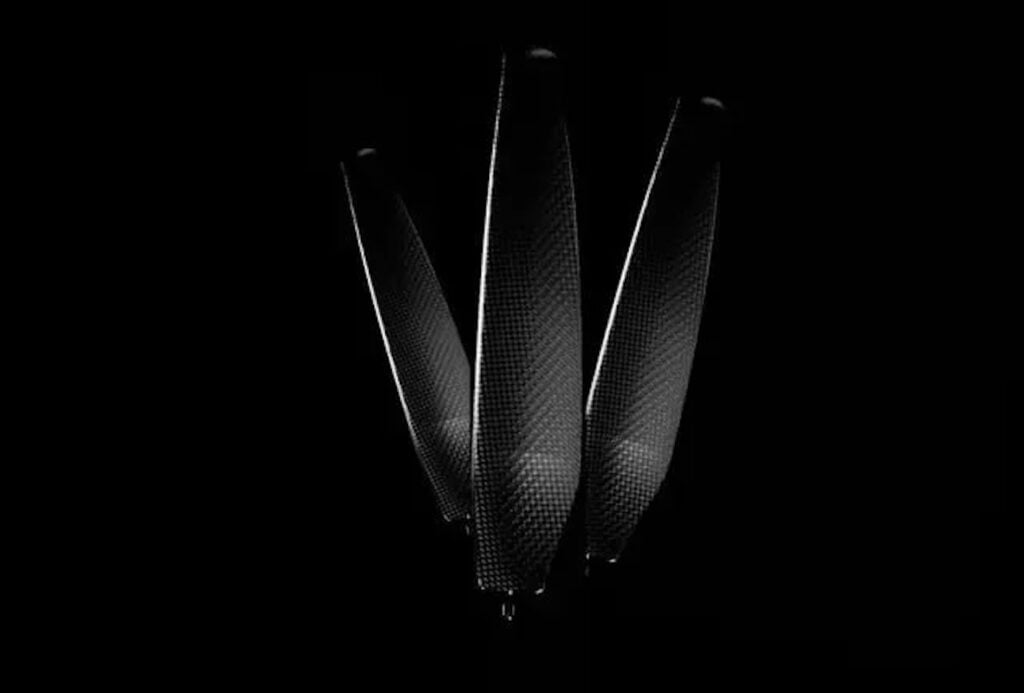
Carbon fiber propellers provide the high stiffness-to-weight ratio and fatigue resistance necessary for heavy-lift platforms. Hybrid layups, including Kevlar, can enhance impact resistance against debris, while glass fiber may be used to adjust flexibility.
Metallic and Reinforced Hub Structures
The blade root and hub interface experience high stress. Metallic hubs, usually aluminum or steel alloys, distribute loads evenly and ensure secure attachment in high-torque systems.
Environmental Protection
Defense-grade drone propellers for heavy lift require protective coatings to guard against UV degradation, moisture, and abrasive wear. This ensures the blades withstand sand-laden airflow and salt environments without delamination or structural weakening.
Structural Engineering & Load Management
Centrifugal and Bending Loads
As diameter increases, centrifugal force rises significantly with rotational speed. Heavy-lift blades are engineered to resist root separation and spanwise bending. Clamped or bolted hub interfaces are used depending on the specific torque requirements of the platform.
Vibration and Harmonic Mitigation
Imbalance generates vibration that can degrade avionics and sensor performance. Propeller balancing tolerances in defense platforms are tighter than in commercial equivalents to ensure stability. Accurate blade tracking is also required to maintain equal lift distribution and prevent oscillatory loads.
COTS vs Custom-Engineered Heavy-Lift Drone Propellers
The decision between standard and bespoke components involves balancing immediate availability with long-term platform optimization. Commercial Off-The-Shelf (COTS) options can reduce procurement timelines and costs for mature airframes. However, custom-engineered propellers allow for optimization of unique airframes and specific environmental conditions. For defense programs, supply chain security and compliance with export regulations are also critical factors in the selection process.
Emerging Trends in High-Thrust Drone Propellers
Technological advancements in manufacturing and materials are driving new capabilities in heavy-lift drone propeller efficiency and maintenance:
Adaptive Systems: Research into blade geometries that adjust pitch or camber dynamically to improve efficiency across flight regimes.
Health Monitoring: Embedded sensors providing real-time structural health data for predictive maintenance.
Advanced Manufacturing: Use of automated fiber placement to improve structural consistency in large-diameter blades.
Computational Optimization: AI-driven tools enabling refined blade profiles tailored to specific mission envelopes.
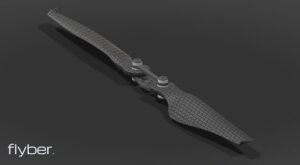
Flyber CEO and co-founder Rowan Carstensen shares insights into the company’s carbon-fiber UAV propellers, its scalable engineering process, and the wide range of mission applications supported across defense, commercial, and urban air mobility sectors
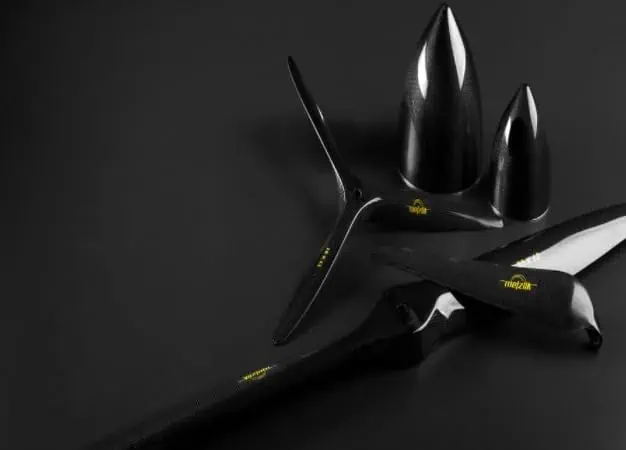
UAV Propulsion Tech will be marketing Mejzlik Propellers’ solutions for UAVs, meeting quality, safety and performance requirements for a range of defense and aerospace applications
The latest defense technology news, straight to your inbox.
Get our weekly roundup of technology developments, new products and industry news.
THANK YOU FOR SIGNING UP
Thanks for joining us. Check your inbox.
We've sent you an email. Click the confirmation link to complete your subscription to the weekly eBrief. In the meantime, explore the latest news, suppliers and technologies on DA.
Advancing Defense Capability Through Strategic Collaboration
Defense Advancement works with major OEMs to foster collaboration and increase engagement with SMEs, to accelerate innovation and drive defense capabilities forward.