
Showcase your capabilities
If you design, build or supply Custom Drone Propellers, create a profile to showcase your capabilities and connect with visitors who have an active requirement for your solutions.




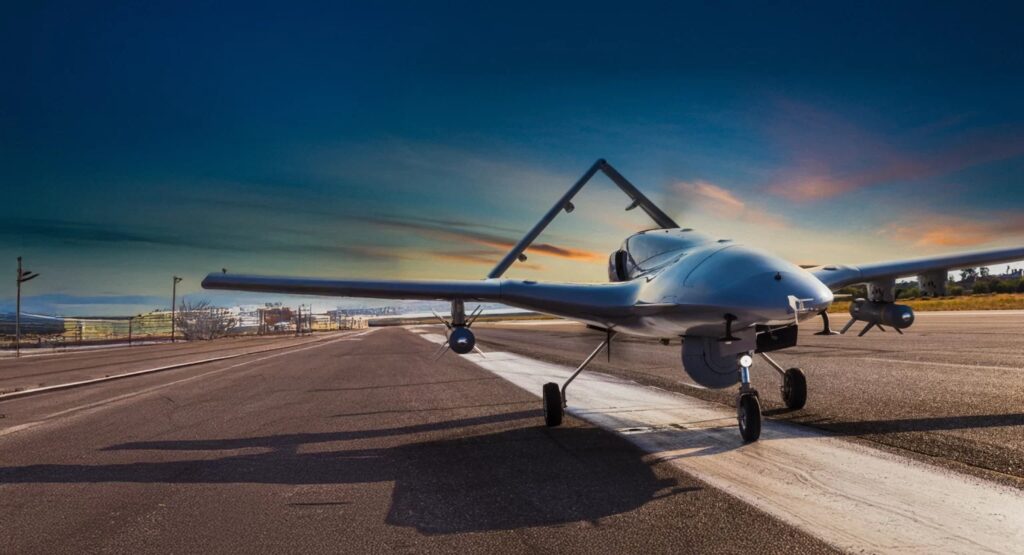
Military-grade custom drone propellers are engineered aerodynamic components developed to optimize thrust, efficiency, and acoustic performance for defense UAV platforms. Designed in parallel with the airframe and powertrain, these propellers address mission-specific requirements across ISR, tactical resupply, loitering munitions, and maritime operations.
This page features leading manufacturers of custom drone propellers with optimized blade geometry, tailored pitch distribution, multi-blade or coaxial architectures, and advanced composite constructions to balance stiffness, weight, and durability.
Read the Technology Overview
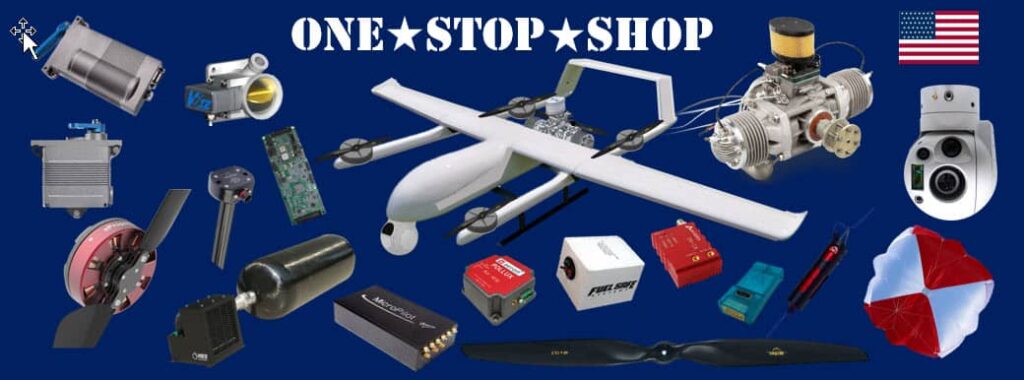
COTS & Custom Drone Propellers and Electric Motors for Military UAVs

If you design, build or supply Custom Drone Propellers, create a profile to showcase your capabilities and connect with visitors who have an active requirement for your solutions.

Custom drone propeller manufacturing is a critical enabler of performance, survivability, and mission effectiveness across modern military UAV platforms. While commercial off-the-shelf (COTS) propellers may be suitable for recreational use, they rarely meet the stringent aerodynamic, structural, and acoustic requirements of professional defense systems.
Military UAVs operate across extreme temperature bands, high-altitude density conditions, and maritime atmospheres. Whether the mission involves long-endurance ISR, tactical resupply, or loitering munitions, propulsion efficiency is directly tied to operational reach and payload capacity. To support these deployments, custom propellers are often designed in parallel with the airframe to optimize thrust, manage vibrational loads, and satisfy defined acoustic signature requirements associated with stealth-optimized propellers.
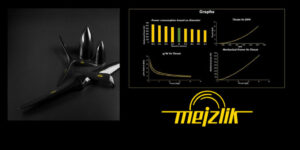
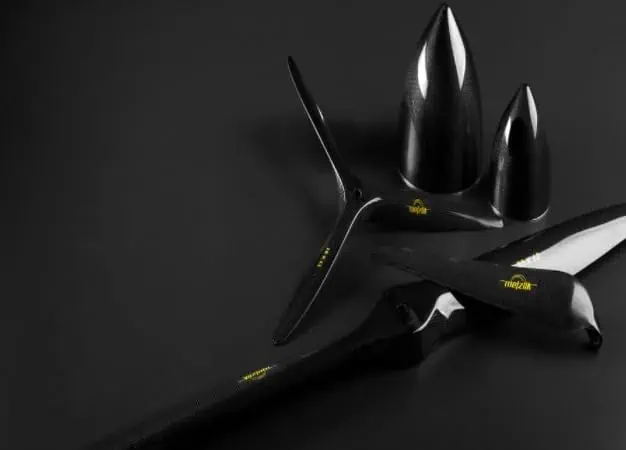
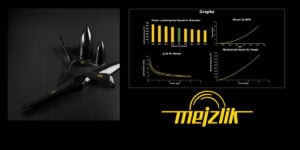
Custom Drone Propellers by UAV Propulsion Tech.
The airfoil section selected for a propeller blade governs lift coefficients, drag, and stall behavior. In defense UAVs, the airfoil should be matched to the platform’s operating Reynolds number. Low-Reynolds-number airfoils are typically required for small tactical drones, while higher-speed platforms require thinner sections to mitigate compressibility drag and manage Mach effects near the blade tip.
Propeller blades experience varying relative airflow velocity along their span. To maintain an optimal angle of attack from root to tip, designers incorporate geometric twist. In endurance-focused ISR platforms, this twist is optimized for cruise efficiency. For tactical UAVs requiring heavy-lift propellers for rapid climb or dash performance, pitch distribution is often biased toward higher thrust generation at elevated power settings.
Blade taper influences structural stiffness and aerodynamic loading. A wider root provides structural strength and improved hub load transfer, while a tapered tip reduces induced drag and tip vortex intensity.
Fixed-pitch propellers remain common in small UAVs due to mechanical simplicity. However, variable pitch systems offer substantial advantages in larger or multi-mission platforms. These architectures allow in-flight optimization of blade angles for takeoff, cruise, and descent, significantly improving fuel efficiency in combustion systems and responsiveness in hybrid-electric platforms.
Propeller diameter determines disk area, which in turn influences induced velocity for a given thrust requirement. Larger diameters generally improve efficiency by accelerating a greater mass of air at lower velocity. However, diameter is often constrained by airframe geometry and ground clearance. Defense UAVs often prioritize lower tip speeds to reduce acoustic signature and manage compressibility effects at high rotational speeds.
For electric UAVs, propeller design should align precisely with motor torque and efficiency curves. An oversized propeller can overload a motor, increasing thermal stress and reducing battery life. Conversely, an under-loaded motor operates inefficiently. Custom propeller development involves integrated powertrain modeling, incorporating ESC performance and expected duty cycles.
Custom UAV propellers for military operations often rely on advanced composite constructions to balance stiffness, weight, and durability. Common composite approaches include:
Machined aluminum propellers provide durability for combustion-powered UAVs, while titanium hubs offer superior corrosion resistance in maritime applications. Hybrid assemblies combining metallic hubs with composite blades leverage the strengths of both materials while simplifying maintenance.
Custom propeller manufacturers for UAVs are increasingly using additive manufacturing to accelerate tooling iteration. While 3D printing is often used for rapid prototyping and wind tunnel models, it may also support limited production cycles for mission-specific variants where material properties and certification requirements are validated. This allows for aerodynamic refinement based on real-world flight test data.
Two-blade propellers are typically more aerodynamically efficient. However, multi-blade configurations can reduce individual blade loading and tip vortex strength, which may lower certain tonal noise components depending on operating RPM and loading. For covert operations, acoustic signature management can justify the use of additional blades in specific configurations.
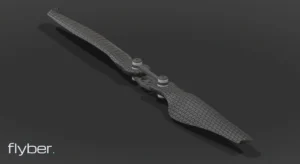
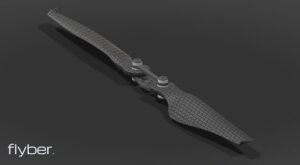
Custom Drone Propeller Blades by Flyber.
Adding blades distributes thrust across more structural elements, reducing per-blade bending stress. In contested environments, multi-blade configurations may offer improved tolerance to minor leading-edge erosion or small impact defects. Severe blade damage, however, typically results in imbalance and requires corrective maintenance, so this should not be considered true operational redundancy.
Single-rotor systems generate reactive torque. Counter-rotating propeller systems inherently cancel this torque, improving stability. Coaxial propellers enable higher thrust within a compact footprint, making them ideal for tactical ISR drones deployed from confined launch systems or naval decks.
Surface treatments and protective coatings are applied to enhance propeller durability and environmental resilience. Key considerations include:
These measures collectively extend operational service life while preserving aerodynamic performance and structural integrity in demanding defense environments.
A rigorous testing and validation process is essential to ensure that a custom drone propeller meets defined aerodynamic, structural, and mission performance requirements before operational deployment.
Through disciplined analysis, controlled testing, and formal qualification, the propeller system is verified for safe integration and reliable performance across the intended flight envelope.
Ongoing research and development efforts are shaping the next generation of custom UAV propeller technologies. Notable areas include:
As UAV composite propeller manufacturers continue to advance materials science and numerical optimization tools, the integration of advanced aerodynamic modeling techniques is set to further accelerate the development of bespoke propulsion solutions for the next generation of defense systems.


 Searching Companies & Products