Showcase your capabilities
If you design, build or supply Propeller Balancers, create a profile to showcase your capabilities and connect with visitors who have an active requirement for your solutions.




Propeller balancers are maintenance and production tools used to identify and correct mass imbalance in propeller assemblies for drones, UAVs, and military aircraft. They range from static fixtures for small propellers to dynamic, on-aircraft systems that measure vibration, RPM, and phase angle under representative operating conditions.
This page showcases leading propeller balancer manufacturers supporting UAV integration facilities, flight-line maintenance, depot workflows, and production-line quality control by reducing vibration that can affect airframes, bearings, sensors, and EO/IR payload stability.
Read the Technology Overview
Drone Thrust Stands & Wind Tunnel Testing Systems for Defense & Aerospace OEMs

If you design, build or supply Propeller Balancers, create a profile to showcase your capabilities and connect with visitors who have an active requirement for your solutions.

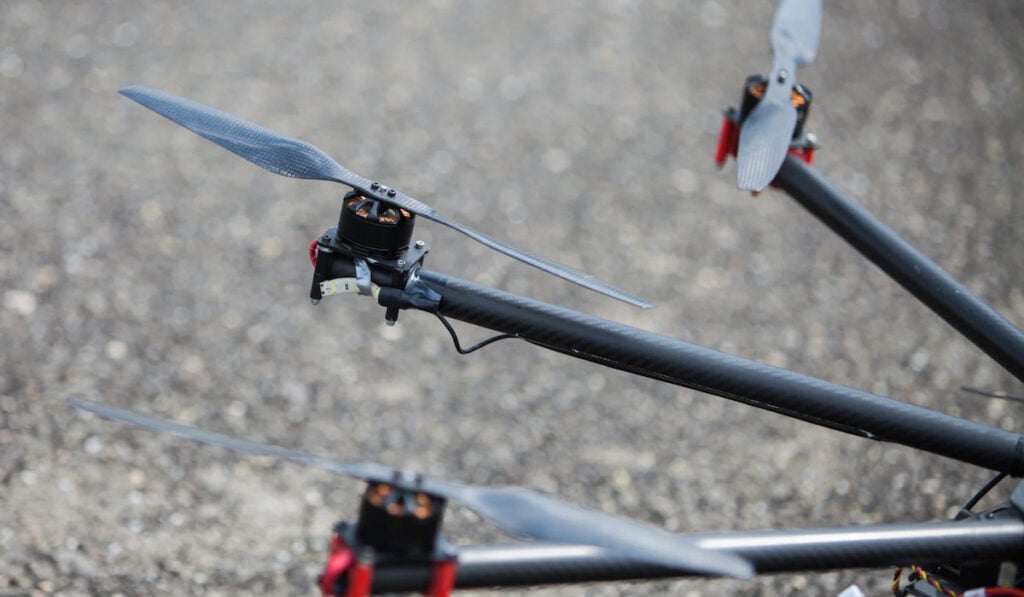
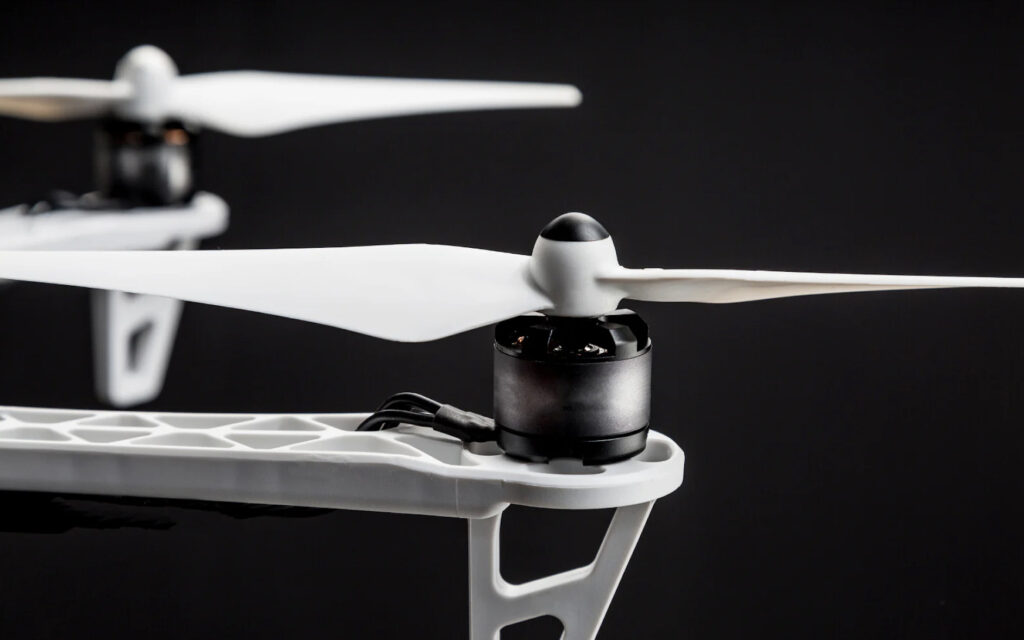
Propeller balancing corrects uneven mass distribution, mounting eccentricity, or rotational asymmetry within a propeller assembly to ensure smooth rotation at operational speeds. A drone propeller balancer identifies and corrects imperfections in small-to-medium UAV propellers, either as a component-level propeller balancing tool or as part of an integrated propulsion test stand, while aircraft propeller balancing equipment is often used to assess larger assemblies on the airframe during controlled engine or powerplant operation.
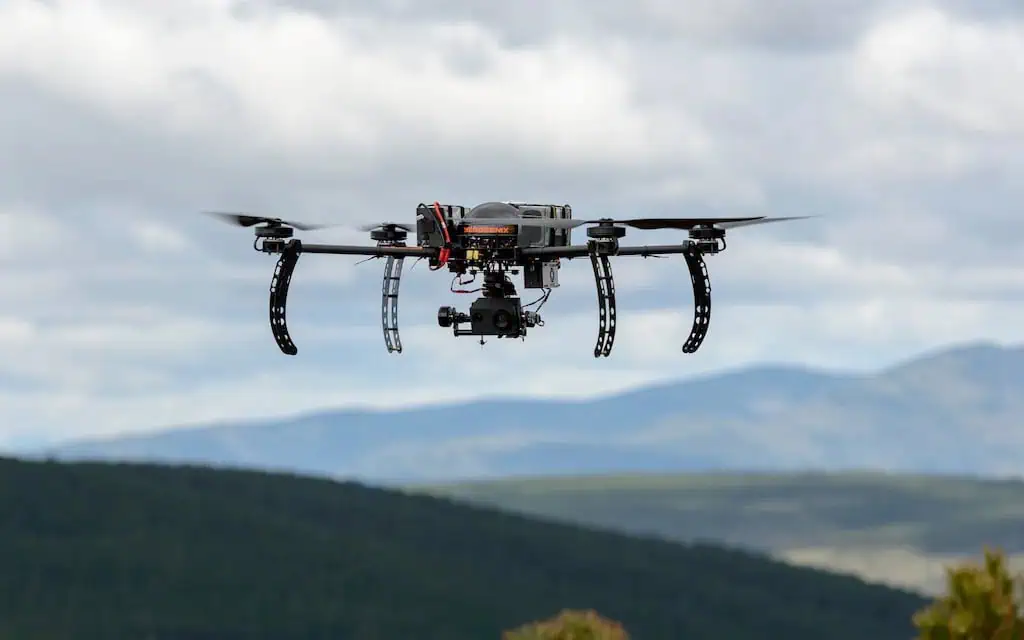
These propeller balancers support operational readiness across tactical ISR UAVs, heavy-lift uncrewed platforms, and military turboprops by reducing destructive vibration before it degrades payload performance, compromises structural integrity, or shortens component service life.
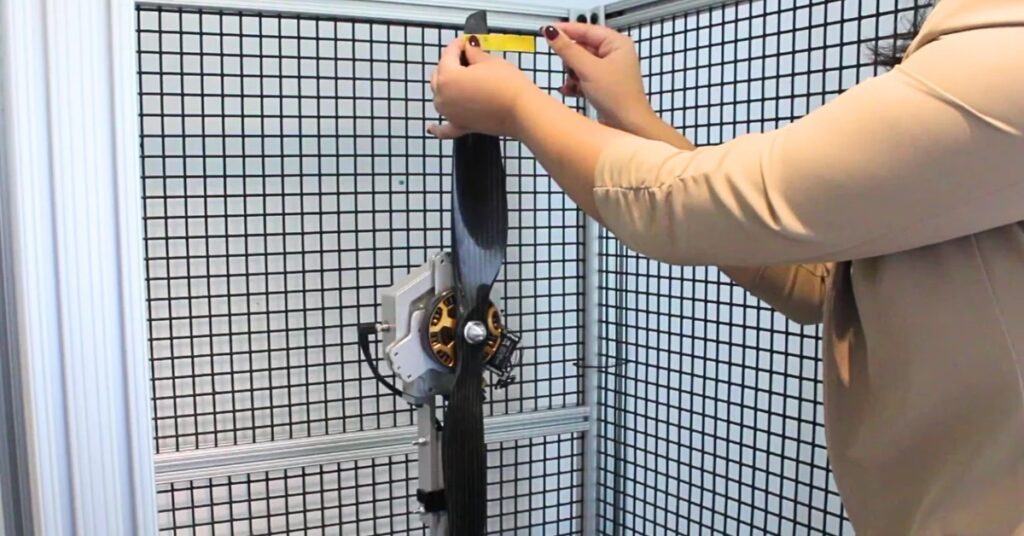
Propeller Balancer from Tyto Robotics
Static propeller balancers determine if a propeller possesses a heavy spot when suspended on a low-friction shaft, mandrel, magnetic fixture, or cone-mounted arbor. This static propeller balancing technique serves as a baseline entry point for small propellers and a preliminary step for larger assemblies, including aircraft propeller static balancing where approved procedures allow it. A propeller balancer used in this way allows operators to remove material from the heavy blade or apply small correction masses to the lighter side until the prop remains level across multiple orientations, making it a basic method for balancing a propeller before dynamic testing.
A dynamic propeller balancer measures vibration while the propeller rotates under power by combining accelerometers, tachometers, phase reference sensors, and data acquisition software. This dynamic propeller balancing approach is especially important for larger aircraft and advanced tactical UAV propulsion systems because it evaluates the propeller, hub, spinner, backplate, fasteners, motor or engine interface, and mounting structure as a single integrated rotating system. An aircraft dynamic propeller balance check may be performed when installed vibration levels need to be measured under representative operating conditions.
On-aircraft propeller balancing equipment analyzes the propulsion system in its fully assembled state, measuring vibration directly from the active platform rather than bench-testing components in isolation. These aircraft propeller balancers capture real-world installation variables and help field technicians distinguish propeller imbalance from related rotating defects such as shaft runout, bearing wear, eccentric spinners, or mounting issues under high operational tempos.
Field portable kits allow maintenance teams to perform precision balancing outside of depot environments using ruggedized cases that house compact sensors, trial weights, and intuitive balancing software. These highly portable units operate reliably via battery power, vehicle inverters, or generator power to support forward-deployed defense teams operating from unimproved runways, naval decks, or temporary launch sites.
Bench-top systems provide a stable testing environment, precision fixturing, and strong measurement repeatability for workshops, maintenance depots, and UAV integration facilities. These systems enable pre-installation balancing, balancing propellers for specific motor pairings, and precision matching of propellers to specific motors. Advanced setups may also integrate with thrust stands to evaluate combined electrical and mechanical powertrain performance.
An industrial propeller balancing machine is designed for high-throughput manufacturing environments, automated pass/fail criteria, guided material modification readouts, and serialized data logging. This automated approach can flag manufacturing anomalies such as tool wear, dimensional drift, resin content variation, or inconsistent laminate curing before composite blades ever reach the active fleet. In industrial support environments, a propeller shaft balancing machine may also be used for associated shafts, adapters, or rotating interfaces, although it should not be treated as a substitute for balancing the propeller assembly itself.
Propeller imbalance generates continuous cyclic forces that radiate through the airframe, targeting motor mounts, structural booms, fuselage joints, and payload rails on UAVs, or engine cowlings and avionics shelves on aircraft. Balancing a propeller reduces this excitation force, helping protect adjacent structural components, prevent fasteners from losing torque, and extend overall airframe service life in harsh environments.
In electric UAVs, imbalance imposes severe radial and axial loads on small motor bearings and can contribute to oscillatory load demands that reduce powertrain efficiency and increase stress on connected drive electronics such as Electronic Speed Controllers (ESCs). Implementing systematic balancing ensures that rotating components operate closer to their nominal design parameters, helping mitigate bearing fatigue, reduce alternating stress on shafts, and preserve maintenance intervals.
Vibration generates both airborne tonal noise and structure-borne acoustic resonance, producing distinct acoustic modulation and harmonic noise from mass distribution or tracking errors. While balancing alone cannot resolve noise caused by blade tip speed or aerodynamic design, eliminating mechanical modulation and structural rattling can help maintain acoustic discretion during low-altitude tactical loiter profiles.
Modern ISR payloads require exceptional mechanical stability, meaning that high-amplitude airframe vibration can easily degrade image resolution, stress gimbal motors, and cause premature bearing failure. Balanced propellers reduce vibration at the source before it travels through the airframe to the payload bay, helping minimize pixel jitter and preserve the clarity of actionable imagery.
High-frequency mechanical vibration introduces significant noise into flight control sensors, forcing the autopilot to apply aggressive digital filtering that can introduce control latency or cause attitude drift and uncommanded oscillations. Executing proper drone propeller balancing provides a cleaner mechanical environment for the flight controller, resulting in sharper attitude estimation and more predictable control responses across the flight envelope.
Imbalance wastes energy by converting a portion of the powertrain’s kinetic energy into parasitic structural vibration and uneven bearing drag rather than usable aerodynamic thrust. A balanced propeller minimizes these mechanical inefficiencies and current spikes, helping improve propulsion efficiency and support longer time-on-station for tactical and long-endurance assets.
The following technical indicators are utilized by defense technicians to evaluate and record the balance quality of rotating propulsion assemblies:
| Metric or Output | Technical Definition | Operational Significance for Defense Platforms |
| Residual & Permissible Unbalance | Residual unbalance is the mass eccentricity remaining after correction, while permissible unbalance defines the maximum allowable threshold for the assembly. | Establishes objective pass/fail limits, ensuring consistent maintenance standards across depots. Procedures may align with ISO 21940-11 guidance for rigid rotors where applicable. |
| Balance Quality Grades | Relates allowable residual unbalance directly to maximum operational rotor speed and application type. | Allows engineers to specify exact tolerance targets; high-performance UAVs may require custom, precise thresholds due to sensitive payload profiles. |
| Vibration Metrics (Velocity, Acceleration, Displacement) | Quantifies vibration severity across different frequency bands, commonly expressed as velocity, acceleration, or displacement depending on the diagnostic method. | Provides maintainers with clear before-and-after metrics to assess risk to airframes and onboard sensors. |
| RPM Tracking & Order Analysis | Correlates vibration peaks directly to rotational speed, isolating specific multipliers (orders) of shaft frequency. | Separates actual propeller mass imbalance (1x running speed) from structural resonances, motor electrical faults, or blade-pass aerodynamic pulses. |
| Phase Angle & Correction Vector | The angular measurement identifying where a correction mass or material adjustment should be made relative to a known geometric reference mark. | Points the maintainer to the calculated angular position for material modification, reducing trial-and-error corrections. |
| Frequency-Domain / Harmonic Separation | Transforms time-domain sensor data into a frequency spectrum via Fast Fourier Transform (FFT) algorithms. | Allows technicians to differentiate between mass unbalance, bearing degradation, aerodynamic anomalies, and gearbox meshing frequencies. |
Propeller balancing corrections are typically made through controlled material removal, approved mass addition, or configuration-level adjustments to the complete rotating assembly.
Selecting the correct correction method depends on propeller material, platform type, manufacturer limits, airworthiness requirements, and whether the balancing is being performed at component, assembly, or installed-system level.
Navigating the compliance landscape can require adherence to specific military, aviation, and international qualification guidelines. Propeller balancing procedures and propeller balancing equipment may be governed by a combination of rotor balancing standards, aircraft maintenance manuals, military environmental requirements, and platform-specific airworthiness documentation.
These framework documents help ensure that test equipment and balancing procedures meet applicable airworthiness and qualification criteria.
Modern industrial trends focus heavily on automation, advanced data tracking, and multidisciplinary optimization.
These technical developments continue to streamline production throughput while increasing the baseline reliability of advanced uncrewed fleets.


 Searching Companies & Products