Stealth drone propellers are specialized rotor systems engineered to reduce the acoustic signature of UAVs by controlling aerodynamic flow, pressure distribution, and tonal output. Unlike heavy-lift designs, a silent drone propeller prioritizes suppression of blade passage frequency and harmonic spikes to limit passive acoustic detection.
This page showcases leading manufacturers of silent propellers for drones, designed for deployment across covert ISR, urban reconnaissance, maritime surveillance, and autonomous loitering platforms.
If you design, build or supply Stealth Drone Propellers, create a profile to showcase your capabilities and connect with visitors who have an active requirement for your solutions.
Stealth drone propellers are specialized components engineered to mitigate the acoustic footprint of Unmanned Aerial Vehicles (UAVs) by carefully managing aerodynamic flow and pressure distribution. These silent drone propellers are optimized for reduced detectability, unlike heavy-lift propellers, which prioritize thrust and payload capacity. In modern conflict, the acoustic signature of a platform represents a primary vulnerability. While radar cross section and thermal output are often prioritized, the audible frequencies produced by drone rotors are frequently the first indicators of presence. In electrically powered systems, engine noise is secondary to the aerodynamic noise generated by the rotor blades.
Propeller noise is generally divided into tonal noise, generated at the blade-passage frequency and its harmonics, and broadband noise, produced by turbulence and vortex shedding. Effective stealth propellers focus on suppressing narrowband tonal spikes, as these are easier to detect and track than broadband acoustic energy.
Applications of Stealth Drone Propellers Across Military Operations
Special Operations and Covert ISR
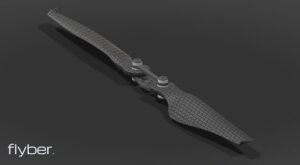
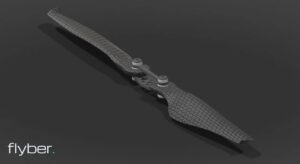
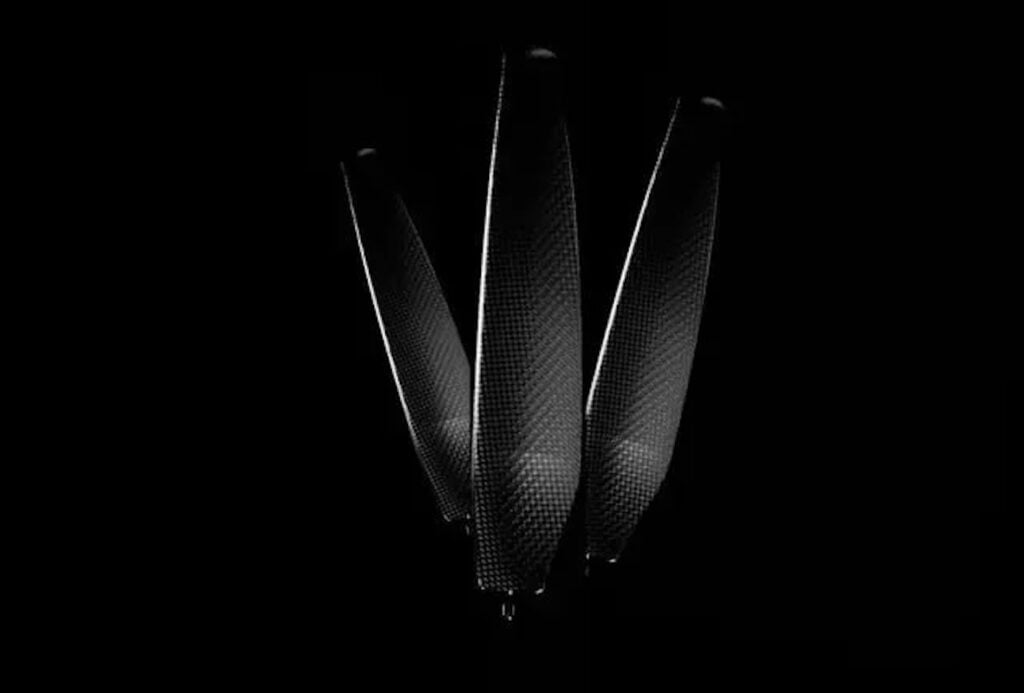
Custom Drone Propeller Blades by Flyber
Special operations units rely on compact aircraft equipped with lightweight, small drone propellers to conduct reconnaissance at low altitude. Silent propellers for drones reduce tonal prominence within the frequency range most sensitive to human hearing, lowering perceived proximity and directionality during covert ISR missions.
Urban Tactical Reconnaissance
Urban environments amplify harmonic signatures through reflection and reverberation. In multirotor platforms, interaction noise can occur when adjacent drone rotors produce intersecting wakes, creating secondary tonal components. Proper blade optimization and rotor spacing are essential when integrating propellers for close-proximity ISR operations in dense infrastructure.
Naval and Littoral Surveillance
Over water, low-frequency tonal components propagate farther due to minimal obstruction. Maritime ISR platforms require configurations that reduce blade-passage frequency prominence rather than merely shifting acoustic energy higher in the spectrum.
Autonomous Loitering Systems
Persistent loitering systems operating over contested territory remain vulnerable to passive acoustic detection. Unlike heavy-lift propellers, which often operate at higher disc loading, stealth designs distribute aerodynamic loading more evenly to reduce pressure-pulse intensity. In some cases, mission-specific custom propellers are developed to balance endurance, thrust, and acoustic discretion.
Design Principles of Silent Drone Propellers
Low-Noise Blade Geometry and Airfoil Optimization
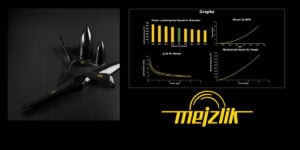
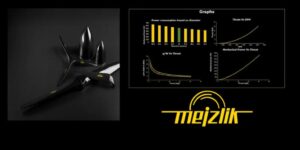
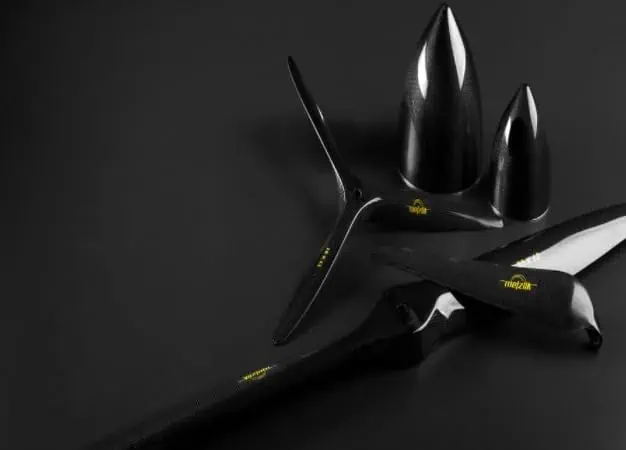
Military-grade COTS & custom carbon fiber propellers for UAVs from UAV Propulsion Tech
The primary source of propeller noise is the pressure differential between blade surfaces. Airfoil refinement, swept leading edges, and tapered tips reduce coherent vortex formation and redistribute acoustic energy. These approaches are common in advanced silent propellers for drones used in defense applications.
Blade Count, Disc Diameter, and Rotational Speed Trade-Offs
Acoustic intensity scales with blade-tip speed. Increasing disc diameter allows lower rotational speed for equivalent thrust, thereby reducing tonal prominence. Increasing blade count distributes aerodynamic loading, lowering per-blade pressure pulses. However, excessive blade count can increase rotor-interaction noise in multirotor aircraft.
Serrated and Scalloped Trailing Edges
Some stealth drone propellers incorporate serrated trailing edges inspired by owl-feather morphology. These features disrupt coherent turbulent structures and reduce narrowband tonal noise.
Shrouded and Ducted Propeller Configurations
Ducted systems modify tip-leakage flow and alter vortex-formation patterns. While they do not eliminate vortices entirely, they can reduce lateral acoustic radiation from exposed rotors, although aerodynamic trade-offs must be considered.
Materials & Construction Techniques Used in Stealth Propellers
Composite Materials and Damping Properties
Material selection significantly influences vibration coupling. Carbon fiber propellers offer high stiffness and low mass, but acoustic performance depends on structural damping and modal tuning rather than material choice alone. Stealth-optimized propellers may incorporate internal damping layers to limit structure-borne radiation.
Carbon Fiber Versus Thermoplastics Versus Advanced Polymers
Low-cost plastics may flex under load, introducing unsteady aerodynamic noise. Reinforced thermoplastics and advanced composites maintain geometric stability at high rotational speeds, which is critical for minimizing tonal irregularities across rotor blades.
Additive Manufacturing for Acoustic Optimization
Additive manufacturing enables rapid prototyping of custom propellers and facilitates internal structural tuning. Although aerodynamic noise remains dominant, structural optimization can reduce secondary vibration radiation.
Integration with Low-Observable UAV Architectures
Effective acoustic reduction requires coordination between propeller design and overall airframe configuration. Propeller placement relative to the airframe directly influences acoustic radiation patterns and ground-level exposure. Shielding strategies may include positioning propellers behind structural elements or within partially enclosed configurations to attenuate direct line-of-sight noise propagation.
In multirotor systems, careful management of wake interaction between rotors is critical. Overlapping vortices and turbulent inflow can introduce additional tonal components, increasing detectability. Appropriate rotor spacing and aerodynamic tuning help mitigate these effects.
Motor-control strategies also contribute to acoustic performance. Field-oriented control reduces torque ripple and limits mechanical vibration coupling into the propeller assembly, resulting in smoother rotational behavior and reduced emitted noise.
Common Testing & Validation Procedures
Acoustic performance must be verified through structured testing and measurement protocols. Validation typically begins in an anechoic chamber, where engineers measure blade-passage frequency, harmonic content, and overall spectral characteristics under controlled conditions. Tonal-peak amplitude, broadband distribution, and detectability characteristics are assessed to determine acoustic-signature risk.
Open-field testing complements laboratory analysis by evaluating sound propagation over distance in realistic atmospheric conditions. Variables such as temperature gradients, humidity, wind, and terrain influence acoustic travel and must be incorporated into operational modeling. Defense-grade systems must also meet environmental durability standards to ensure blade-geometry stability across temperature extremes, vibration loads, and long-term operational stress.
Emerging Trends in Silent Drone Propeller Design
Future stealth propellers and silent drone propellers are expected to incorporate adaptive geometries using morphing composites or electrically responsive materials capable of adjusting blade twist or camber in flight. This approach may allow higher efficiency during transit and reduced acoustic output during loiter without requiring hardware changes.
Advances in digital modeling and rotor-phase synchronization may enable coordinated control of adjacent drone rotors to suppress interaction noise. As passive acoustic-detection systems become more sensitive, stealth optimization is likely to focus increasingly on spectral shaping and architecture-specific acoustic management rather than simple amplitude reduction.
Flyber CEO and co-founder Rowan Carstensen shares insights into the company’s carbon-fiber UAV propellers, its scalable engineering process, and the wide range of mission applications supported across defense, commercial, and urban air mobility sectors
UAV Propulsion Tech will be marketing Mejzlik Propellers’ solutions for UAVs, meeting quality, safety and performance requirements for a range of defense and aerospace applications
The latest defense technology news, straight to your inbox.
Get our weekly roundup of technology developments, new products and industry news.
THANK YOU FOR SIGNING UP
Thanks for joining us. Check your inbox.
We've sent you an email. Click the confirmation link to complete your subscription to the weekly eBrief. In the meantime, explore the latest news, suppliers and technologies on DA.
Advancing Defense Capability Through Strategic Collaboration
Defense Advancement works with major OEMs to foster collaboration and increase engagement with SMEs, to accelerate innovation and drive defense capabilities forward.