



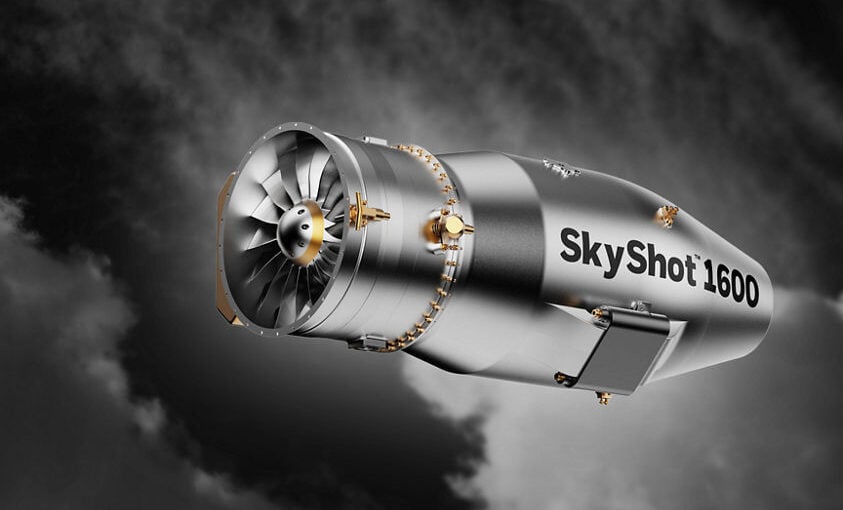
Honeywell Aerospace’s small-thrust-class SkyShot 1600 engine has been selected by the U.S. Air Force to advance into Preliminary Design Review under the service’s Autonomous Collaborative Platform program.
The Preliminary Design Review represents a formal milestone where the Air Force evaluates whether the engine design has achieved sufficient technical maturity to proceed into detailed development. Designed to meet the cost, speed and performance needs of next-generation autonomous platforms, the engine is designed to meet performance requirements for collaborative combat aircraft and unmanned aircraft systems.
Dave Marinick, president and CEO of Engines and Power Systems at Honeywell Aerospace, said, “We’ve leveraged our proven and tested technology, plus the latest advancements in digital modeling and manufacturing, to design an engine ready to power the next generation of collaborative combat aircraft and unmanned systems.
“We look forward to supporting the U.S. Air Force in their mission of building smarter, more effective and more cost-efficient systems.”
The SkyShot 1600 is designed to meet mission-critical performance parameters including high-altitude capabilities, rigorous G-level performance and maneuverability targets. The engine features a flexible architecture supporting turbojet or turbofan variants from 800 to 2,800 pound-force of thrust. Honeywell has demonstrated the core engine across its full rated thrust range.
The engine is also designed to move quickly from digital modeling to physical production. A significant percentage of the materials used are capable of being additively manufactured or produced using high-volume manufacturing techniques, which Honeywell says can enable greater speed and supply chain resilience.