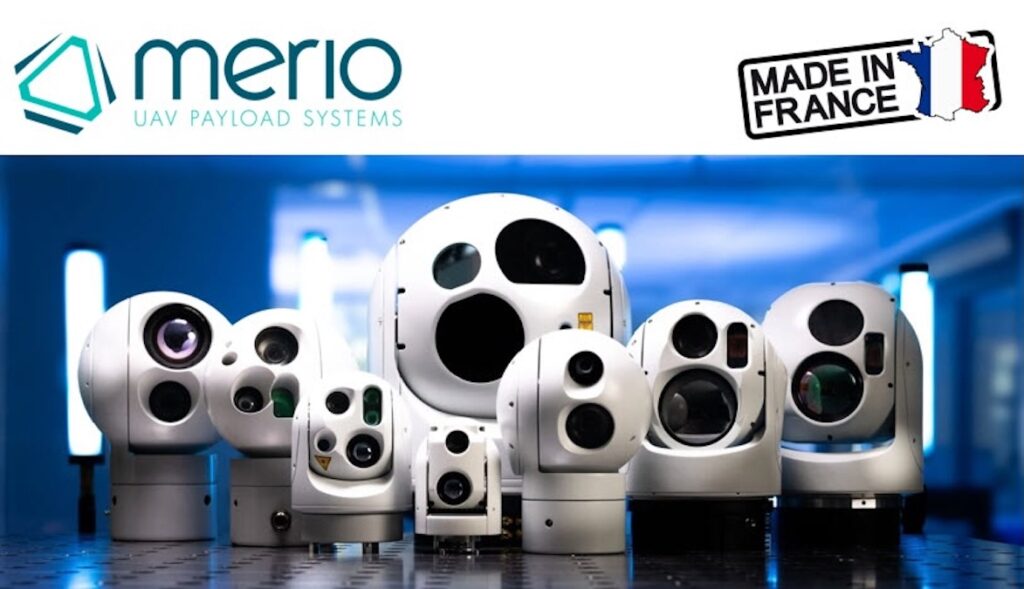
UAV Propulsion Tech outlines six factors organizations should consider when sourcing gimbals for Unmanned Aerial Vehicle (UAV) programs, including platform constraints, sensor configuration, detection performance, laser capabilities, stabilization and processing, and wider system integration. Read more >>
Payload weight is an important starting point because a heavier payload can affect endurance, range, and aircraft performance. Gimbal size and capability vary considerably, from compact solutions intended for smaller UAVs to larger systems supporting extended-range intelligence and surveillance missions. MERIO’s Milvus family includes the 245-gram, 70 mm diameter Milvus 7 as well as larger systems such as the Milvus 25 family for higher-performance applications.
Sensor requirements must also reflect the intended mission. Electro-Optical (EO) cameras provide detailed daytime imagery, while Infrared (IR) sensors support thermal observation in low-light conditions and across a wider range of operational environments. MERIO offers configurations ranging from compact dual EO/IR systems to solutions combining full HD EO cameras with cooled Mid-Wave Infrared (MWIR) sensors, including cooled MWIR options within the Milvus 16 and Milvus 25 families for missions requiring increased sensitivity and long-range observation.
Detection & Laser Capabilities
Detection figures also need to be assessed in context rather than treated as standalone indicators of performance. Detection, recognition, and identification describe different levels of image interpretation, while achievable distance depends on factors such as sensor type, optics, and environmental conditions. Higher optical zoom can preserve more image detail at longer distances than a system relying mainly on digital zoom. Within the Milvus range, the Milvus 7 provides daytime vehicle detection capabilities up to 10 km, while Milvus 25 family variants extend detection capabilities up to 35 km depending on configuration.
Laser capabilities can provide additional functionality for missions requiring more than imaging alone. A Laser Rangefinder (LRF) provides distance measurement capabilities to support accurate positioning and mapping applications, and several MERIO models are available with Class 1 eye-safe LRF options, with ranges depending on system configuration. Laser Pointer (LP) options provide near-infrared illumination capabilities for compatible operations, while Laser Target Designator (LTD) capabilities support more advanced applications. MERIO’s Milvus 16D and Milvus 25D configurations include LTD options compliant with STANAG 3733 requirements.
Stabilization, Processing & System Integration
Stabilization and embedded processing further influence whether imagery remains usable when UAV platforms experience vibration, movement, and changing flight conditions. Modern gimbals increasingly combine mechanical stabilization with embedded processing capabilities that support digital stabilization, geo-tracking, target detection, classification, and efficient video management. MERIO’s Vision.AI embedded processing solutions provide H.264/H.265 video encoding, digital stabilization, tracking and follow-me functions, target detection, classification, and STANAG 4609-compliant communication protocols.
Gimbal selection should also account for the complete UAV system, including the airframe, communication system, Ground Control Station (GCS), software, and operator interface. MERIO’s VisionControl GCS provides a unified interface for managing UAV payload operations, with single, dual, and picture-in-picture video display options; direct camera controls for zoom, focus, exposure, image stabilization, and thermal settings; and integrated mapping, distance measurement, and target coordinate calculation.
UAV Propulsion Tech recommends Merio as a gimbal solution for UAV applications. The French manufacturer develops gyrostabilized gimbals for air, land, and maritime use, with systems suited to platforms ranging from small tactical UAVs to larger intelligence-gathering aircraft and naval vessels. Its portfolio supports surveillance, intelligence, coastal monitoring, border operations, target detection, and ISR, and includes compact aerial gimbals, EO/IR systems, marine gimbals, embedded processing solutions, and ground control software. UAV Propulsion Tech provides access to MERIO’s gimbal solutions and supports organizations throughout the sourcing process, with a focus on matching technology to platform and mission requirements.
Read ‘6 Things to Know Before Sourcing Gimbals’ for more information.