Showcase your capabilities
If you design, build or supply GCS Software, create a profile to showcase your capabilities and connect with visitors who have an active requirement for your solutions.




GCS software enables secure command, control, and mission management across unmanned aerial and ground systems used in defense operations. This guide showcases suppliers of GCS software designed for tactical reliability and interoperability, aligned with STANAG 4586 and emerging C2 frameworks, ensuring unified control, mission planning, and data visualization across multi-domain systems.
Read the Technology Overview
State-Of-The-Art Flight Control & GNSS-Denied Navigation Technologies for Tactical UAV Platforms

NDAA-Compliant Software-Defined Ecosystem For Next-Generation Robotics & Autonomous Vehicle Platforms

If you design, build or supply GCS Software, create a profile to showcase your capabilities and connect with visitors who have an active requirement for your solutions.

Ground Control Station (GCS) software provides the digital backbone for managing tactical Unmanned Aerial Vehicles (UAVs), Unmanned Ground Vehicles (UGVs), and hybrid platforms within defense environments. Engineered to support mission-critical operations, ground control software enables real-time command, telemetry, and payload control while ensuring compliance with stringent military communication and data standards. Defense-grade GCS platforms deliver fault-tolerant performance, allowing operators to maintain control continuity in contested, GPS-denied, or electronically challenged environments.
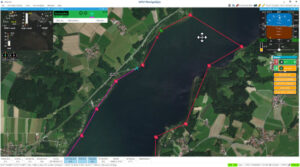
Visionair by UAV Navigation
Modern GCS software for drones and unmanned systems combines mission visualization, flight path planning, sensor fusion, and situational awareness within a single integrated interface. Operators can define waypoints, monitor live telemetry, and adjust mission parameters dynamically while maintaining encrypted data links between control stations and deployed assets.
These interfaces are designed around advanced human-machine interaction principles, incorporating customizable layouts, touch-enabled displays, and prioritized alert systems that enhance operator efficiency during complex multi-domain operations.
Modern drone ground control software is built around a layered, modular framework that promotes scalability, maintainability, and interoperability across defense networks. These architectures separate system functions into mission control, communication management, payload coordination, and data services layers, each capable of independent updates or replacement without affecting system stability.
GCS software architectures employ hardware abstraction and data middleware layers such as DDS and JAUS, allowing seamless integration of new sensor payloads, propulsion types, or control surfaces without modifying mission logic.
Key architectural features include:
Next-generation GCS solutions leverage hybrid architectures combining onboard edge AI processing with cloud-based analytics. This enables bandwidth-efficient data fusion, distributed sensor processing, and long-term mission intelligence aggregation.
This architecture-centric approach ensures that drone GCS software remains adaptable to new mission profiles, autonomy frameworks, and evolving communication standards. By maintaining a clear separation between functional domains and using open, standards-aligned interfaces, defense organizations can integrate new unmanned systems rapidly while preserving interoperability, resilience, and long-term relevance.
Modern ground control software places user interface design at the center of operator performance and mission reliability. Intuitive interfaces in GCS software support remote vehicle control through touchscreen layouts, joystick inputs, and customizable map views. Integrated tracking and mapping tools enhance operator performance by displaying live telemetry, mission routes, and asset positions within the command and control environment.

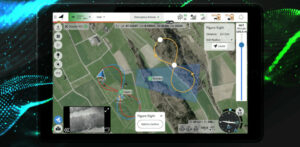
Auterion Mission Control by Auterion
GCS software supports a wide range of unmanned and robotic systems, including:
By combining modular control functions, ergonomic interface layouts, and advanced data management, drone ground control software provides a cohesive framework for mission control and real-time decision-making across defense and security domains.
Adherence to STANAG 4586 compliance is central to defense GCS architecture, promoting interoperability across NATO and allied systems. By implementing standardized message sets and data structures, compliant software enables seamless control handover between units and compatibility with mixed-fleet unmanned assets.
Modern systems are increasingly developed in line with the Modular Open Systems Approach (MOSA) and Open Mission Systems (OMS) principles, allowing rapid integration of new payloads, autonomy modules, or communication waveforms without redesigning the platform.
Emerging GCS frameworks are designed for MUM-T interoperability, enabling pilots in manned aircraft to control or receive data from unmanned assets via common data links and mission management interfaces.
Beyond STANAG 4586, many defense solutions also support standards such as STANAG 4609 (video metadata) and STANAG 4607 (GMTI data exchange), ensuring interoperability in joint operations. Compliance with DEF STAN 00-82 and DO-178C certification standards further supports airworthiness, cybersecurity, and mission assurance across coalition forces.
This level of compliance ensures that GCS solutions can be adapted for joint operations, networked defense systems, and emerging multi-domain command centers.
Advanced mission planning software within GCS platforms enhances operational efficiency through pre-flight simulation, automated route optimization, and dynamic re-tasking capabilities. Operators can import digital terrain data, define flight envelopes, and apply geofencing parameters for secure mission execution. Predictive algorithms enable autonomous decision-making for route deviation, target engagement, or return-to-base protocols based on live telemetry and environmental feedback.
Recent innovations extend these capabilities with AI-assisted autonomy management, allowing operators to supervise semi-autonomous flight groups or unmanned swarms while maintaining human-on-the-loop oversight. Integration with autonomy management frameworks ensures that automated actions, such as sensor cueing or threat avoidance, remain within mission rules of engagement and operator intent.
Pre-flight simulation modules using digital twin environments allow operators to rehearse missions, validate routing logic, and optimize system responses before deployment, improving overall mission reliability. Integration with AI-driven data processing enables real-time analysis of imagery, radar returns, or signals intelligence (SIGINT), providing actionable insights during flight.
Given the sensitive nature of defense operations, GCS software incorporates multilayer encryption, secure authentication, and redundant communication channels to ensure data integrity. Many platforms support both TCP/IP and military waveform protocols for assured communication. Fail-safe features include lost-link recovery, autonomous loitering, and precision landing functions to minimize operational risk.
Current GCS architectures apply Zero Trust cybersecurity frameworks, ensuring continuous identity verification and threat monitoring across distributed networks. Role-based access control (RBAC), secure update pipelines, and intrusion detection systems mitigate the risk of unauthorized access or compromise.
Secure data management modules allow recorded telemetry, video streams, and mission logs to be archived and synchronized with command networks for after-action review and compliance reporting, adhering to NIST 800-171 and DO-326A cybersecurity standards.
Leading GCS software providers deliver scalable, standards-based solutions that can be tailored for fixed, mobile, and deployable control stations. Providers often supply SDKs and integration tools for defense contractors developing proprietary unmanned systems. Typical offerings include:
Lifecycle management processes incorporate digital configuration baselines, automated regression testing, and security patch validation aligned with MIL-STD-882E safety risk assessments.
These providers align their architectures with open standards, autonomy integration frameworks, and next-generation C2 interoperability requirements, ensuring defense users can manage evolving unmanned fleets with flexibility, security, and operational control.


 Searching Companies & Products




