
A whitepaper from WOLF Advanced Technology, titled Eyes in the Sky, Intelligence at the Edge: Hybrid GPU–FPGA Architectures for Real-Time Airborne EO/IR Missions, examines how hybrid GPU–FPGA architectures can address the latency, synchronization, and computational demands of real-time airborne EO/IR processing.
The paper explores the complementary roles of FPGAs and NVIDIA GPUs in processing data from multiple airborne sensors. FPGAs handle video interfacing, frame acquisition, timestamping, synchronization, and image correction with predictable timing, while GPUs provide parallel processing for AI-based object detection and classification, multi-object tracking, image enhancement, sensor fusion, and geospatial overlays. It also examines how GPUDirect RDMA transfers FPGA-prepared image buffers directly into GPU memory, reducing host-memory copies and CPU involvement to support lower-latency processing.
Operational Applications and Hardware Architectures
Applications examined include airborne law enforcement, search and rescue, and disaster response, where onboard AI processing can support the automatic detection of people, vehicles, vessels, life rafts, thermal signatures, wildfire hotspots, and damaged infrastructure.
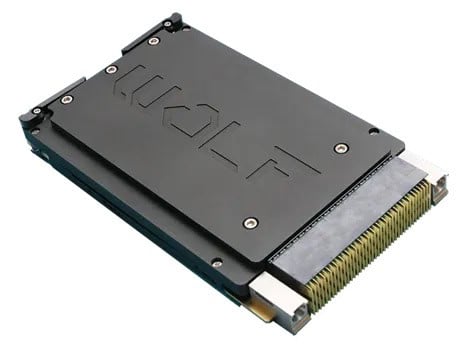
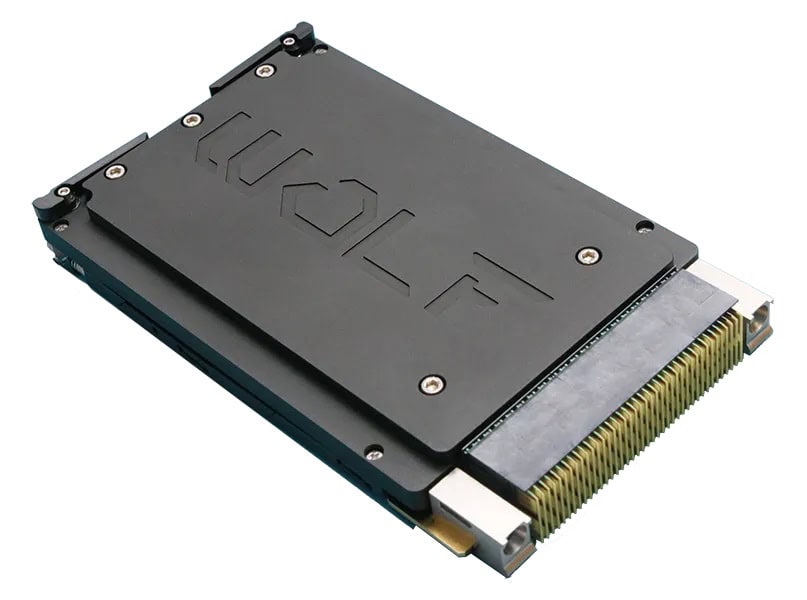
WOLF considers how these capabilities can reduce operator workload while preserving human decision-making, including in environments where communications networks are degraded or unavailable. It also details supporting WOLF hardware, including the WOLF-3570 XMC module, which combines an NVIDIA RTX™ 2000 Ada GPU, integrated FGX2 FPGA, and GPUDirect RDMA; the WOLF-3185 FGX2 for deterministic sensor acquisition and preprocessing; and the WOLF-3476 and WOLF-3576 for GPU-accelerated analytics and visualization.
The whitepaper also addresses operator trust and sensor-data integrity as generative enhancement, autonomous cueing, and vision-language models enter airborne workflows. It examines the need to distinguish original sensor imagery from enhanced, fused, or inferred information, alongside maintaining an auditable chain of provenance covering original frames, timestamps, calibration state, processing steps, and model versions. The full paper provides further technical discussion of hybrid processing architectures, airborne applications, and the management of sensor data throughout the EO/IR processing pipeline.