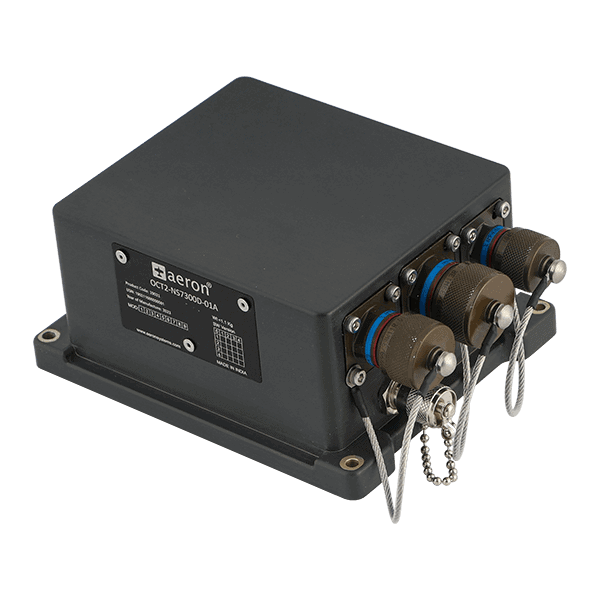



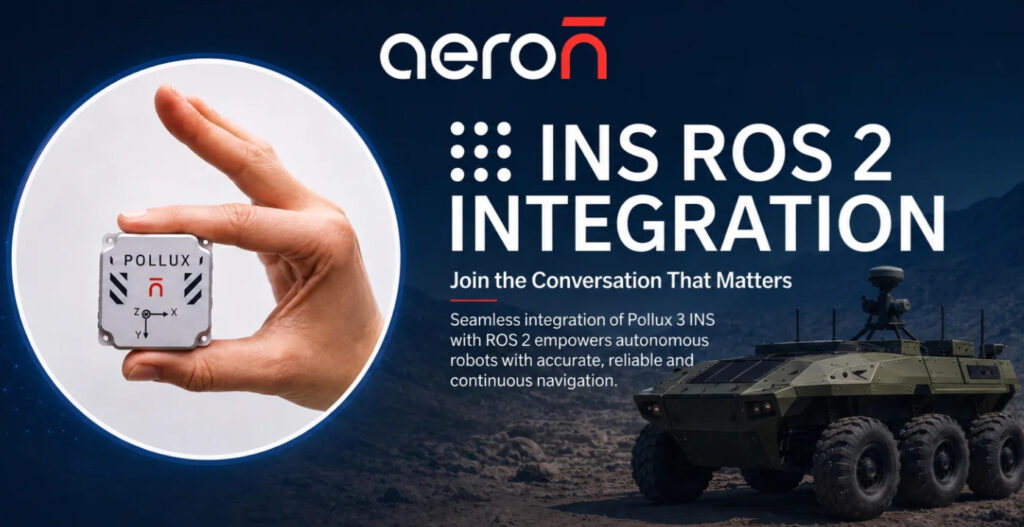
Aeron Systems has developed a dedicated ROS2 driver to integrate its Pollux 3 (PLX3-N) GNSS-aided Inertial Navigation System (INS) with autonomous robots, UAVs and UGVs, providing reliable navigation data for increasingly sophisticated robotic platforms.
Autonomous systems require continuous position, velocity and attitude information for localisation, trajectory planning and control. While GNSS can provide accurate positioning, signal blockage, interference and GNSS-denied environments can interrupt navigation. By combining inertial measurements with GNSS and other sensor inputs, Pollux 3 enables continuous navigation, dead reckoning during temporary GNSS outages, and sensor fusion with technologies including LiDAR, cameras and odometry.
Designed with a low size, weight and power (SWaP) profile, Pollux 3 provides high-performance attitude, heading, position and velocity estimation, with navigation data output at up to 200 Hz and IMU data at up to 1,000 Hz. Its integrated multi-constellation GNSS and EKF-based sensor fusion further supports reliable navigation across demanding operating environments.
The Pollux 3 ROS2 driver is implemented as a managed lifecycle node and composable component, publishing REP-103, REP-105 and REP-145 compliant topics. It also provides raw Aeron data streams, configurable QoS, diagnostics, calibration services, TF support, automatic serial reconnection and external aiding capabilities.
Compatibility with established ROS2 navigation frameworks, including robot_localization, Nav2 and navsat_transform_node, reduces integration complexity and eliminates the need for additional interface layers. Support for ROS2 Humble and Jazzy, alongside RViz and Gazebo demonstration packages, further streamlines development.
With Pollux 3 providing the navigation backbone and ROS2 supplying the autonomy framework, Aeron Systems’ solution offers a production-ready approach to integrating accurate, resilient navigation into UAVs, UGVs, AMRs, inspection robots, defence platforms and other next-generation autonomous systems.
Read INS-ROS2 Integration for Next-Generation Autonomous Robotic Platforms.