Aeron Systems has launched DriftLoc™, a new navigation algorithm designed to deliver reliable inertial positioning for extended periods without access to GNSS.
The technology addresses a fundamental challenge facing modern navigation systems, where position accuracy can rapidly degrade when satellite signals are blocked, disrupted, or deliberately jammed.
GNSS remains a critical positioning technology wherever a clear view of the sky is available, but environments such as tunnels, urban canyons, underground facilities and areas affected by signal interference can leave conventional navigation systems increasingly reliant on inertial estimates. Over time, small errors from MEMS gyroscopes and accelerometers accumulate through integration, causing unaided position estimates to drift significantly.
Traditional approaches to reducing this drift have typically involved higher-grade inertial sensors, including fiber-optic and ring-laser gyroscopes. While these technologies provide excellent performance, their size, power consumption, cost and export restrictions can make them impractical for many commercial and compact autonomous systems.
DriftLoc takes a different approach, using real-time algorithms to estimate and continuously correct changing sensor errors. Designed to run on a commodity IMU and modest embedded processor, the technology combines a physics-driven kinematic model with Bayesian estimation and statistical signal processing.
Rather than relying solely on raw accelerometer and gyroscope measurements, DriftLoc continuously evaluates the platform’s motion and uses its behavior, including acceleration, deceleration, stationary periods, turning and settling, to establish mathematical correlations and identify errors as they develop. This allows the system to maintain a statistically weighted estimate of sensor reliability and continuously refine the inertial position solution in real time.
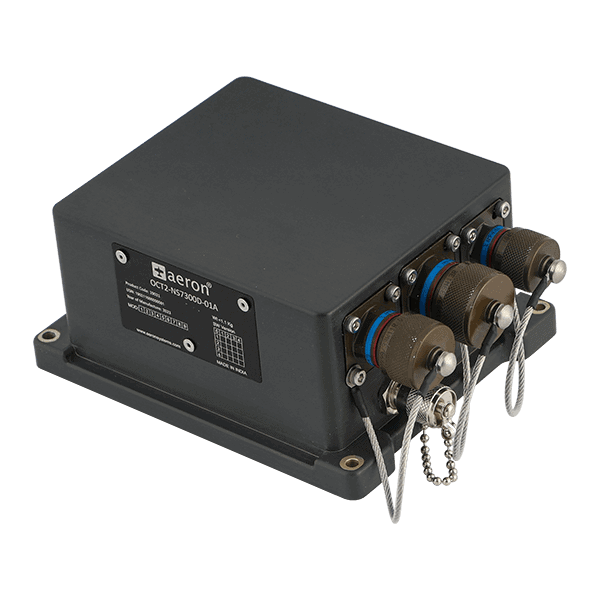
The technology has been demonstrated on Aeron Systems’ compact MEMS-based PLX3-N inertial navigation system. During a van-based test, the PLX3-N was operated without a GNSS antenna. Following a 30-second static alignment period, initial coordinates were supplied through the user interface from a GNSS-aided reference system installed separately for comparison.
The PLX3-N subsequently generated a clean, pure-inertial-derived position solution in real time, demonstrating DriftLoc’s ability to maintain positioning when GNSS is unavailable.
By shifting the focus from increasingly sophisticated inertial hardware to advanced real-time estimation, DriftLoc is intended to provide near-navigation-grade positioning performance using hardware measured in grams and tens of dollars rather than kilograms and tens of thousands of dollars.