




WOLF Advanced Technology is developing compact embedded computing systems for defense and aerospace platforms that require AI, video, and sensor-processing capabilities at the tactical edge. Read more >>
Across Europe, defense priorities are shifting toward faster deployment, improved operational readiness, and greater technological independence. Governments are increasing defense spending while directing investment toward artificial intelligence, autonomous systems, ISR, drone technology, and next-generation battlefield capabilities.
These priorities are increasing the demands placed on deployed computing hardware. Modern platforms must process growing volumes of sensor and video data while operating within constrained physical footprints and demanding environmental conditions.
For unmanned systems, tactical vehicles, airborne platforms, and other mission systems, this is driving greater reliance on embedded processing at the edge.
Processing Mission Data at the Edge
Defense platforms can generate large volumes of sensor, video, and mission data during operation. In many environments, transmitting all of this information to centralized infrastructure is neither practical nor desirable.
Bandwidth limitations, communications latency, contested networks, and operational security requirements can all restrict dependence on remote processing. Placing compute resources onboard the platform allows data to be handled closer to its source.
This creates a requirement for embedded systems capable of supporting real-time AI inference, sensor processing, machine vision, and video analysis without continuous external connectivity. The hardware must also withstand demanding aerospace and defense environments while operating within strict size, weight, power, and cost constraints.
For system designers, the challenge is not simply to increase computing performance. That processing capability must also remain within tightly controlled SWaP-C limits.
Open Architectures and Smaller Form Factors
European defense programs are also moving toward modular and open system architectures. These approaches can make platforms easier to adapt as mission requirements change, rather than relying on closed systems that are difficult to modify or upgrade.
Standards such as VPX and SOSA support modular integration and system scalability while helping reduce long-term integration complexity. At the same time, growing processing requirements at the tactical edge are increasing demand for smaller embedded computing formats.
VNX+ provides one approach to this requirement. The standard supports high-performance embedded computing within a compact form factor, allowing AI processing, networking, video, and sensor functions to be integrated into platforms where traditional VPX systems may be impractical.
This is particularly relevant to autonomous systems, tactical vehicles, airborne platforms, and other applications where available space, weight, and electrical power are limited. The engineering challenge is therefore increasingly centered on combining processing performance, modularity, and reduced physical size within a single architecture.
WOLF’s VNX+ System
WOLF Advanced Technology has developed its VNX+ ecosystem around these constraints, providing rugged, modular computing systems for data-intensive aerospace and defense applications.
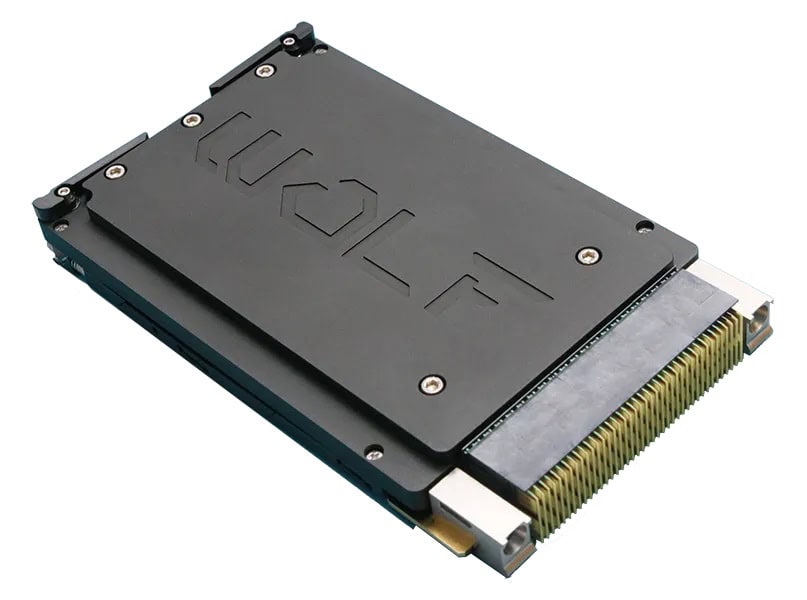
At Eurosatory 2026, the company demonstrated a single-slot VNX+ system designed to support advanced AI processing at the tactical edge.
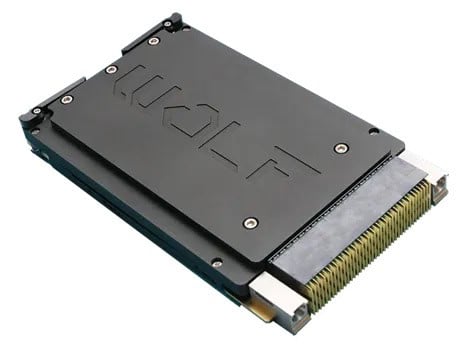
The rugged system integrates WOLF’s NX-powered single-board computer (SBC) module with onboard power conversion inside a compact chassis designed for deployment in space-constrained applications.
The demonstration showed AI inference, machine vision, real-time video processing, and sensor analytics being performed directly at the edge within a compact footprint. The system also includes a 1 TB self-encrypting NVMe drive (SED), providing hardware-level data protection for mission-critical applications.
Extending the VNX Architecture
The system also reflects the broader development of the VNX+ standard.
VNX+ builds on the VITA 74 VNX specification and extends the capabilities of small-form-factor embedded computing through support for higher power delivery and advanced connector technologies.
These additions allow more demanding workloads to be supported while retaining the compact footprint required by many modern aerospace and defense platforms.
As processing requirements increase, this combination of greater computing capability and reduced system volume can support applications where conventional embedded architectures may be too large or power intensive.
Embedded Computing for Future Defense Platforms
Europe’s changing defense requirements are increasing demand for systems that can be integrated quickly, adapted to different missions, and deployed across a range of platform types.
Meeting those requirements will depend on embedded architectures that combine AI processing capability with open standards, ruggedization, modular design, and compact packaging.
WOLF Advanced Technology is continuing to develop its VNX+ computing systems around these requirements, with an emphasis on edge processing and SWaP-C efficiency for aerospace and defense applications.