Fan Array Wind Generators (Windshapers) for Military UAV Testing
Fan array wind generators, also known as windshapers, are advanced open-air wind tunnel systems that simulate complex aerodynamic conditions in real-world military drone and UAV testing environments. These modular fan systems replicate variable wind profiles and turbulence with high precision, enabling accurate, repeatable testing of military unmanned aerial vehicles.
If you design, build or supply Fan Array Wind Generators (Windshapers), create a profile to showcase your capabilities and connect with visitors who have an active requirement for your solutions.
Fan Array Wind Generators (Windshapers) for Military UAV Testing
Overview by
Summer James
Updated:
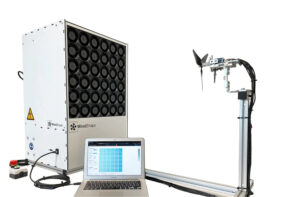
Fan array wind generators, also called windshapers or open-air wind tunnels, are tools for testing and developing UAVs, particularly in military applications. These systems consist of coordinated arrays of fans (EDFs) that simulate dynamic wind conditions in three dimensions. Unlike conventional closed-loop wind tunnels, windshapers allow open air interaction, enabling tests with actual control systems, onboard sensors, and propulsion units in real-time, under controlled yet realistic conditions.
What Are Fan Array Wind Generators?
Fan array wind generators are modular systems of independently controlled electric fans that create programmable airflow patterns for simulating real-world wind conditions in UAV testing environments.
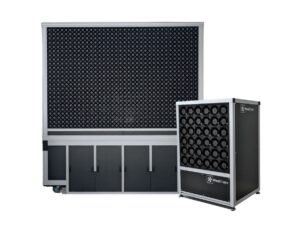
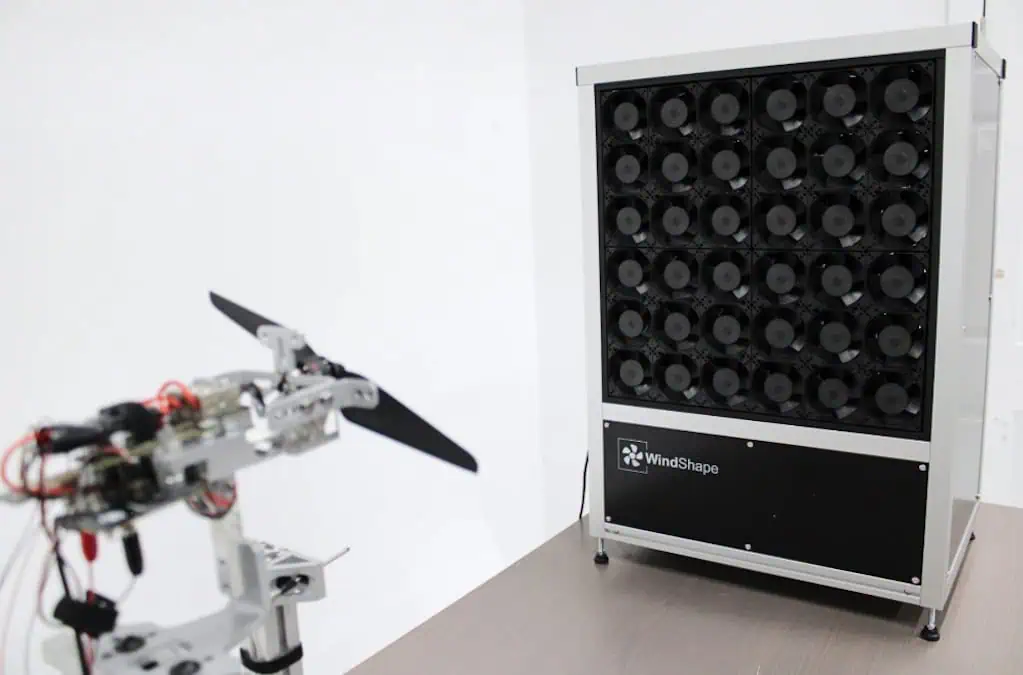
Windsahpers by Tyto Robotics.
These systems consist of dense grids of electric ducted fans (EDFs), each controlled via a centralized system to deliver dynamic, spatially variable airflow. Unlike traditional wind tunnels, which produce uniform flow, fan arrays enable precise control over wind speed, direction, and turbulence at each point in the grid. This allows for simulating complex aerodynamic conditions such as gusts, wind shear, vortex shedding, and turbulence.
Each fan unit incorporates adjustable fan blades powered by high-response drive motors, capable of creating steady or transient airflow profiles on command. This functionality is critical for evaluating UAV stability, control algorithms, and flight behavior under variable environmental loads.
Fan arrays are typically used in conjunction with propulsion test stands to enable simultaneous measurement of thrust, torque, and aerodynamic forces. Integrated data acquisition systems, force sensors, pressure sensors, and flow visualization tools like smoke generators and laser doppler velocimeters provide a comprehensive picture of UAV performance. Their open-air configuration supports full-system testing, including sensor feedback and autonomous navigation, within a safe, repeatable, and highly customizable environment.
Applications in Military UAV Testing
Military unmanned aerial vehicles require rigorous testing to ensure operational performance in diverse and unpredictable environments. Fan array wind generators facilitate:
Propulsion System Testing: Integrating propulsion test stands with fan arrays allows real-time thrust vector and control response evaluations.
Flight Stability Studies: Windshapers simulate crosswinds, turbulence, and rapid weather shifts, ideal for testing UAV flight algorithms.
Sensor Calibration: Systems such as pitot tubes and pressure sensors can be evaluated under variable wind conditions for accurate airspeed and pressure measurements.
Aerodynamic Characterization: Open-air wind tunnels support full-scale aerodynamic measurements using force sensors, balance systems, and smoke generators.
Types of Windshapers and Wind Tunnel Systems
Fan array wind generator systems vary by configuration, power, and control fidelity:
2D Arrays: Planar configurations are ideal for frontal wind profile simulation.
3D Arrays: Wrap-around or multi-face arrays that allow full envelope testing.
Modular Systems: Scalable designs to accommodate different UAV sizes and thrust levels.
Integrated Test Platforms: Systems combining support struts, data acquisition systems, and propulsion stands into a single test environment.
These systems often integrate drive motors, electric ducted fans, diffusers, nozzles, and airflow control sensors to replicate complex aerodynamic flows.
Comparisons with Traditional Wind Tunnel Testing
Unlike conventional wind tunnels, which are typically enclosed and offer limited lateral motion for the test article, fan array windshapers are open-air platforms. This offers several advantages:
Feature
Traditional Wind Tunnel
Fan Array Wind Generator
Enclosure
Enclosed
Open air
Wind Profile Complexity
Uniform or laminar
Dynamic, programmable
Interaction with UAV Systems
Limited
Full real-time systems
Sensor and Propulsion Testing
Partial
Full integration
UAV Size Flexibility
Constrained
Scalable array configurations
Fan arrays enable real-world interactions such as GPS signal use, autonomous navigation testing, and onboard sensor validation; functions that are difficult or impossible in enclosed tunnels.
Key Components and Instrumentation
Effective windshaper systems typically include:
Fan Blades and Drive Motors: High-speed, responsive elements producing controllable wind forces.
Diffusers and Nozzles: Used to shape and direct airflow for smoother gradients or concentrated turbulence.
Force and Balance Systems: To measure aerodynamic loads on UAVs during flight simulations.
Pressure and Pitot Sensors: Integrated into the test setup to monitor fluid dynamics in real time.
Data Acquisition Systems: Central hubs collecting and processing sensor data for performance analysis.
Smoke Generators and Laser Doppler Velocimeters: Used for flow visualization and velocity mapping.
Support Struts and Test Sections: Modular, adjustable fixtures for UAV mounting and positioning.
Relevant Standards and Testing Protocols
Military UAV testing with windshapers must adhere to specific testing standards to ensure data consistency and reliability:
MIL-STD-810: Environmental engineering considerations and laboratory testing.
MIL-STD-461: Electromagnetic interference considerations for integrated sensor and propulsion systems.
STANAG 4671: UAV system airworthiness requirements.
NATO AGARD standards: For aerodynamic testing and instrumentation calibration.
Adherence to these standards supports defense system validation, development cycles, and cross-platform interoperability.
Integration with UAV Research and Development
Windshapers are essential to drone research and development programs, enabling engineering teams to:
Conduct iterative testing during UAV prototyping
Simulate and study edge-of-envelope maneuvers
Evaluate system performance before live flight testing
Test under safe and repeatable conditions
From wind tunnel testing of early design models to final-stage UAV testing under simulated mission profiles, fan array wind generators are critical tools in reducing development risk, improving system reliability, and accelerating deployment for military operations.
Tyto Robotics explores wind tunnel options, comparing rentals, closed-return tunnels, and modular WindShapers to help researchers balance cost, flexibility, and testing needs
Tyto Robotics carried out controlled wind tunnel testing on a 9-inch drone propeller, evaluating performance across airspeeds from 0 to 38 mph and analyzing thrust, thrust-to-power ratios, and overall propeller efficiency
The latest defense technology news, straight to your inbox.
Get our weekly roundup of technology developments, new products and industry news.
THANK YOU FOR SIGNING UP
Thanks for joining us. Check your inbox.
We've sent you an email. Click the confirmation link to complete your subscription to the weekly eBrief. In the meantime, explore the latest news, suppliers and technologies on DA.
Advancing Defense Capability Through Strategic Collaboration
Defense Advancement works with major OEMs to foster collaboration and increase engagement with SMEs, to accelerate innovation and drive defense capabilities forward.