



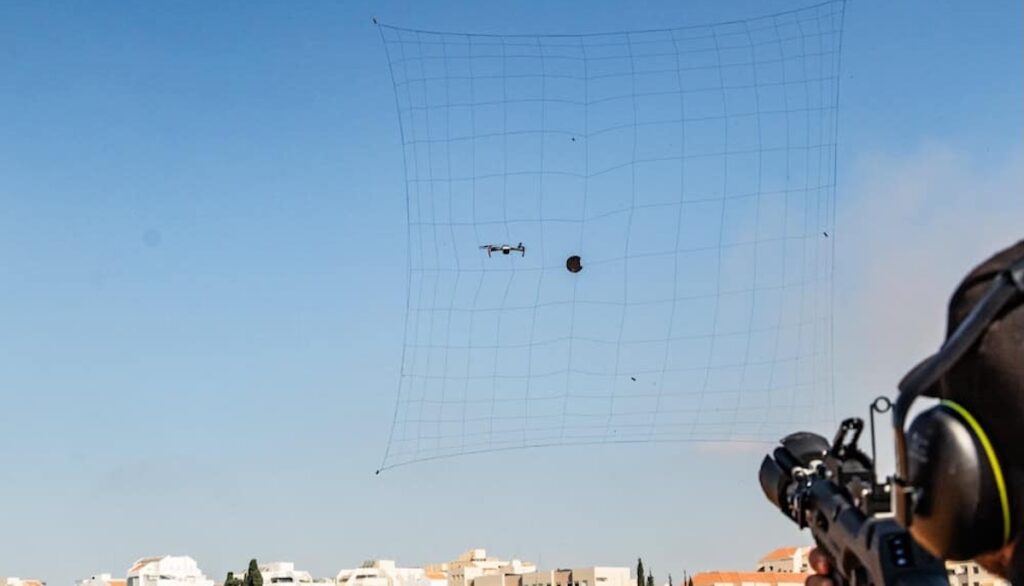
In this Q&A with Defense Advancement, Ariel Alon, CEO of ParaZero Technologies, discusses the operational gap addressed by the company’s DefendAir family of net-based Counter-UAS solutions and the growing importance of close-range, non-explosive interception within layered drone defense.
The discussion comes as inexpensive First Person View (FPV) drones, fiber-optic systems and increasingly autonomous unmanned aircraft reshape the battlefield, prompting military forces to reassess how they protect personnel, vehicles and strategic assets.
As low-cost drones become increasingly accessible and are deployed at greater scale, why must C-UAS solutions be affordable, rapidly fielded and sustainable over repeated engagements?
Drone defense is no longer only a question of whether a force can stop an individual aircraft. The more important question is whether it can continue stopping threats when dozens or potentially hundreds of inexpensive drones are launched over time or from multiple directions.
 An expensive interceptor may be appropriate for certain threats, but it cannot be the only response to a drone costing a fraction of the price. Otherwise, the attacker can create a favorable cost exchange by increasing the number of drones, while even a highly capable defense can be exhausted if every engagement consumes a scarce or expensive interceptor.
C-UAS systems must therefore be affordable enough to deploy in meaningful numbers, simple to operate at the tactical level, rapidly replenished and ready to field within the timescale of the threat.
DefendAir was developed around that reality, providing a repeatable physical defeat capability that can be distributed across personnel, vehicles and protected sites without requiring a premium interceptor for every engagement.
What operational gap was DefendAir designed to close, particularly against fast, low-flying, fiber-optic and increasingly autonomous drones?
DefendAir was designed for scenarios in which a hostile drone has penetrated the outer defensive layers and response time has been reduced to seconds.
Detection and electronic disruption remain important, but may be ineffective against drones emerging from concealment, flying at very low altitude, using fiber-optic control or operating autonomously without an exploitable radio-frequency connection.
DefendAir places a physical defeat capability close to the protected soldier, vehicle or asset, intercepting drones during the terminal phase when warning time is short, electronic defeat is ineffective or the wider C-UAS architecture has already been penetrated.
DefendAir physically intercepts drones using a net rather than relying on explosive effects. What operational advantages does this approach provide?
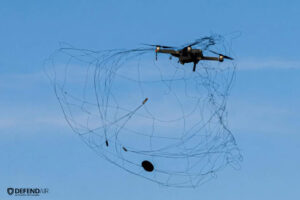
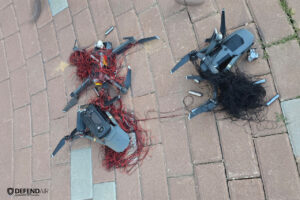
The first advantage is that the defeat mechanism is independent of how the drone is controlled. Fiber-optic, autonomous and radio-controlled drones use different guidance and communications methods, but all depend on propulsion to remain airborne. The net physically entangles that system and prevents the aircraft from continuing toward its target.
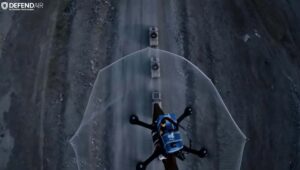 The second advantage is the interception itself. DefendAir creates a broad physical capture area in the drone’s flight path, rather than relying on an explosive warhead or small projectile to achieve a precise impact on a fast, maneuvering target.
This provides a hard-kill result without the blast, fragmentation and rounds downrange associated with many traditional kinetic effectors, which can be important around friendly forces, urban areas, critical infrastructure, storage facilities, airfields and sensitive systems. U.S. counter-UAS guidance includes net capture within the kinetic hard-kill category.
No interception method removes every risk, as the aircraft and payload must still fall to the ground. However, net-based interception can reduce the secondary risks associated with explosive destruction while remaining effective against threats that cannot be jammed.
ParaZero originally developed rapid-deployment drone safety systems. How has that engineering heritage shaped DefendAir?
ParaZero began around 13 years ago by addressing an aviation safety challenge: deploying a lightweight autonomous system quickly and reliably to protect an aircraft and the people or property beneath it.
This required expertise in rapid deployment, aerodynamics, lightweight materials, regulation, environmental conditions, real-time activation and the integration of mechanical, electronic and software components—all directly relevant to net-based interception.
That heritage also shaped the decision to pursue a non-explosive solution. ParaZero approached Counter-UAS from an aviation and systems-engineering perspective, focusing on a controlled physical effect, a compact deployable mechanism and integration across different platforms. This provided a practical foundation for entering the sector without starting from a blank page.
DefendAir is being developed across personal, perimeter, vehicle-mounted and airborne configurations. Why is a common, adaptable architecture essential?
Drone-threat scenarios vary across dismounted personnel, armored vehicles, air-defense batteries and strategic installations, each with different range, reaction-time, coverage and integration requirements.

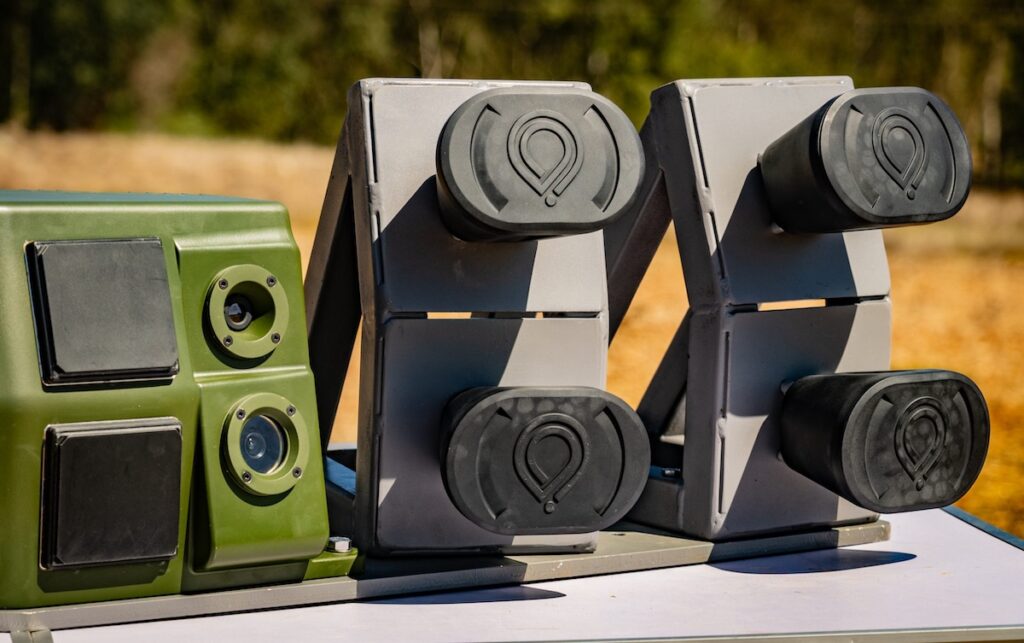
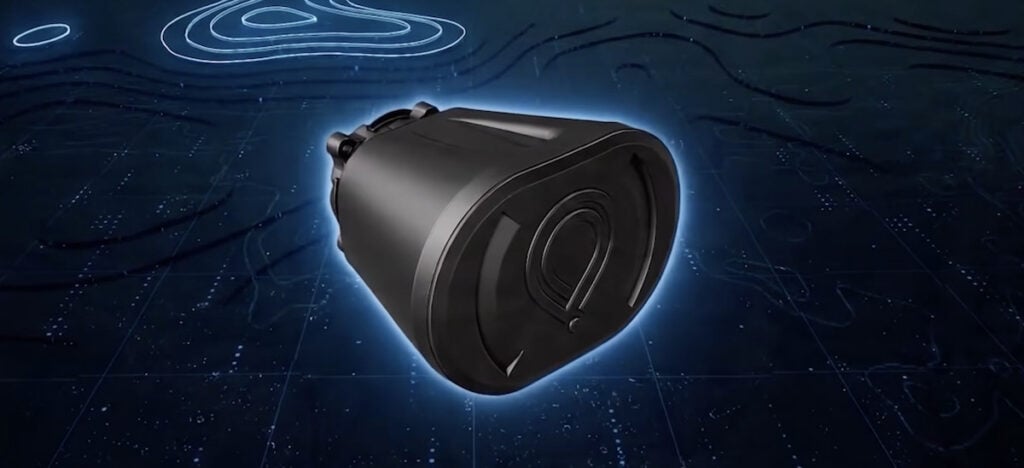
DefendAir Net Pod
At the personal layer, DefendAir provides a compact, manually operated capability. It can also be deployed as a fixed perimeter system connected to external sensors and command-and-control systems, a vehicle-mounted configuration able to operate while moving, or an airborne solution integrated with partner drones.
Each configuration uses ParaZero’s adaptable Net Pod architecture, with net size, materials, launch energy and deployment characteristics tailored to the target, platform and mission. DefendAir can also integrate with existing radar, electro-optical sensors, fire-control and command-and-control systems without replacing the wider architecture.
Why is close-in protection of high-value military assets such as radar systems, air-defense batteries, command posts and armored vehicles becoming a priority?
Recent conflicts have shown that systems protecting a force must also be protected. A low-cost FPV drone can threaten a far more valuable radar, launcher, communications node or armored vehicle, with wider consequences for detection, coordination and area defense.
Because some drones may penetrate outer C-UAS layers or emerge at close range, these assets require dedicated terminal protection. For armored vehicles, limited visibility, high crew workload and seconds-long response times make autonomous cueing and engagement essential. At fixed sites, DefendAir can provide a localized physical layer connected to existing sensors and fire-control systems.
This shifts protection from passive cages or barriers to active interception before impact.
Where does DefendAir fit within a layered C-UAS architecture alongside detection, identification, electronic warfare and other defeat technologies?
There is no silver bullet in Counter-UAS. A resilient architecture must assume that every layer has limitations and that some threats will continue toward the target.
Detection and identification establish the threat, while electronic warfare, long-range kinetic or directed-energy systems, passive protection and operational procedures provide additional defensive layers.
 DefendAir complements these capabilities with a physical defeat layer close to the protected force or asset. It is particularly relevant when a drone penetrates the outer layers, lacks an exploitable radio-frequency link or cannot be intercepted explosively near friendly personnel or sensitive infrastructure.
At the perimeter and vehicle layers, existing radar, electro-optical or other sensors detect and track the threat, while the fire-control architecture cues the net-based effector. DefendAir does not replace the wider C-UAS ecosystem; it provides the controlled physical interception layer that completes it.
What is required to move a last-layer C-UAS system from a successful demonstration to operational deployment at scale?
A successful interception demonstrates that the technology works, but an operational capability requires much more.
The system must be integrated with relevant sensors, C2 networks and fire-control architecture, and qualified for its platform and environment. Vehicle-mounted systems, for example, must withstand shock, vibration, dust, moisture, temperature extremes and continuous field use.
Deployment also requires doctrine, training and clear rules of engagement. Commanders must determine how the system should be positioned, how many launchers are needed and how it fits alongside electronic warfare and other defensive measures.
Sustainment is equally important. Reload pods, maintenance procedures and replacement components must support repeated engagements.
Our focus is therefore on the complete capability: interception, integration, training, reload logistics, manufacturing capacity and long-term support. This is the difference between demonstrating technology and providing a system military forces can depend on in the field.
Thank you for your insights, Ariel. It has been a pleasure learning more about DefendAir and ParaZero Technologies’ approach to close-range, non-explosive interception within layered C-UAS defense.