Showcase your capabilities
If you design, build or supply Sealing Solutions, create a profile to showcase your capabilities and connect with visitors who have an active requirement for your solutions.




Military sealing solutions protect critical interfaces from fluid loss, gas leakage and environmental contamination across aerospace, land and maritime defense platforms. These systems include O-rings, gaskets, rotary shaft seals, rod and piston seals, hydraulic and pneumatic seals, and mechanical face seals.
This category features leading manufacturers of sealing solutions for defense applications, including seals for propulsion, actuation, braking, and electronics.
Read the Technology Overview
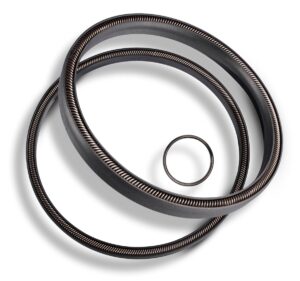
Advanced Sealing, Composite & Connector Solutions for Defense Environments


Non-Linear Analysis Consultancy Developing Advanced Polymer Sealing Solutions for Defense

If you design, build or supply Sealing Solutions, create a profile to showcase your capabilities and connect with visitors who have an active requirement for your solutions.

Military sealing solutions protect critical hardware interfaces against fluid loss, gas leakage, and environmental contamination across aerospace, land, and maritime defense platforms. Because a minor seal failure can impair propulsion, braking, actuation, or crew safety, military components must survive rapid thermal cycling, pressure spikes, severe vibration, and prolonged storage without degrading. Operating environments demand uncompromising reliability, whether protecting flight controls at high altitude or sealing underwater drive shafts against deep hydrostatic pressures.
Designing effective sealing systems requires a holistic engineering approach rather than evaluating polymer chemistry in isolation. System integrators must evaluate gland geometry, mating surface finishes, pressure orientation, and dynamic motion alongside fluid compatibility and thermal limits. Material traceability and repeatable manufacturing remain equally vital, as minor compound variations can significantly affect performance. Consequently, specifications for aerospace and defense sealing solutions treat operational conditions as primary design parameters.
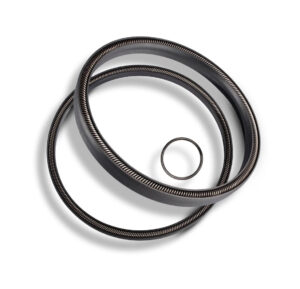
Advanced sealing solutions from Greene Tweed
O-rings provide an economical, compact sealing solution for radial and axial glands by deforming under initial compression to close leakage paths, while system pressure further increases contact stress. However, reliable installation requires precise control over groove dimensions, squeeze percentage, stretch, and gland volume fill to prevent low-pressure leaks or pressure extrusion into clearance gaps. For non-circular or irregular joint geometry, such as access hatches and connector interfaces, custom sealing solutions including molded frame gaskets and specialized extruded profiles ensure uniform contact pressure.
Gaskets establish a reliable barrier across broad mating surfaces such as covers, manifolds, and electronic housings using elastomeric sheets, molded profiles, or metal-elastomer bonded carriers. They must maintain uniform contact stress despite flange deflection, thermal expansion, and severe vibration. Metal-elastomer bonded configurations are particularly useful in complex aerospace covers, where the metallic frame provides structural stability while the elastomeric element handles interface sealing and helps control compression.
Rotary shaft seals retain lubricants, hydraulic oil, or coolant around rotating shafts while excluding water, dust, and abrasive grit across engines, transmissions, pumps, and drivetrains. Dynamic shaft runout, alignment, surface hardness, surface finish, and rotational speed directly influence seal wear life. Military compliant sealing solutions frequently incorporate secondary exclusion lips, V-rings, or labyrinth paths to endure harsh field environments while resisting permanent compression set during extended vehicle storage.
Rod and piston seals operate within hydraulic cylinders, dampers, shock absorbers, and flight-control actuators, separating internal pressure chambers and preventing external fluid loss across moving rods. These dynamic seals balance fluid retention against sliding friction to avoid stick-slip motion and heat buildup that could degrade precision positioning. Complete rod sealing systems integrate primary pressure seals, secondary buffer seals, external wipers to remove grit from retracting rods, and guide rings to absorb side loads.
Hydraulic sealing systems manage dense fluids under high working pressures and severe shock loads, demanding high extrusion resistance, wear endurance, and fluid compatibility. Pneumatic seals manage compressible gases under lighter lubrication, requiring low breakaway friction and reliable retention at low pressures. Profiles and compounds designed for lubricated hydraulic service may perform poorly in dry or lightly lubricated pneumatic service, so seal materials and geometries must be selected specifically for the intended hydraulic or pneumatic duty cycle.
Mechanical face seals isolate fluids between rotating and stationary hardware using two precision-machined flat faces held together by springs or system pressure. These assemblies normally operate with a microscopic fluid film that provides lubrication while limiting leakage to a controlled level. Constructed using materials such as silicon carbide, tungsten carbide, and carbon-graphite, they protect pumps, heavy vehicle final drives, and naval propulsion systems against severe pressure, high surface speeds, and abrasive contamination in applications where flexible lip seals may be unsuitable.
Polymer classifications provide only a starting point, as final performance depends on the compound formulation, durometer, cure system, and manufacturing quality. Materials should therefore be tested against the actual fuels, oils, solvents, temperatures, and environmental conditions encountered in service.
| Material | Characteristics |
| Nitrile Rubber (NBR) | Offers good fuel and oil resistance, mechanical strength, and cost-effective performance, but has limited resistance to ozone and high temperatures. |
| Fluorocarbon Elastomers (FKM) | Provide excellent resistance to fuels, chemicals, and high temperatures, although low-temperature flexibility and fluid compatibility vary by grade. |
| Silicone Elastomers (VMQ) | Retain flexibility across extreme temperatures and resist ozone and weathering, but offer relatively low tear and abrasion resistance. |
| EPDM Rubber | Provides excellent resistance to water, weathering, ozone, and many glycol-based fluids, but is unsuitable for petroleum fuels and mineral oils. |
| Neoprene (Chloroprene / CR) | Delivers balanced resistance to weathering, ozone, flame, and moderate oil exposure without specializing in extreme conditions. |
| Polyurethane (AU/EU) | Offers high tensile strength, wear resistance, abrasion resistance, and resistance to extrusion, although hydrolysis performance depends on the formulation. |
| Fluorosilicone (FVMQ) | Combines low-temperature flexibility with good fuel and oil resistance, but has lower tear and mechanical strength than many other elastomers. |
| PTFE / Filled PTFE | Provides very low friction, broad chemical resistance, and a wide temperature range, but may require energizers and can be susceptible to creep. |
Aerospace sealing solutions are primarily used to contain fuel, lubricants, hydraulic fluid, pressurized air, and hot gases within aircraft systems. They support the reliable operation of engines, fuel circuits, flight-control actuators, landing gear, braking systems, and pneumatic equipment, where even minor leakage can affect performance, safety, or mission availability.
Seals and gaskets also protect cockpits, access panels, avionics, connectors, payloads, and battery compartments from moisture, dust, temperature extremes, pressure changes, and vibration. Applications range from fixed-wing aircraft and rotorcraft to uncrewed aerial vehicles, with designs selected to balance low weight, long service life, fluid compatibility, and dependable performance across changing altitudes and operating conditions.
Reliable military sealing solutions are used throughout armored vehicles, logistics platforms, mobile weapon systems, and uncrewed ground vehicles to retain oils and hydraulic fluids while preventing water, dust, sand, mud, and chemical contaminants from entering critical components. Typical uses include engines, transmissions, axles, suspension systems, steering actuators, hatches, turret rings, and remote weapon stations.
Custom sealing solutions are often required where standard components cannot accommodate unusual housing dimensions, large structural tolerances, heavy shock loads, or prolonged storage. They are also used to maintain protected crew compartments, CBRN overpressure boundaries, electronics enclosures, and amphibious hull penetrations under demanding conditions that may include deep-water fording, decontamination, severe vibration, and limited maintenance access.
Marine sealing solutions are used to maintain watertight and fluid-tight boundaries throughout surface ships, submarines, and uncrewed maritime platforms. They help prevent seawater from entering pressure hulls, propulsion systems, machinery spaces, hatches, bulkheads, sensor housings, and electrical penetrations while also retaining lubricants, fuels, cooling fluids, and hydraulic media.
Naval seals must continue operating under saltwater exposure, hydrostatic pressure, structural movement, corrosion, and repeated pressure cycling. Key applications include propulsion shafts, pumps, ballast and bilge systems, watertight doors, sonar equipment, subsea cable penetrators, battery pods, and payload bays, where leakage can damage equipment, compromise buoyancy, or reduce vessel integrity.
Military standards, detail specifications, aerospace material specifications, and platform-specific requirements may apply at component, equipment, subsystem, or complete-platform level.
Seal designers must translate applicable environmental, electromagnetic, shock, fluid-compatibility, and service-life requirements into appropriate material formulations, geometry, manufacturing controls, and validation testing.
Maintaining rigorous test documentation supports material traceability and repeatable field performance across long defense procurement cycles.
Advanced material engineering and embedded diagnostics are driving performance improvements in modern military sealing applications. Next-generation sealing technologies focus on real-time health monitoring, friction reduction, and rapid logistics support:
Adopting these advanced technologies can enhance platform readiness while reducing maintenance demands for high-value military assets.


 Searching Companies & Products