
Showcase your capabilities
If you design, build or supply Drone Detection Radar, create a profile to showcase your capabilities and connect with visitors who have an active requirement for your solutions.



Drone detection radar systems are specialized surveillance technologies used to detect, track, and classify Unmanned Aerial Systems (UAS), including small, low-flying drones. These systems support military counter-drone operations, airspace monitoring, force protection, and the security of critical infrastructure.
This page features suppliers of C-UAS radar solutions, including Frequency-Modulated Continuous-Wave (FMCW), pulse-Doppler, Active Electronically Scanned Array (AESA), and mechanically scanned radar technologies.
Read the Technology Overview
Manufacturer & Systems Integrator of Deployable Systems for Military, Government & Security Applications

Radar Reinvented: Radars for Counter-UAS, Base & Asset Security, and Portable ISR

If you design, build or supply Drone Detection Radar, create a profile to showcase your capabilities and connect with visitors who have an active requirement for your solutions.

Drone detection radar systems are specialized surveillance technologies designed to detect, track, and help classify Unmanned Aerial Systems (UAS), including small, low-flying drones that can be difficult to detect using conventional air surveillance radar. These systems transmit Radio Frequency (RF) signals and analyze reflected echoes to determine target range, direction, and movement. Drone tracking radar is a key component of military Counter-Unmanned Aircraft Systems (C-UAS), supporting airspace surveillance, force protection, and counter-drone operations.
Modern anti-drone radar systems use technologies such as Frequency-Modulated Continuous-Wave (FMCW) radar, pulse-Doppler processing, and electronically scanned antenna arrays to detect targets with small Radar Cross Sections (RCS). Depending on their architecture, these systems provide continuous surveillance, three-dimensional tracking, and target classification capabilities. Radar tracks can also direct Electro-Optical/Infrared (EO/IR) cameras toward detected objects, while integration with passive RF drone detection sensors, acoustic drone detection systems, and C-UAS command and control systems supports coordinated threat identification and response.
Drone detection radar manufacturers offer several architectures suited to different surveillance ranges, deployment environments, and tracking requirements. These technologies differ in their transmitted waveforms, antenna scanning methods, and signal processing capabilities.
| Radar Type | Operating Principle | Detection Capabilities | Limitations |
| FMCW Radar | Transmits continuously varying frequency signals to estimate target range and radial velocity. | Supports range and Doppler measurement, including small drone detection and tracking. | Performance depends on bandwidth, interference, transmitter leakage, and radar design. |
| Pulse-Doppler Radar | Transmits pulses and uses Doppler processing to distinguish moving targets from clutter. | Supports long-range surveillance, moving target detection, and multi-target tracking. | Low-speed targets may be difficult to distinguish from clutter. |
| CW Doppler Radar | Transmits a Continuous-Wave (CW) signal and measures Doppler frequency shifts. | Detects motion and radial velocity, supporting movement detection and signature analysis. | Conventional unmodulated CW radar cannot directly measure target range. |
| AESA Radar | Uses an Active Electronically Scanned Array (AESA) to steer radar beams electronically. | Enables rapid beam steering, flexible coverage, and simultaneous surveillance and tracking tasks. | Greater complexity, power requirements, and potentially higher costs. |
| PESA Radar | Uses a Passive Electronically Scanned Array (PESA) with a shared transmitter and controlled phase shifters. | Provides electronic beam steering and rapid tracking without mechanical movement. | Less flexible transmit beam control than typical AESA systems. |
| Mechanically Scanned Radar | Physically rotates or moves an antenna to scan the surveillance area. | Provides wide-area coverage, including continuous 360-degree surveillance. | Scan rate, revisit time, and mechanical maintenance requirements. |
| Multistatic and Networked Radar Systems | Use separated transmitters and receivers or coordinate multiple networked radar sensors. | Can extend coverage, reduce blind spots, and improve tracking through multiple observation geometries. | Require reliable communications, coordination, and potentially complex synchronization. |
| Passive Radar Systems | Analyze reflections of external radio transmissions without emitting dedicated radar signals. | Enable aerial target detection using available illumination sources. | Depend on external transmitters, signal geometry, and available transmissions. |
Drone detection radars operate across different frequency bands, influencing antenna size, angular resolution, propagation characteristics, and detection performance. Band selection depends on surveillance range, target characteristics, operating conditions, and spectrum restrictions.
Higher frequencies can support smaller antennas and finer angular resolution for a given antenna size, while range resolution depends primarily on signal bandwidth. Overall detection performance also depends on transmitter power, antenna gain, receiver sensitivity, target RCS, and environmental clutter.
Military installations use drone detection radar to monitor surrounding airspace for unauthorized UAS activity. Fixed-site systems provide continuous surveillance of approach routes, perimeter areas, and low-altitude airspace, supporting early warning and personnel protection. Border installations also use radar to monitor aerial activity across remote terrain.
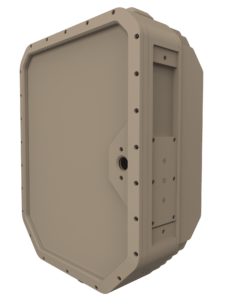
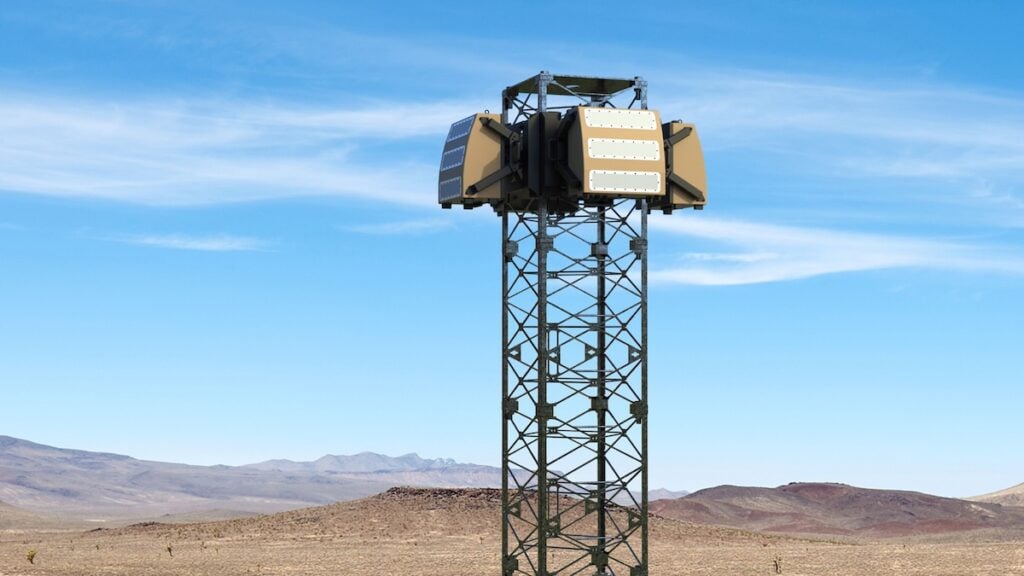
EchoShield Drone Detection Radar System by EchoDyne
Vehicle-mounted and portable UAS detection radar systems support tactical units facing drones used for reconnaissance, targeting, or attack. Compact sensors can be integrated into military vehicles, mobile command platforms, and deployable C-UAS systems. Low Size, Weight, and Power (SWaP) requirements are important where installation space and electrical power are limited.
Naval platforms use drone detection radar to identify aerial threats approaching warships, patrol vessels, and maritime infrastructure. Systems must operate despite sea clutter, vessel movement, and water reflections. Shipborne C-UAS radar supplements existing defense sensors, while coastal installations help protect naval bases, harbors, and strategic approaches.
Counter-drone radar integrates with Short-Range Air Defense (SHORAD) systems to provide detection, tracking, and target information. Radar complements other air defense sensors by identifying low-altitude threats and supplying tracking data to command and control systems. Depending on track quality and system architecture, this information can support interceptor cueing and other authorized C-UAS responses.
Drone tracking radar supports surveillance of simultaneous threats, including coordinated swarms and One-Way Attack (OWA) drones. Advanced processing helps distinguish closely spaced targets, maintain individual tracks, and monitor approaching formations. High tracking capacity, frequent updates, and reliable sensor fusion are important when responding to numerous drones.
Airports, military airfields, ports, and maritime facilities use drone detection radar to monitor restricted airspace. Because radar does not depend on onboard drone communications, it can detect both remotely piloted and autonomous aircraft. Integration with EO/IR cameras and other sensors supports target verification before further action.
Government facilities, defense installations, and energy infrastructure may use fixed drone detection radar systems for continuous monitoring. Sensors can cover specific approach corridors or operate in networks providing overlapping surveillance coverage, generating alerts and tracking potential aerial intrusions.
Portable anti-drone radar systems support temporary surveillance around military exercises, high-security events, and sensitive locations. Deployments may use vehicle-mounted sensors, telescopic masts, and self-contained power supplies. Rapid setup, compact dimensions, and security system compatibility are key considerations.
Advances in radar hardware, digital signal processing, and target classification are improving C-UAS radar capabilities, particularly for small target detection, mobile deployments, and complex operating environments.
As drone threats become smaller, more numerous, and increasingly autonomous, manufacturers are developing radar systems with improved target discrimination, faster processing, and greater integration with military air defense networks. These advances support surveillance across fixed, mobile, and maritime C-UAS installations.


 Searching Companies & Products