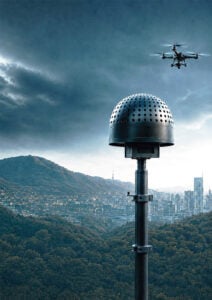
Acoustic drone detection systems are passive sensing solutions that identify UAVs by analyzing noise signatures from rotors, motors, and flight dynamics. Used within counter-UAS architectures, they support low-altitude threat awareness where RF-silent or low-RCS drones may be difficult to detect with active sensors alone.
This guide covers drone detection systems and solutions for fixed sites, mobile assets, borders, airbases, and maritime facilities.
If you design, build or supply Acoustic Drone Detection, create a profile to showcase your capabilities and connect with visitors who have an active requirement for your solutions.
Overview of Acoustic Drone Detection Systems for Defense & Security Applications
Overview by
William Mackenzie
Updated:
Introduction to Acoustic Drone Detection
Acoustic drone detection systems serve as a critical, emission-free capability within modern counter-UAS architectures. By continuously analyzing the acoustic detection of drone noise signatures from rotors and motors, a real-time acoustic drone detection system identifies low-altitude, autonomous, or RF-silent threats that routinely evade traditional radar. When integrated into a multi-sensor framework, these acoustic sensors for drone detection pick up the slack by listening through environmental clutter and providing early directional cues to accelerate target acquisition.
This acoustic based drone detection method operates completely passively, ensuring sensor survivability on the battlefield. Field deployment configurations range from a single standalone acoustic drone detector to highly resilient networks of military acoustic sensors that isolate targets using advanced acoustic drone detection algorithms.
Defense Applications of Acoustic Drone Detection Systems
Defense use cases differ fundamentally from civil security deployments because military acoustic technology must operate reliably near generators, heavy tactical vehicles, weapons systems, radios, radar emitters, ship machinery, and active battlefield operations. Acoustic detection systems designed for these environments must isolate target signatures under exceptionally harsh noise conditions.
Forward Operating Base Protection
Forward operating bases rely heavily on persistent perimeter awareness to defend against low-altitude reconnaissance and loitering munitions. Deploying an acoustic sensor drone detection node array around the outer security boundary, on masts, or on temporary elevated structures allows forces to secure blind spots. These nodes alert operators to a potential approach, providing an immediate bearing line to cue thermal cameras or localized radar systems. In high-threat areas, long-term acoustic signal detection also supports pattern-of-life analysis by logging repeated approach vectors or drone launch directions.
Airbase and Flight Line Security
Airbases face a dual risk from hostile surveillance and direct interference with flight operations. While acoustic radar or microphone arrays can effectively protect runways, fuel farms, and hardened shelters, the flight line environment introduces severe acoustic masking from aircraft engines, auxiliary power units, and ground support equipment. To counteract this, military acoustic sensors must be tightly integrated into a fused surveillance picture. Their utility peaks during quiet hours, at night, or around remote perimeters where structural obstructions create radar blind zones.
Border Surveillance and Restricted Area Monitoring
Border security involves vast, unmonitored perimeters with rugged terrain and minimal infrastructure. Unattended acoustic detection of drones provides an excellent solution for monitoring valleys, ridgelines, and choke points where active tracking is logistically unfeasible. Because these passive sensors are highly compact, they can be easily concealed from adversarial observation. Networked arrays allow operators to determine if a target is merely passing through the area or moving deliberately toward a restricted installation.
Convoy, Patrol and Mobile Asset Protection
Protecting mobile assets is one of the toughest challenges for acoustic drone detection systems due to the self-noise generated by vehicle engines, tracks, and tires. Implementing a vehicle-mounted acoustic drone detector requires sophisticated vibration isolation and adaptive filtering algorithms that interface directly with the platform’s engine telemetry and heading data. These systems are highly effective during convoy halts, checkpoint operations, or when integrated onto specialized, low-noise support vehicles within a tactical column.
Naval Base, Harbor and Shipboard Perimeter Monitoring
Naval installations and docked vessels require reliable protection against waterborne and aerial reconnaissance threats. Marine-grade acoustic sensor for drone detection equipment helps secure piers, shipyards, and restricted maritime corridors. Deploying these systems directly on active vessels introduces complex variables like wave impact noise, wind shear over superstructures, and salt-fog corrosion. Consequently, ruggedized construction and highly specialized acoustic enclosures are mandatory for shipboard operations.
Critical Infrastructure and Homeland Defense
National security agencies increasingly deploy real-time acoustic systems for UAV detection to safeguard power stations, communication hubs, and temporary protected airspace during high-profile events. Because acoustic sensing does not transmit radio frequencies, it avoids disrupting congested urban RF environments. For fixed critical infrastructure, engineering teams prioritize long-term weatherproofing, secure network infrastructure, and direct integration into existing security operations centers.
Components of Acoustic Drone Detection Systems
A defense-grade acoustic drone detection system requires a comprehensive architecture comprising specialized hardware, precise timing synchronization, and robust edge processing to handle data streams efficiently.
Component
Primary Function
Key Technical Considerations
Microphones and Transducers
Capture environmental acoustic signals
Requires ruggedized MEMS arrays with wide dynamic range and deep environmental sealing.
Sensor Node Architecture
Localizes hardware deployment footprint
Balances localized, single-node bearing warning against multi-node distributed triangulation.
Array Geometry & Aperture
Defines angular tracking resolution
Optimizes baseline spacing between microphones to avoid spatial aliasing across target frequencies.
Edge Processing Hardware
Conducts localized data computation
Utilizes dedicated DSPs and AI accelerators to run neural networks without bandwidth bottlenecks.
Signal Processing & Drone Classification Capabilities
Isolating a faint drone signature from a chaotic environmental noise floor requires an advanced, multi-stage digital signal processing pipeline.
Noise Filtering and Acoustic Pre-Processing
Initial pre-processing removes low-frequency wind noise, controls sensor gain, and dampens sudden impulsive sounds like gunfire or vehicle doors closing. This digital filtering must be highly adaptive. Aggressive filtering can inadvertently erase the weak harmonic structures of a distant drone, meaning the system must be calibrated using realistic battlefield data rather than pristine laboratory recordings.
Beamforming and Spatial Filtering
Beamforming mathematically combines the inputs from multiple microphone channels to focus the system’s sensitivity in a specific direction while suppressing ambient noise from other angles. This spatial filtering significantly boosts the signal-to-noise ratio, enabling the system to calculate an accurate direction of arrival even when a drone is operating at the absolute limit of its acoustic range.
Time Difference of Arrival (TDOA) and Angle of Arrival (AOA) Methods
Distributed networks rely on Time Difference of Arrival (TDOA) and Angle of Arrival (AOA) math to pin down target locations. TDOA calculations demand hyper-accurate clock synchronization across all nodes, often achieved via GPS-disciplined oscillators or precision time protocols. When multiple nodes achieve stable AOA lines, the master C-UAS software can cross-reference the vectors to generate real-time spatial tracks.
Feature Extraction and Spectral Profiles
To classify a target, the system converts raw audio into visual spectrograms and Mel-frequency cepstral coefficients (MFCCs). These formats highlight distinctive rotor harmonics, blade-pass frequencies, and shifts caused by maneuvering. Because a drone’s acoustic signature changes dramatically when it climbs, turns, or carries a heavy payload, classifier algorithms must be trained on exhaustive datasets covering multiple aspect angles and weather conditions.
Confidence Scoring and False Alarm Management
A reliable acoustic drone detection system must separate legitimate threats from everyday noise sources like lawnmowers, birds, or passing motorcycles. Modern systems assign an real-time confidence score based on signal stability, harmonic structure, and multi-node correlation. This prevents operator fatigue from frequent nuisance alarms while ensuring the track initiation logic activates immediately when a credible threat matches known drone behavior profiles.
Integration with Broader C-UAS Networks
Acoustic technology reaches its full potential when seamlessly woven into a unified command-and-control network.
Acoustic Sensing with Radar
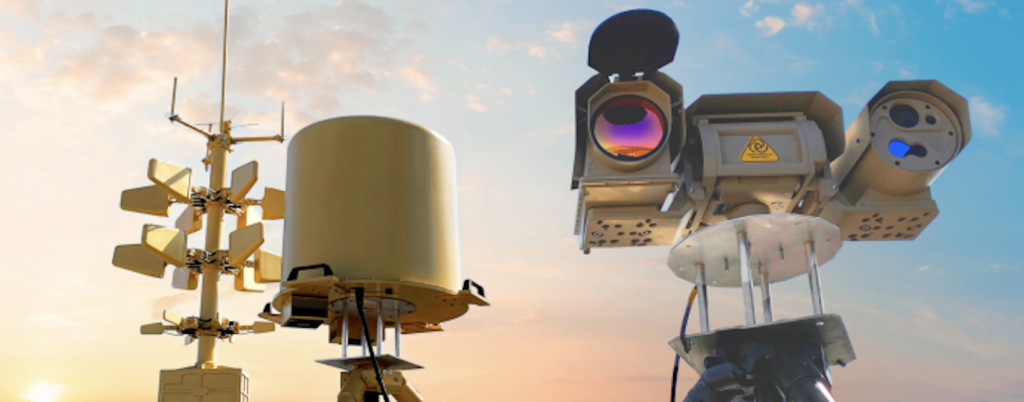
Detection radar and acoustic sensors possess highly complementary capabilities. Active radar tracks range and velocity over wide areas but struggles with slow, low-RCS targets near the ground. An acoustic radar system or distributed microphone network provides continuous, passive classification within those exact radar blind zones. When a radar return correlates with an acoustic detection vector, tracking confidence spikes instantly.
Acoustic Cueing for EO/IR Cameras
Electro-optical and infrared (EO/IR) cameras are the gold standard for visual target confirmation before taking mitigation action. However, manually scanning a wide sky or complex skyline is incredibly slow. Real-time acoustic systems for UAV detection can instantly slew a camera platform to the exact bearing of an incoming threat, drastically reducing target acquisition time at night or in adverse weather.
Acoustic and RF Detection Synergy
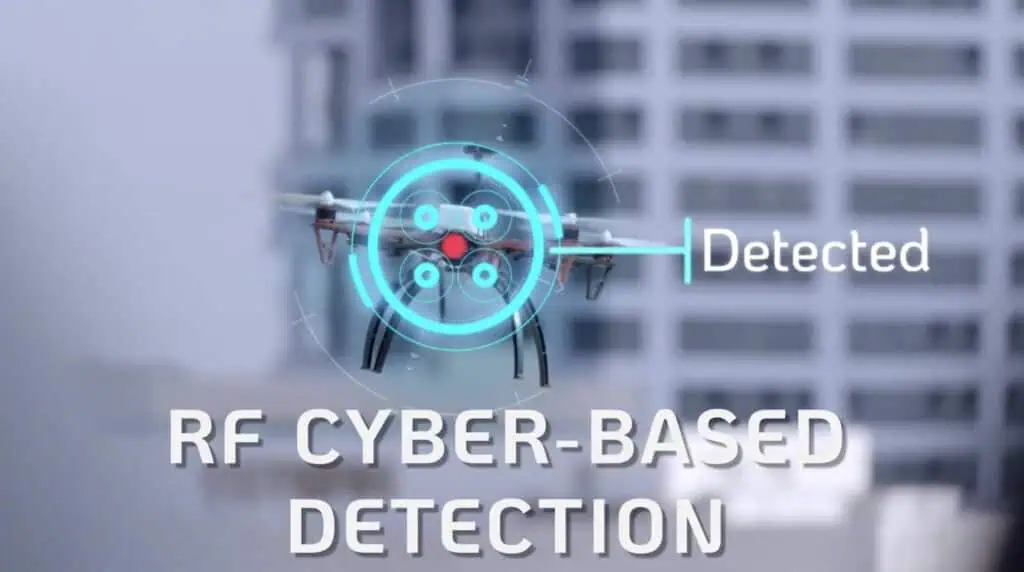
RF drone detection sensors excel at identifying control links and locating the operator on the ground, but they are blind to autonomous drones flying on pre-programmed coordinates or using fiber-optic tethers. Because acoustic sensors listen to physical propulsion rather than radio emissions, combining RF and acoustic detection ensures comprehensive coverage against both cooperative and non-cooperative threats.
Target Handover to Mitigation Systems
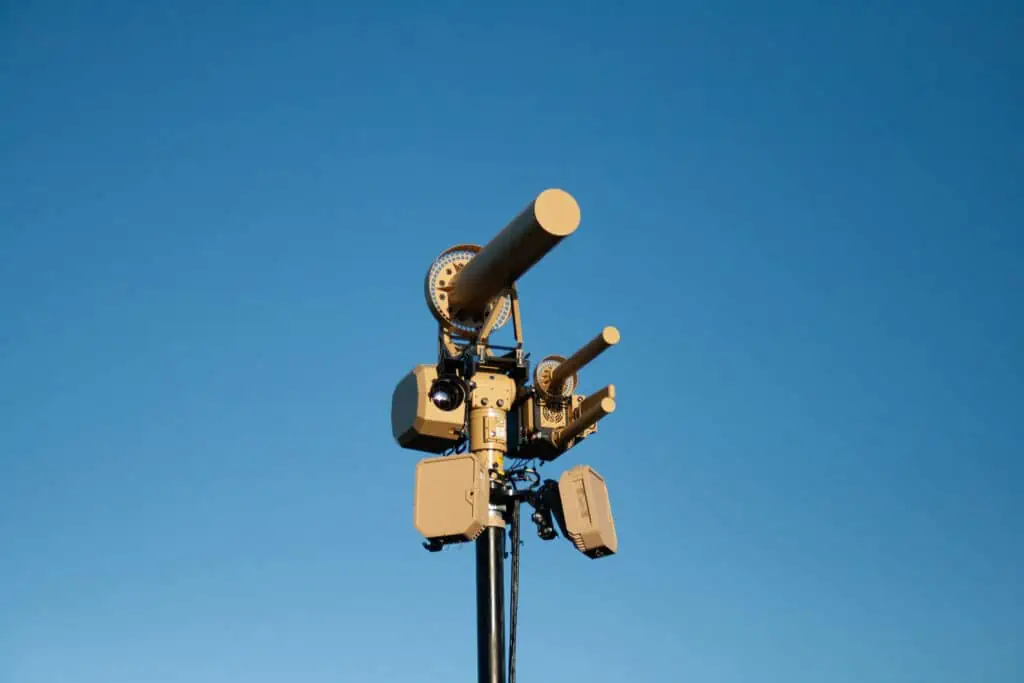
Once a track is established, the acoustic system passes actionable metadata to electronic warfare or kinetic mitigation systems. This data includes the target’s bearing, estimated location, and classification confidence. While a directed-energy weapon needs hyper-precise fire-control tracking, directional RF jammers or GPS denial systems can easily neutralize a threat using the sector cues provided by an acoustic array.
Military Standards, Testing & Qualification
Military hardware must undergo rigorous standardization and testing protocols to transition successfully from a laboratory concept to an operational defense asset.
Environmental Qualification: Hardware must endure extreme temperatures, high humidity, blowing sand, and intense vibration without losing tracking accuracy.
MIL-STD-810 Testing: Evaluation focusing heavily on sand exposure, salt fog, rain intrusion, and icing ensures windscreens and seals maintain baseline calibration.
MIL-STD-461 EMI/EMC: Hardware processing units must not emit interfering signals and must remain fully functional near high-power battlefield jammers and active radar transmitters.
Satisfying these robust military criteria ensures that passive acoustic sensors remain resilient and reliable when deployed in unpredictable, highly contested combat environments.
Emerging Trends in Acoustic Drone Detection
The rapid evolution of artificial intelligence and edge computing is driving significant technological breakthroughs in the counter-unmanned surveillance sector.
AI-Enhanced Classification: Modern neural networks treat acoustic spectrograms as visual data to improve target classification accuracy across unfamiliar background environments.
Multi-Sensor Deep Fusion: Future C-UAS architectures process acoustic, RF, optical, and radar inputs through a single software engine to generate one high-confidence track.
Autonomous Perimeter Monitoring: Low-power distributed networks maintain a silent watch along remote borders, alerting central networks only when verifying a true threat.
Swarm Identification Methods: Next-generation processing leverages advanced blind source separation techniques to untangle overlapping frequencies from multiple simultaneous targets.
These advancing capabilities will allow future defense forces to counter increasingly sophisticated, coordinated, and autonomous aerial threats.
D-Fend Solutions presents a detailed review of five principal drone detection technologies, highlighting technical limitations, environmental influences, and integration requirements for enhanced counter-UAS performance
Indra has coordinated Spanish involvement in the JEY-CUAS project, defining how to operate with the systems in different scenarios and has analyzed the most advanced technologies to detect and neutralize hostile UAVs in military environments
With the integration of new sensors, Chess Dynamics' C-UAS system now capable of detecting targets at maximum distance, locating with 4D coordinates, and ensuring accurate and stable tracking
Deployed by U.S. government agencies both within the continental U.S. and abroad, Dedrone’s smart airspace security protects physical assets, people, and information from small unmanned aerial system attacks and intelligence gathering
The latest defense technology news, straight to your inbox.
Get our weekly roundup of technology developments, new products and industry news.
THANK YOU FOR SIGNING UP
Thanks for joining us. Check your inbox.
We've sent you an email. Click the confirmation link to complete your subscription to the weekly eBrief. In the meantime, explore the latest news, suppliers and technologies on DA.
Advancing Defense Capability Through Strategic Collaboration
Defense Advancement works with major OEMs to foster collaboration and increase engagement with SMEs, to accelerate innovation and drive defense capabilities forward.