Showcase your capabilities
If you design, build or supply Marine Searchlights, create a profile to showcase your capabilities and connect with visitors who have an active requirement for your solutions.




Marine searchlights are high-intensity illumination systems used aboard naval vessels, patrol boats, and commercial ships for maritime surveillance, vessel identification, search and rescue, and nighttime navigation. Available as LED, xenon, and halogen systems, naval searchlights provide focused illumination for maritime security, interdiction, boarding operations, and hazard detection.
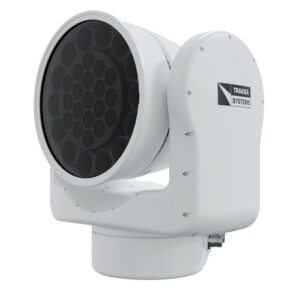
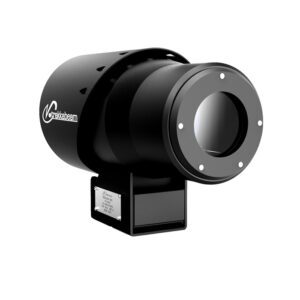
This category features suppliers of marine and naval searchlights, offering configurations including fixed-mount, remote-controlled, and stabilized searchlights.
Read the Technology Overview
Integrated Vision, Imaging & Illumination Technologies for Airborne, Land & Maritime Missions

If you design, build or supply Marine Searchlights, create a profile to showcase your capabilities and connect with visitors who have an active requirement for your solutions.
No products available No products available from suppliers based in . View products from all territories

Marine searchlights are high-intensity illumination systems designed for search, observation, identification, and navigation support aboard naval vessels, patrol boats, commercial ships, and other marine platforms. Available in LED, xenon, and halogen configurations, these systems produce concentrated beams for long-range illumination, while marine floodlights provide wider coverage for decks, working areas, and nearby surroundings.
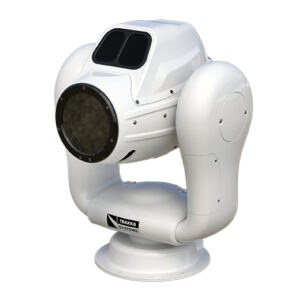
A marine spotlight may feature fixed mounting, manual adjustment, remote-controlled pan and tilt, or stabilization to compensate for vessel motion. Naval searchlights can also integrate with Electro-Optical/Infrared (EO/IR) sensors and surveillance systems for coordinated illumination. Selection depends on beam intensity, optical performance, electrical compatibility, mounting arrangements, and environmental protection.
Marine and naval searchlights are available with several light-source technologies and mounting configurations, each with different performance characteristics and operational requirements.
Marine searchlights support nighttime search and rescue operations by illuminating people, floating objects, rescue equipment, and nearby vessels. High-intensity boat searchlights help crews scan the surrounding water, while adjustable beams provide broader coverage during initial searches and concentrated illumination during recovery. Stabilized searchlights are particularly useful when vessel motion makes it difficult to maintain illumination in a selected direction. Dedicated deck spotlights can also illuminate recovery stations, ladders, and embarkation areas.
Naval searchlights are used during maritime patrol, interception, boarding, and vessel identification operations. Concentrated visible-light beams allow crews to illuminate vessel markings, deck activity, and other observable features when conditions permit. On selected naval and coast guard platforms, searchlight positioning can be coordinated with radar or EO/IR surveillance systems, allowing operators to direct illumination toward previously detected contacts. Remote control supports operation from protected bridge or command positions.
Marine spotlights support security patrols around ports, naval bases, restricted waterways, and coastal infrastructure. Patrol vessels use directional illumination to inspect small boats, monitor approaches to secured areas, and support personnel during nighttime security operations. High power marine searchlights provide concentrated illumination over longer distances, while marine floodlights are better suited to nearby berths, decks, and working areas. Searchlight positioning must also account for glare affecting bridge personnel, nearby vessels, and surveillance cameras.
A ship searchlight can assist with visual assessment of nearby hazards, unlit structures, floating debris, and shoreline features during nighttime operations. Boat spotlights also support close-quarters maneuvering, docking, and identification of objects outside the coverage of fixed lighting. Adjustable beams allow crews to illuminate specific areas without unnecessarily lighting the surrounding environment. During ship-to-shore operations, searchlights can illuminate landing points, personnel transfer areas, and coastal infrastructure. Their use must not obscure prescribed navigation lights, impair visibility, or create confusion with other vessels’ lights.
Marine searchlights may be subject to environmental, electrical, Electromagnetic Compatibility (EMC), and vessel-specific requirements. Applicable standards depend on the installation, vessel classification, operating environment, and procurement specification.
Manufacturers should provide relevant qualification records, test reports, and environmental ratings to demonstrate compliance with the requirements specified for a particular installation.
Selecting a marine searchlight requires consideration of the vessel’s operating profile, illumination requirements, available mounting space, and electrical interfaces. The following criteria support comparisons between marine and naval searchlights for different applications.
| Selection Criteria | Key Considerations |
| Required Illumination Range and Beam Intensity | Compare peak beam intensity in candela, beam divergence, and target illuminance in lux at specified distances. Advertised illumination range should include the illuminance threshold used. |
| Mounting and Installation Considerations | Assess deck, bridge, superstructure, and mast mounting locations, including structural support, field of movement, cable routing, and maintenance access. |
| Searchlight Size and Vessel Compatibility | Compare assembly dimensions, weight, power demand, and mechanical clearances against available space and vessel characteristics. Compact boat searchlights may be preferable for smaller patrol craft. |
| Pan and Tilt Coverage | Check horizontal and vertical movement limits, positioning speed, movement resolution, and restrictions caused by surrounding vessel structures. |
| Stabilization Requirements | Determine whether compensation for vessel roll and pitch is necessary, considering operating sea states, stabilization accuracy, and pointing response. |
| Remote Control and System Integration | Evaluate joystick controls, multiple control stations, position feedback, and compatibility with bridge equipment, EO/IR cameras, or surveillance control systems. |
| Environmental Protection and Corrosion Resistance | Verify enclosure IP ratings, operating temperature, corrosion-resistant materials, protective coatings, and relevant shock, vibration, and EMC qualification. |
For naval and commercial marine procurement, suppliers should provide measured optical specifications, electrical interface documentation, mounting drawings, and applicable environmental test evidence. These details support direct comparison between LED marine searchlights, conventional lamp-based systems, and stabilized or remote-controlled configurations.


 Searching Companies & Products