


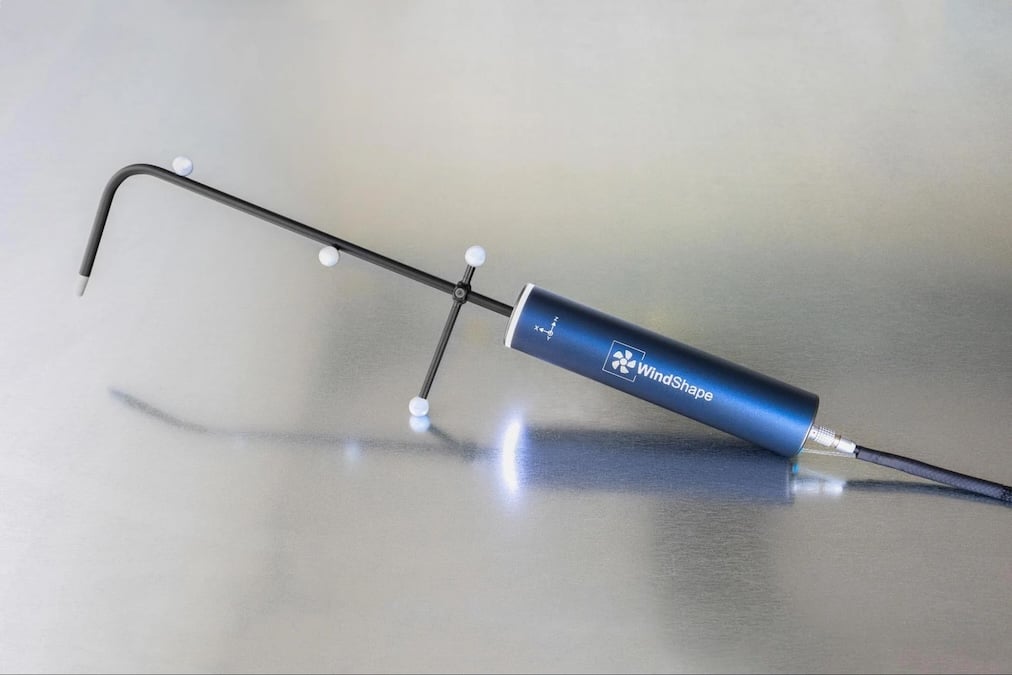
Accurately measuring turbulent airflow and wind shear is an important consideration in drone testing and wind tunnel research. Tyto Robotics examines how its WindProbe 3D combines multi-hole pressure sensing, motion tracking, and real-time visualization to map three-dimensional wind profiles and provide quantitative data for evaluating airflow conditions. Read more >>
The WindProbe uses a five-hole pressure sensor with a 40-degree acceptance cone to measure wind velocity vectors across the x, y, and z axes. Operating at an acquisition frequency of 200 Hz, the probe captures rapid changes in airflow and can measure wind speeds as low as 1 m/s and up to 60 m/s, depending on the model.
When paired with motion capture cameras, markers on the probe enable its position to be tracked in 3D space, allowing airflow measurements across wind tunnel test sections and around objects such as propellers, airfoils, and drones.
Using WindVision software, measurements can be visualized in real time, with adjustable spatial resolution and the ability to measure velocity vectors in volumes as small as 1 cm³. The article also demonstrates a wind shear simulation using a 2×2 WindShaper configuration, with the left fan modules operating at 2 m/s and the right modules at 6 m/s. The WindProbe maps the resulting velocity gradient, providing a visualization of the simulated airflow before a drone is flown through the conditions to assess its response and practice recovery.
The full article, How to Measure Wind in 3D With the WindProbe 3D, examines the WindProbe’s measurement principles, motion tracking capabilities, and software workflow, including how three-dimensional airflow mapping can be applied to wind tunnel testing and controlled drone flight exercises.