OptoMedia Technology explores how fiber optic transmission can support defense systems where longer-distance communication, resistance to electromagnetic interference, compact integration and reliable operation in demanding environments are critical.
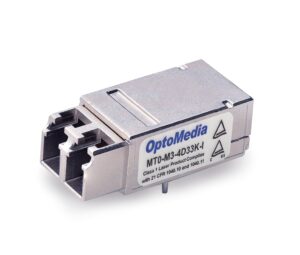
10G Multi-Mode Mini SFF
Fiber transmits data optically rather than electrically, making it naturally resistant to electromagnetic interference. This can help maintain stable signal performance around radios, motors, power equipment and other sources of electromagnetic interference.
Unlike conductive copper cabling, optical fiber also does not carry electrical signals along the transmission medium, reducing associated electromagnetic emissions and providing an additional benefit where sensitive data transmission is important.
OptoMedia positions its ruggedized optical modules for government and defense systems including data centers, central control centers and C4I infrastructure, where reliable transmission of critical operational and sensitive data is important.
Longer-Distance Connectivity
A key advantage of fiber over traditional Ethernet over copper is transmission distance. Fiber can maintain reliable communication across much greater distances, making it well suited to distributed systems, remote equipment installations and command infrastructure.
OptoMedia’s 1.25G Single-Mode Mini SFF and 10G Single-Mode Mini SFF both support optical links up to 10 km, providing compact connectivity options where longer transmission distances are required.
Supporting SWaP-Constrained Systems
Optical connectivity also needs to fit within platforms where Size, Weight and Power (SWaP) are tightly constrained.
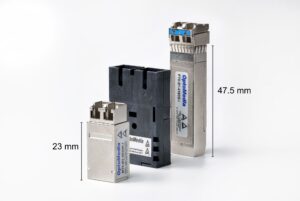 With a length of less than 30 mm, Mini SFF transceivers are nearly 50% shorter than standard SFP transceivers, making them suitable for space-constrained designs. Direct Printed Circuit Board (PCB) mounting removes the need for a conventional SFP cage, helping reduce system footprint, component count and weight.
Rugged Integration
Military equipment may also be exposed to temperature extremes, vibration, shock and moisture.
Selected OptoMedia Mini SFF models support case temperatures up to 95°C, while optional conformal coating can provide added protection against humidity and moisture. The soldered PCB connection can also help reduce movement, loosening and accidental disconnection under vibration or shock.
The fixed design provides an additional system-security benefit. Because the Mini SFF is not intended to be easily removed or replaced, it can help reduce the risk of accidental removal, tampering or unauthorized module replacement.
Available in 1G, 10G and 25G versions, OptoMedia’s Mini SFF portfolio demonstrates how the advantages of fiber optic transmission can be combined with compact, rugged integration for military and other mission-critical systems.