
Tocaro Blue outlines the core challenges of working with maritime radar, and how its ProteusCore™ software resolves them using machine learning and proprietary data.
Radar remains an essential sensor for maritime operations, but interpreting its outputs in real-world conditions is inherently complex. Slow scan rates mean that when viewing a single frame, it can be difficult to distinguish real targets from noise. This is further complicated by side lobe effects, multipath interference, and sea clutter such as wake, which can obscure or distort detections.
Target separation is another key limitation. When objects move close together, such as a vessel passing near a marker, traditional radar systems may blur them into one target, making it harder to distinguish between them. At the same time, manual tuning can be difficult for operators, as high gain can cause real targets to be lost in noise, while low gain can result in missed detections. In dynamic sea states, this requires continuous attention, with changing conditions such as rain often forcing operators to restart the tuning process.
Machine Learning-Driven Radar Processing

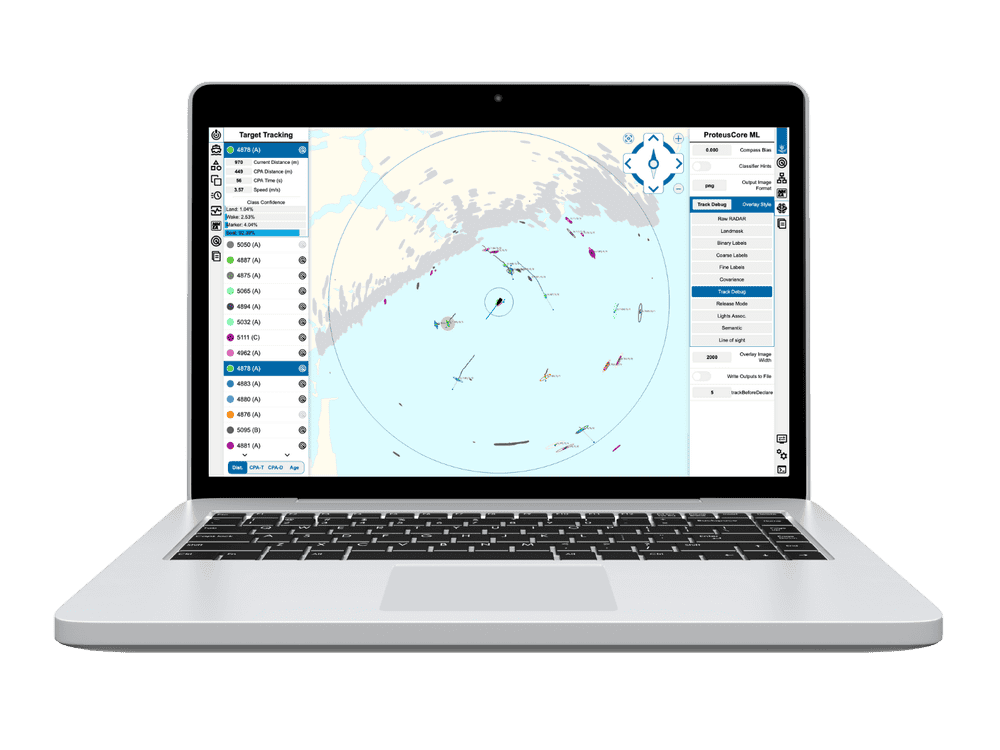
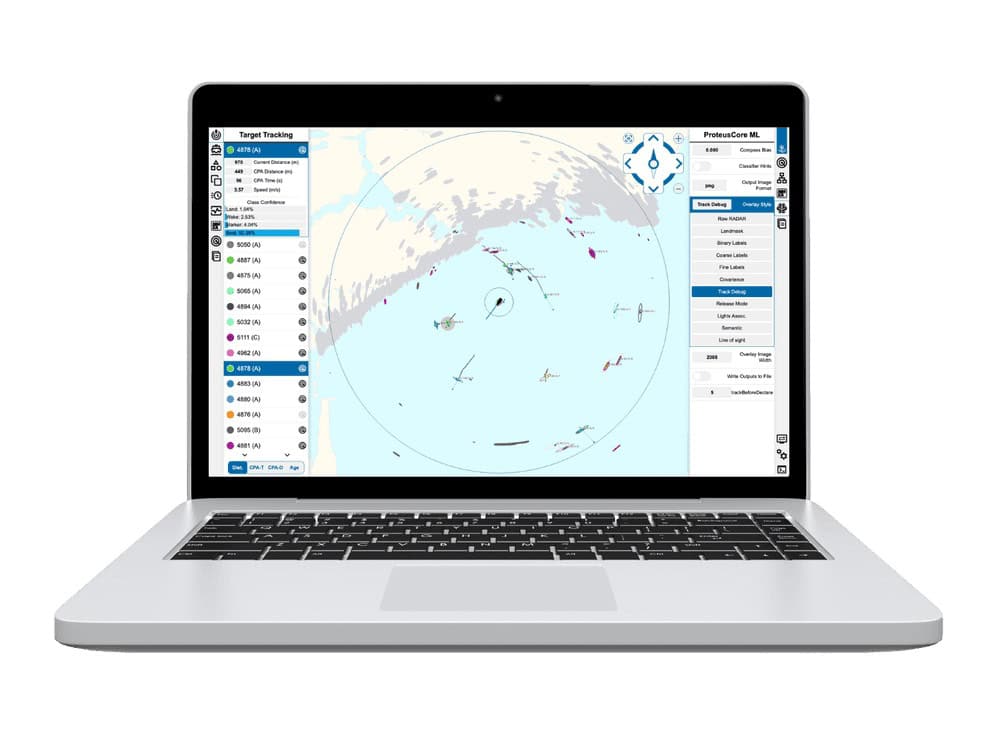
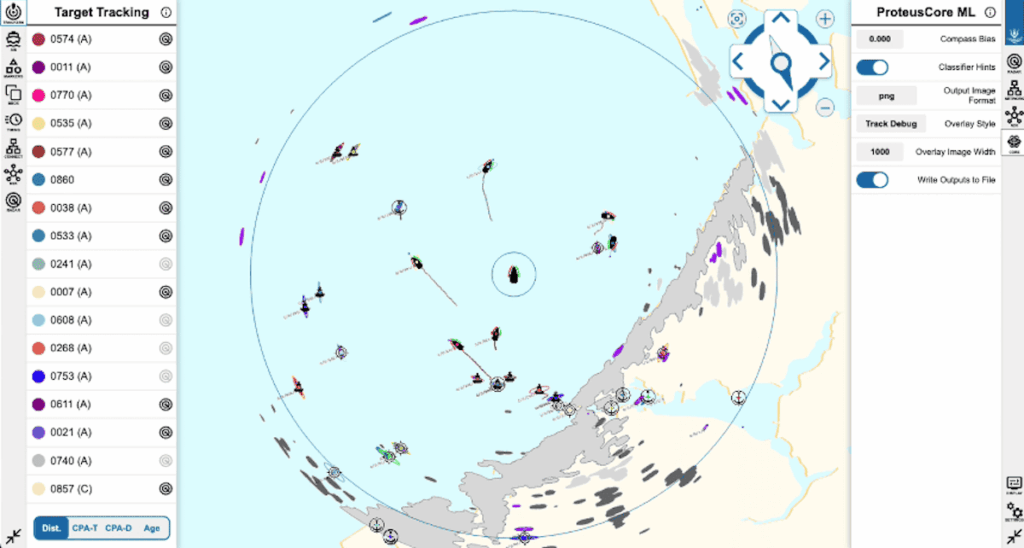
ProteusCore™ radar processing software.
ProteusCore applies Machine Learning (ML) to address these challenges without the need for operator intervention. A key enabler is Tocaro Blue’s proprietary dataset of over 3 million labeled radar frames, developed in the absence of publicly available radar data, which is used to train ML models for detection and classification.
The software accounts for slow scan rates by predicting target positions based on their last known heading and speed, while maintaining target separation so that objects can be tracked individually even when in close proximity. ProteusCore can classify detections with confidence as vessel, marker, land, or noise, typically within five scans, or approximately 5-10 seconds.
A key advantage is the removal of manual tuning through ProteusCore’s ML-based AutoFocus feature, which dynamically adjusts gain and range in real time based on environmental conditions. By filtering out noise and clutter, including over land, the system ensures that only relevant targets are presented, eliminating the need for constant user intervention.
By combining large-scale proprietary data with predictive tracking, automated tuning, and rapid classification, ProteusCore enables more reliable target detection and clearer identification of objects in complex maritime environments.
Further information about the ProteusCore™ radar processing software is available here >>