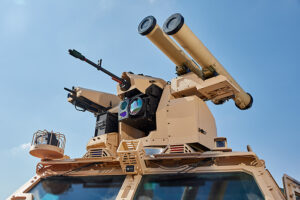
High Power Microwave (HPM) weapons are directed-energy systems that emit concentrated electromagnetic energy to disrupt or damage susceptible electronics in drones and other unmanned systems. Used primarily for Counter-Unmanned Aircraft Systems (C-UAS) operations, HPM weapons provide non-kinetic capabilities for engaging individual UAS and coordinated drone swarms.
This guide covers high power microwave anti-drone systems for military base protection, convoy defense, and Short-Range Air Defense (SHORAD) applications.
If you design, build or supply High Power Microwave (HPM) Weapons, create a profile to showcase your capabilities and connect with visitors who have an active requirement for your solutions.
Overview of High Power Microwave Anti-Done Systems for Military Operations
Overview by
William Mackenzie
Updated:
Introduction to High Power Microwave Weapons
High Power Microwave (HPM) weapons use concentrated electromagnetic energy to disrupt, degrade, or damage electronic systems. These directed-energy weapons generate high-intensity microwave emissions that couple with electronic circuits and components, potentially causing temporary malfunctions or permanent damage. Unlike conventional Radio Frequency (RF) jammers, which primarily interfere with communications or navigation signal reception, HPM weapon systems can induce electrical disturbances within a target’s onboard electronics.
Military HPM weapons are particularly relevant to Counter-Unmanned Aircraft Systems (C-UAS) operations, providing a means of defending against individual drones and coordinated swarms of UAS. Microwave drone defense systems offer a non-kinetic engagement capability without consuming conventional ammunition for each target. Their effectiveness depends on microwave output characteristics, engagement geometry, target vulnerability, and available electrical power.
Types of High Power Microwave Weapons
High power microwave weapons employ different microwave generation technologies, waveforms, and system architectures. These characteristics influence electromagnetic output, power requirements, target effects, and suitability for military deployment.
HPM Weapon Type
Microwave Source or Characteristics
Operating Characteristics
Pulsed HPM Weapons
High-peak-power microwave pulses
Deliver short bursts of electromagnetic energy to disrupt or damage susceptible electronics.
Narrowband HPM Weapons
Microwave energy concentrated within a relatively narrow frequency range
Concentrate output within a defined frequency band, with effectiveness influenced by electromagnetic coupling to target electronics.
Wideband and Ultra-Wideband Weapons
Broadband electromagnetic pulses
Distribute energy across a broad frequency spectrum, providing multiple potential coupling pathways into susceptible electronics.
Solid-State HPM Weapons
Semiconductor-based RF power devices
Use solid-state amplification architectures that can support modular power generation, software-defined operation, and electronically controlled output.
Vacuum Electronic HPM Weapons
High-power microwave tubes and related vacuum electronic sources
Generate high-power microwave emissions using devices such as magnetrons, klystrons, and other specialized vacuum electronic sources.
Key Components of HPM Weapon Systems
HPM weapon systems integrate microwave generators, electrical power supplies, antennas, control electronics, and supporting infrastructure to produce and direct electromagnetic energy toward designated targets. Electrical energy is converted into high-power microwave emissions and radiated through an antenna to induce effects in susceptible target electronics.
The principal components include:
Microwave Generators and RF Sources: Produce high-power microwave emissions using vacuum electronic devices, solid-state amplifiers, or other specialized RF generation technologies.
Pulsed Power Supplies and Energy Storage: Store and deliver electrical energy to support high-peak-power microwave generation during engagements.
High-Voltage Switching and Pulse Forming: Control electrical pulse timing, duration, and delivery to the microwave source in systems requiring pulsed power.
High-Power Microwave Antennas: Radiate microwave energy toward designated engagement areas, with antenna design influencing beamwidth, directionality, and coverage.
Beam Steering and Directional Control: Mechanically position or electronically steer microwave emissions toward targets, depending on the antenna architecture.
Thermal Management and Cooling Systems: Manage heat generated by microwave sources, power electronics, and other components during operation.
Control Electronics and Safety Interlocks: Coordinate system operation, manage firing sequences, monitor equipment status, and provide safeguards against unintended emissions.
Component integration influences system size, weight, power consumption, reliability, and suitability for fixed or mobile military installations.
Core Functions of HPM Weapons for Counter-Drone Defense
Defeating Individual UAS Threats
HPM drone defense systems can disrupt or damage vulnerable electronics within individual UAS, potentially affecting flight stability, onboard processing, or propulsion control. A successful microwave engagement may cause a drone to malfunction, lose control, or become inoperable. These effects depend on the target’s electronic architecture, shielding, and exposure to microwave energy.
Countering Drone Swarms and Multiple UAS
High power microwave weapons can provide an area-effect engagement capability against multiple UAS within a microwave beam or coverage sector. This makes HPM technology particularly relevant to drone swarm defense, where conventional interceptors may require separate engagements against individual targets. Drones within the same emission footprint may experience different effects depending on their positions, electronic susceptibility, and exposure to microwave energy.
Disrupting Drone Flight Controllers and Onboard Electronics
An anti-drone microwave weapon can affect susceptible flight controllers, microprocessors, sensors, and electronic control circuits through electromagnetic coupling. Depending on exposure and component vulnerability, effects may range from temporary processing errors and system resets to permanent electronic damage. Such disruption can prevent a UAS from maintaining controlled flight.
Targeting Drone Communications and Navigation Electronics
Microwave energy can affect susceptible communications receivers, navigation electronics, and connected circuitry within drone systems. Unlike an RF jammer that primarily interferes with signal reception, an HPM weapon can induce electrical disturbances or damage within electronic components. The resulting effects depend on equipment susceptibility and the electromagnetic energy reaching vulnerable circuits.
Defending Against One-Way Attack Drones
HPM anti-drone systems can support defense against one-way attack drones, including platforms operating without continuous external command signals. By affecting onboard electronics rather than relying solely on communications disruption, microwave weapons provide an additional engagement mechanism against autonomous or preprogrammed threats. Effectiveness remains dependent on the drone’s electronic resilience and exposure conditions.
HPM Weapons for Short-Range Air Defense
HPM C-UAS weapons can operate within layered short-range air defense architectures alongside radar, Electro-Optical/Infrared (EO/IR) sensors, electronic warfare systems, and kinetic interceptors. Integrated detection, tracking, and command systems support target identification and engagement coordination. HPM effectors provide an additional non-kinetic option for engaging susceptible electronic threats within their effective coverage.
Military Applications of High Power Microwave Weapons
Military Base and Installation Protection
Fixed and transportable microwave weapon systems can support the protection of military installations against hostile drone activity. When integrated with surveillance sensors and command systems, HPM weapons provide an additional engagement capability against drones approaching protected areas, including those operating in groups.
Forward Operating Base Defense
Mobile or transportable HPM weapon systems can support forward operating base defense against short-range aerial threats. These systems can complement existing C-UAS capabilities by providing a reusable electromagnetic engagement option, subject to available electrical power, cooling capacity, and deployment requirements.
Ground Force and Convoy Protection
Vehicle-mounted HPM weapons can support mobile force protection against hostile drones. Integration with tactical vehicles requires suitable electrical power, thermal management, Electromagnetic Compatibility (EMC), and target-tracking capabilities. Mobile systems can provide additional protection against UAS reconnaissance and attack threats encountered during ground operations.
Countering Electronic Threats and Unmanned Systems
Military microwave weapon systems can be employed against susceptible electronic equipment carried by unmanned aerial, ground, and surface platforms. Potential effects include disruption of onboard control systems, sensor electronics, and processing equipment. Engagement outcomes depend on target design, electromagnetic shielding, and microwave coupling characteristics.
Airfield and Aviation Infrastructure Defense
HPM drone defense systems can contribute to the protection of military airfields, aircraft shelters, and aviation infrastructure against hostile UAS. Deployment requires careful management of electromagnetic emissions to reduce interference risks to friendly aircraft, navigation equipment, communications systems, and other sensitive electronics.
Naval Vessel and Maritime Force Protection
Naval HPM weapon systems offer a potential counter-drone capability against UAS approaching ships or maritime installations. Shipboard integration requires consideration of electrical power capacity, cooling, antenna placement, and EMC with radar, communications, and other onboard electronics. Maritime operating conditions also introduce environmental protection requirements.
Protection of Critical Military Infrastructure
HPM weapons can support layered protection of command facilities, logistics installations, ammunition storage areas, and other critical military assets. Microwave drone defense provides an additional potential engagement option against UAS threats, complementing electronic warfare and conventional air defense systems.
Developments in High Power Microwave Drone Defense
Advances in microwave generation, pulsed power electronics, and antenna technology are supporting the development of more compact, adaptable HPM weapon architectures for military applications.
Key areas of technological development include:
Solid-State Microwave Sources: Semiconductor-based RF power architectures with software-defined control are being developed and demonstrated for counter-drone applications, supporting modular power generation, scalable output, and electronically controlled microwave emissions.
Compact Pulsed Power Systems: Developments in energy storage, high-voltage switching, and power conversion are supporting more compact HPM subsystems suitable for integration into transportable and vehicle-mounted platforms.
Counter-Swarm HPM Capabilities: Demonstrated microwave weapon systems have shown the ability to affect multiple UAS within an emission footprint. Continued development focuses on improving counter-swarm effectiveness, engagement flexibility, and integration with layered air defense systems.
Advanced Beam Control: Electronically steered arrays, software-defined beam management, and directional antenna technologies are being developed to support more flexible microwave coverage, rapid target engagement, and improved control of electromagnetic emissions.
These developments are particularly relevant to the integration of HPM weapon systems into mobile military platforms and layered C-UAS defense architectures.
The latest defense technology news, straight to your inbox.
Get our weekly roundup of technology developments, new products and industry news.
THANK YOU FOR SIGNING UP
Thanks for joining us. Check your inbox.
We've sent you an email. Click the confirmation link to complete your subscription to the weekly eBrief. In the meantime, explore the latest news, suppliers and technologies on DA.
Advancing Defense Capability Through Strategic Collaboration
Defense Advancement works with major OEMs to foster collaboration and increase engagement with SMEs, to accelerate innovation and drive defense capabilities forward.