Showcase your capabilities
If you design, build or supply Anti-Drone Guns, create a profile to showcase your capabilities and connect with visitors who have an active requirement for your solutions.




Military anti-drone guns are portable counter-UAS systems designed to disrupt, disable, capture, or destroy hostile drones, with configurations including RF jammer rifles, sensor-integrated handheld effectors, kinetic weapons, and net-launching systems.
This page features suppliers of military anti-drone guns for base protection, convoy defense, airfield security, naval operations, and dismounted force protection.
Read the Technology Overview
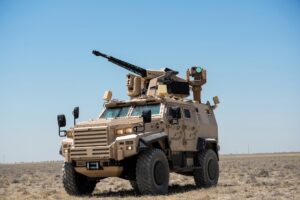
Advanced Mission Systems for Defense Forces Across the Land, Air, Naval & Space Domains

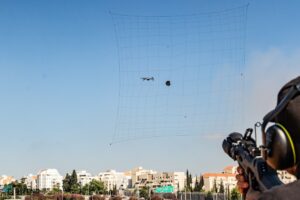
Revolutionary New Net-Based Counter-UAS Systems for Military Force Protection

If you design, build or supply Anti-Drone Guns, create a profile to showcase your capabilities and connect with visitors who have an active requirement for your solutions.

Military anti-drone guns are portable Counter-Unmanned Aircraft Systems (C-UAS) used to disrupt, disable, capture, or destroy hostile drones. They include jammer rifles, net-launching systems, and kinetic weapons, and usually operate alongside radar, Radio Frequency (RF) sensors, Electro-Optical (EO) cameras, command-and-control software, and other air defense systems.
No single anti-drone weapon is effective against every aircraft. RF jamming may cause a drone to land, hover, return home, or lose navigation, but may not stop autonomous, fiber-optic-controlled, frequency-agile, or tethered platforms. Kinetic systems also introduce range, accuracy, safety, and collateral-risk concerns, making handheld anti-drone guns one layer within a broader defensive approach.
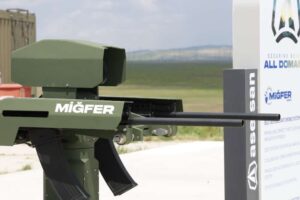
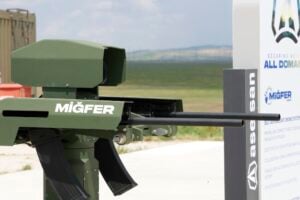
MİĞFER, a interception system for small drone threats, from Aselsan
A standalone handheld anti-drone gun uses directional RF energy to interfere with command, control, video, telemetry, or navigation links. This drone disabler gun is operator-aimed. Performance depends on line of sight, antenna alignment, frequency coverage, signal strength, and fail-safe behavior.
A rifle-form C-UAS gun places antennas, controls, batteries, and sighting aids in a shoulder-fired layout. The form improves handling, although it is an electronic effector unless designed for kinetic engagement.
Backpack-supported systems separate heavier batteries, processors, cooling hardware, or amplifiers from the handheld unit. This can extend endurance, but it increases operator load and setup needs.
Multi-band anti-drone jammer guns address several control and navigation bands. Broader coverage improves flexibility, but use depends on spectrum authorization, electromagnetic deconfliction, threat knowledge, and protection of friendly systems.
Sensor-integrated anti-drone guns receive target information from radar, passive RF detectors, EO cameras, or other sensors. Cueing reduces search time and improves identification in poor visibility or cluttered terrain. Human confirmation remains important where friendly drones, birds, or civilian aircraft may be present.
Vehicle-connected anti-drone rifles may draw power, target data, or communications from a mobile platform. Networked operation supports a shared air picture, but the effector must remain interoperable with command networks and friendly electronics.
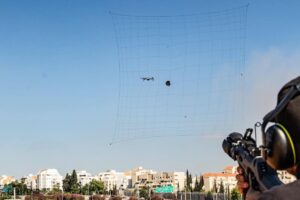
DefendAir, an anti-drone net gun, from ParaZero Technologies
Kinetic anti-drone weapons use conventional firearms, controlled-pattern projectiles, or purpose-developed ammunition to damage or destroy the aircraft. Use requires attention to range, background hazards, falling debris, and the difficulty of hitting a small moving target.
Net-launching systems entangle propellers or restrict flight without RF effects. They may suit areas where jamming is unsuitable, although short range, reload time, wind, and limited effectiveness against fast drones constrain them.
At Forward Operating Bases (FOBs) and logistics sites, a military anti-drone gun can protect command posts, ammunition areas, fuel storage, and other vulnerable assets. It may serve as a last-line effector after sensors classify a drone.
Dismounted units may carry a handheld anti-drone system against reconnaissance, spotting, or First-Person-View (FPV) threats. Low weight, battery endurance, simple controls, and rapid acquisition matter alongside other mission loads.
Convoys can use vehicle-supported or man-portable counter-UAS guns against drones approaching from changing directions. Vehicle sensors improve warning, while secure stowage supports rapid use.
Airfields require counter-UAS measures that protect aircraft, runways, maintenance areas, and fuel infrastructure without disrupting friendly aviation. Anti-drone jamming guns must be coordinated with air traffic procedures, navigation aids, communications, and spectrum use.
Artillery batteries and air defense units are vulnerable to drones used for targeting, battle damage assessment, or attack. A counter-UAS gun adds a close-range layer when higher-tier interceptors are unavailable or reserved.
Border posts and military perimeters may use anti-drone rifles against unauthorized surveillance, smuggling, or payload delivery. Persistent sensors are important because a handheld effector requires early detection.
On ships and at ports, anti-drone guns can defend decks, masts, cargo areas, and critical infrastructure. Maritime use requires corrosion resistance, weather sealing, electromagnetic compatibility, and safe operation around navigation equipment.
Anti-drone guns may address several small-UAS threats, but the suitable effect varies with design, control method, autonomy, speed, altitude, and payload:
Understanding navigation, communications, and link-loss behavior helps determine whether a drone jamming rifle, kinetic drone defense measure, or another effector is appropriate.
Military anti-drone equipment may face heat, cold, dust, rain, vibration, salt exposure, and dense electromagnetic environments. Relevant qualification programs include:
Qualification is not blanket approval. It should identify tested methods, limits, configuration, platform, mission profile, storage, and electromagnetic environment.
Development aims to make anti-drone defense systems more adaptable, connected, and selective:
Future military anti-drone weapons will remain part of layered counter-UAS networks combining detection, identification, command decisions, and multiple defeat options.


 Searching Companies & Products