
Ground Control Stations (GCS)
Discover cutting-edge solutions from 4 leading global suppliers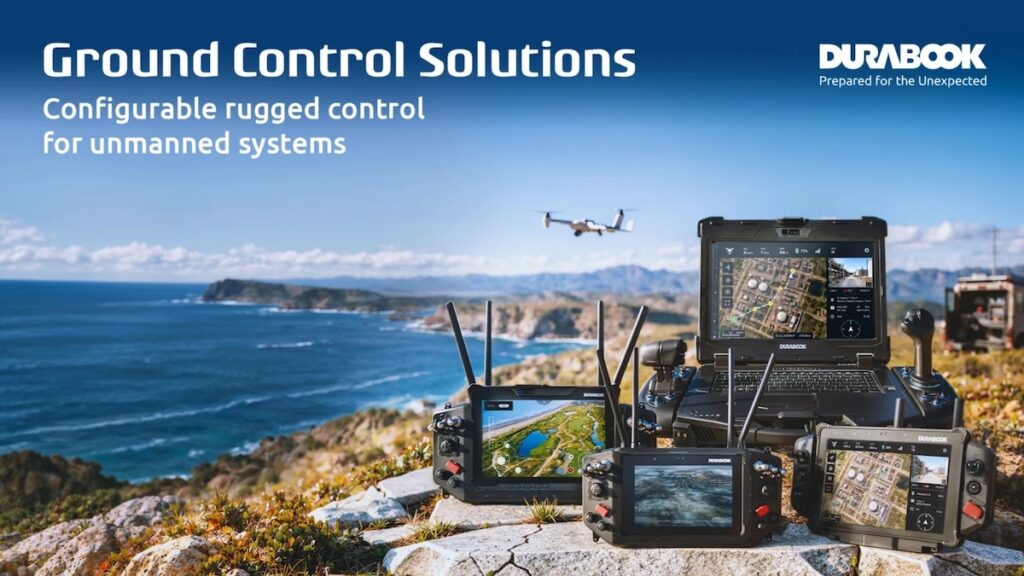
Durabook, the rugged mobile computing brand owned by Twinhead International Corporation, has launched a new Ground Control Station (GCS) portfolio designed for aerial, ground, and maritime unmanned operations.
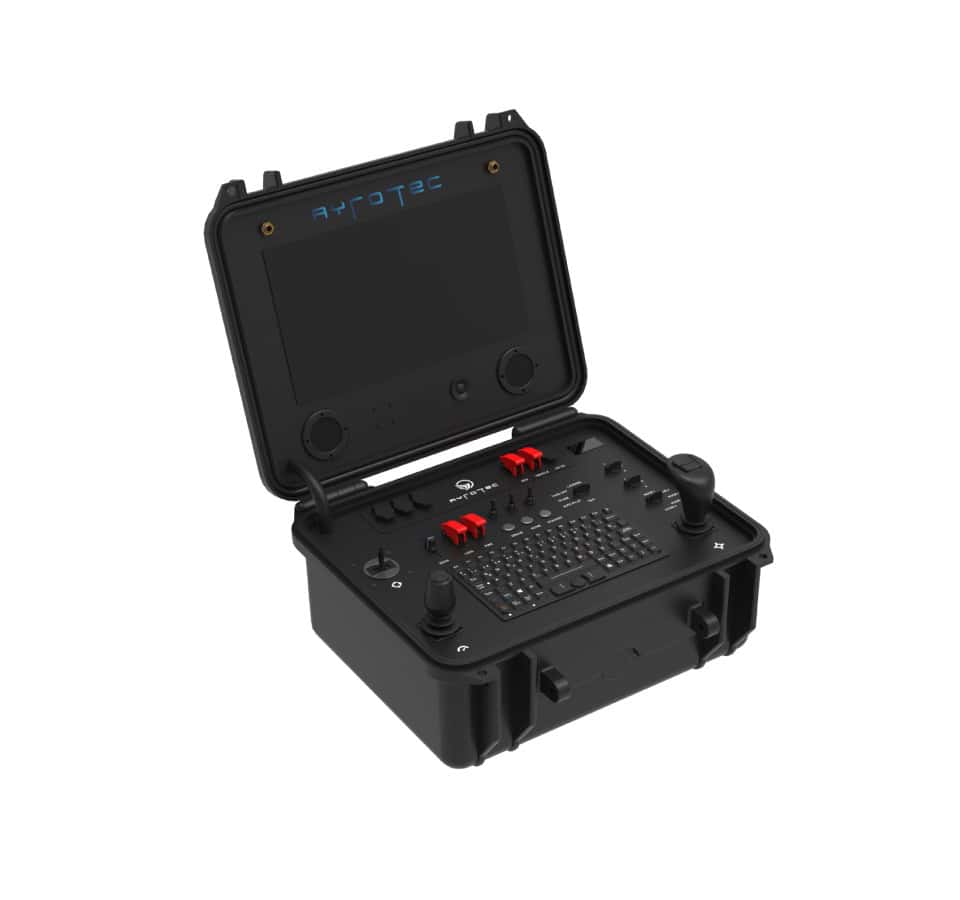
Aimed at system integrators, solution providers, and end users across defense, public safety, and industrial sectors, the lineup pairs tablet and laptop hardware with configurable physical controls, interfaces, expansion options, and communications equipment. Rather than offering fixed off-the-shelf units, Durabook collaborates with customers and integration partners to evaluate operator tasks, connected systems, and deployment conditions before defining an appropriate controller configuration.
“Every customer brings a different combination of operator needs, mission software and connected equipment,” said Twinhead CEO Fred Kao. “Our strength is combining field reliability with the flexibility to bring these elements together. We work closely with customers and integration partners to configure rugged ground control solutions around their applications, from the computing platform and physical controls to the interfaces and communications their teams need in the field.”
The hardware range comprises five base platforms: the 8-inch GC-R8 and GC-R8S tablet controllers, the 10-inch GC-R10 and GC-R10S tablet controllers, and the GC-Z14I laptop-based platform. The compact 8-inch tablets target mobile field operations, whereas the 10-inch models provide larger displays with more room for mission software and operational information, and the GC-Z14I serves workflows combining keyboard input with integrated physical controls. Across the lineup, operators can specify configurable joysticks, switches, assignable buttons, and thumbwheels for platform navigation, payload operation, and camera control, alongside interfaces and expansion options for external peripherals.
On the software side, the Windows-based systems support mission applications such as WinTAK for situational awareness and operational coordination. The platforms also include Linux support, giving development teams additional options for integrating open-source and custom software within their broader command infrastructure.
For field connectivity, the controllers accommodate third-party radio integration alongside Wi-Fi, 4G/5G, and external RF radio options depending on the platform and configuration, with support for satellite backhaul via a separate terminal for deployments beyond conventional network coverage. Depending on the specific model and configuration, the systems meet MIL-STD-810H, MIL-STD-461G, and IP66 requirements for operation in environments involving dust, rain, shock, and vibration.