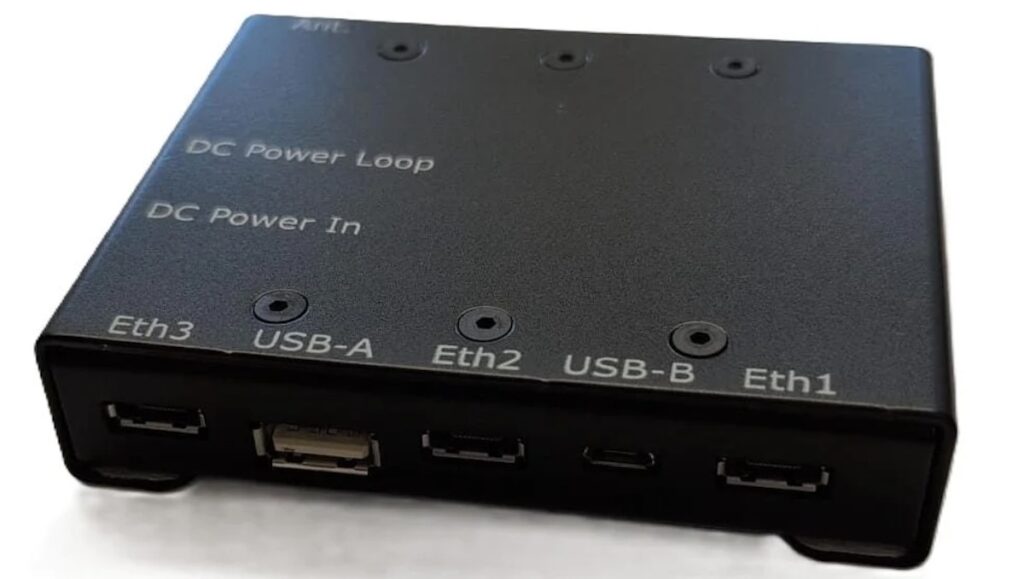




Apella Solutions highlights the challenges surrounding Unmanned Aerial Vehicle (UAV) video transmission across constrained, congested, or constantly changing communications networks, and how its ARGUS Video Transcoder is designed to optimize existing UAV video for transmission across challenging IP networks.
 ARGUS is designed to take existing UAV video and optimize it for transmission, helping maintain operationally useful live video when bandwidth becomes limited.
Addressing the UAV Video Link
For UAV manufacturers and systems integrators, capturing high-quality video is only half the challenge. That video also needs to reach the people who need it, particularly when the communications network is constrained, congested, or constantly changing.
A UAV mission might need to operate across MANET and tactical mesh networks, private or public LTE and 5G, satellite bearers, IP radio networks, and other bandwidth-constrained tactical links.
Rather than designing a UAV around one ideal communications bearer, ARGUS provides a flexible video layer between the camera and the network.
H.264 & H.265 Video Transcoding
With H.264/H.265 transcoding, Apella Solutions states that ARGUS can dramatically reduce the bandwidth required for live video. Configurable bitrates range from 15 kbps to 2 Mbps, while ARGUS supports standard IP video workflows.
Apella Solutions summarizes the approach as:
UAV/Drone → ARGUS → Any Available IP Bearer → Live Video
Fitting Video to the Available Network
A UAV platform may operate over MANET, LTE, satellite, or transition between different communications environments. In these scenarios, ARGUS can help make the video fit the network rather than expecting the network to fit the video.