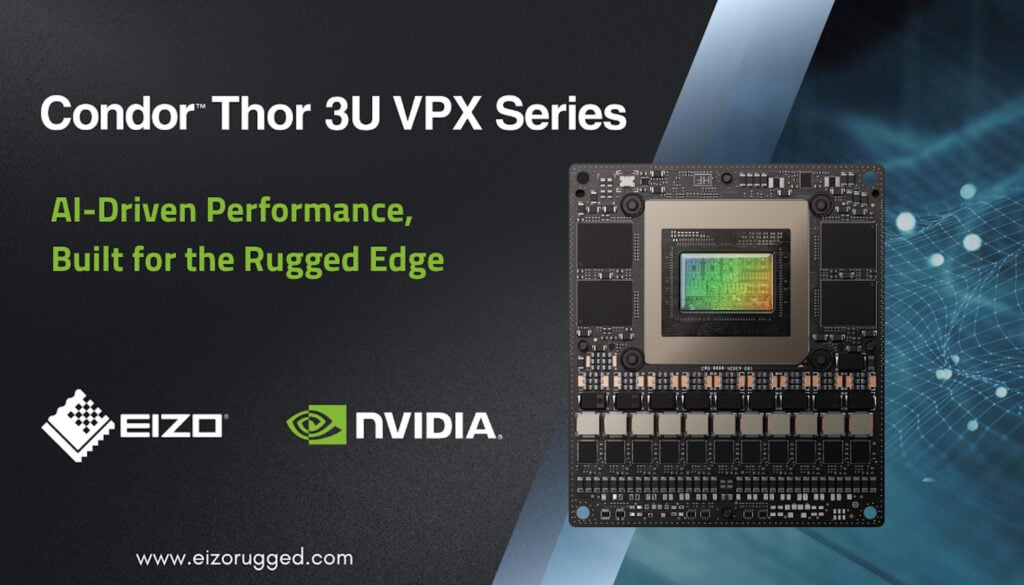




Tactical edge computing architectures must increasingly combine processing performance with the ability to ingest, move, and analyze large volumes of sensor data within constrained platforms. EIZO Rugged Solutions is addressing these requirements with the Condor T5-IOX 3U VPX single-board computer (SBC), which integrates NVIDIA® Jetson™ IGX Thor T5000 processing into an open, modular architecture for sensor and mission-computing systems.
Modern sensor-driven mission systems require more than high-performance processors alone. Multiple streams of raw sensor data must move efficiently between system resources, compute-intensive workloads need to execute with minimal latency, and actionable information must be distributed across the platform without depending solely on remote or centralized processing infrastructure.
These requirements place increasing demands on the embedded computing architecture itself. As AI inference and sensor-processing workloads become more complex, systems must accommodate higher levels of local processing while remaining practical for deployment within rugged size, weight, power, and thermal constraints.
Building Edge Processing Around 3U VPX
3U VPX general-purpose computing modules provide a modular approach to combining processing and data movement at the tactical edge. Based on the VITA 46 VPX and VITA 65 OpenVPX standards, the architecture combines high-speed serial connectivity and standardized module-to-backplane interfaces within a compact, rugged form factor.
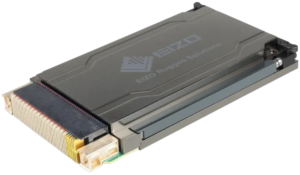
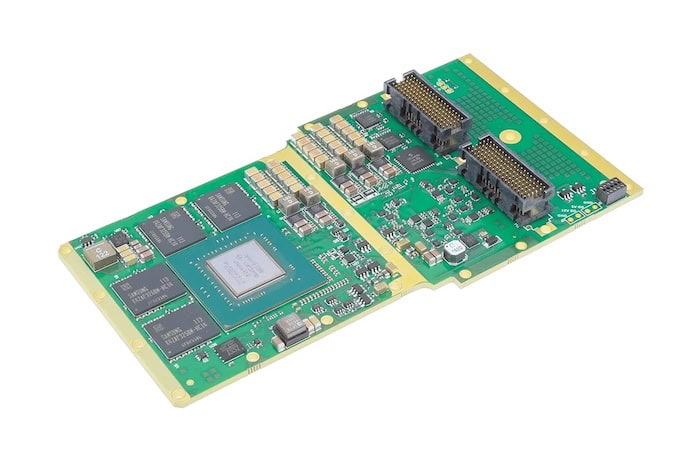
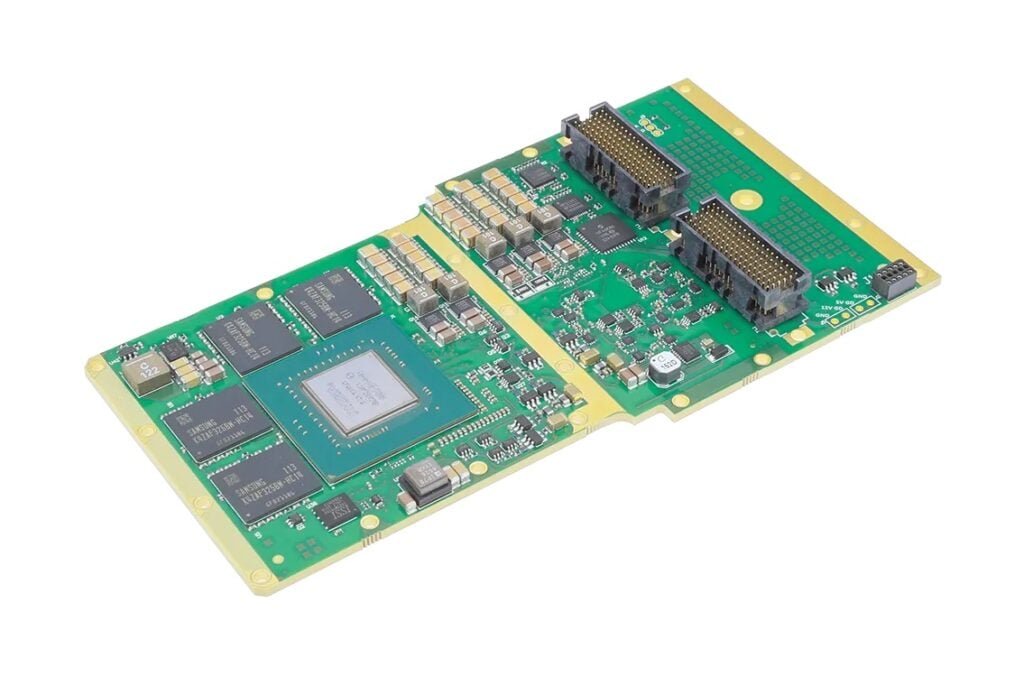
Condor T5-IOX 3U VPX single board computer powered by the NVIDIA Jetson Thor Platform.
This allows CPU processing, GPU acceleration, high-speed networking, sensor I/O, and storage resources to operate within a common system architecture, providing a framework in which processing capabilities can be configured according to mission requirements.
The Condor T5-IOX applies this approach by integrating the NVIDIA Jetson IGX Thor T5000 system-on-module (SoM) into a rugged 3U OpenVPX SBC. The module combines NVIDIA Blackwell GPU acceleration with a 14-core Arm® Neoverse™ V3AE CPU, up to 128 GB of LPDDR5X memory, high-speed networking, video ingest, and system I/O.
Shared system memory of up to 128 GB of LPDDR5X provides memory bandwidth of up to 273 GB/s. The NVIDIA Jetson IGX Thor unified memory architecture allows the CPU and Blackwell GPU to access the same physical memory pool, reducing the requirement to repeatedly copy large datasets between separate CPU and GPU memory spaces.
For payloads handling multiple high-resolution sensor streams, AI models, imagery, and other real-time data, this architecture can streamline processing and reduce data-transfer overhead as information moves between CPU- and GPU-accelerated workloads. The 128 GB memory capacity also allows the Condor T5-IOX to support larger AI models and datasets, as well as multiple concurrent processing workloads within the mission payload.
Increasing AI Compute Density
The NVIDIA Jetson IGX T5000 delivers up to 2,070 FP4 TFLOPS of sparse AI compute performance, providing the Condor T5-IOX with substantial GPU acceleration within a single 3U VPX slot.
This compute density gives system designers greater flexibility to consolidate processing functions within space-constrained architectures. As sensor counts and resolutions increase and AI models become more complex, additional compute capacity can support multiple data streams and concurrent accelerated workloads without immediately requiring additional GPU cards or external processing resources.
Compute-intensive functions including AI inference, computer vision, multi-sensor fusion, video/signal processing, and real-time analytics can therefore be performed directly within the mission payload.
Processing information closer to its source can reduce the need to transfer large quantities of raw sensor data to remote processing resources. This can reduce unnecessary data movement and help minimize latency while allowing higher-level information to be distributed throughout the system.
High-speed Ethernet, PCIe Gen 5, and 12G-SDI interfaces provide multiple routes for moving information into and out of the processor, while the Blackwell GPU provides acceleration for analyzing the incoming data in real time.
Consolidating these capabilities on one SBC can also reduce the number of separate resources required for sensor-data acquisition, movement, and processing. Within fixed slot, power, and cooling limits, this processing density can create opportunities either to reduce slot count or to retain additional VPX slots for application-specific resources including FPGA processing, RF interfaces, storage, networking, or further GPU acceleration.
SOSA® Alignment for Modular Integration
The Condor T5-IOX has been developed in alignment with the SOSA® Technical Standard, enabling its NVIDIA Jetson IGX Thor processing capabilities to be incorporated into open, modular system architectures.
SOSA builds on OpenVPX and other open standards to further define common hardware, electrical, mechanical, and system interfaces for sensor and mission-computing systems. Instead of constructing tightly coupled systems around proprietary interfaces, this approach supports the integration of appropriately matched plug-in cards, backplanes, and other system resources around defined interfaces and profiles.
Within this architecture, the Condor T5-IOX can function as an AI and general-purpose computing resource alongside complementary plug-in cards providing GPU or FPGA acceleration, networking, sensor acquisition, storage, and other specialized processing functions.
Direct High-Bandwidth Sensor Connectivity
Sensor connectivity is another component of the SBC’s architecture. Four 12G-SDI video inputs provide high-bandwidth interfaces for connecting multiple high-resolution video sensors directly to the Condor T5-IOX.
Each 12G-SDI interface can carry UHD/4K video at up to 60 frames per second over a single connection. The four interfaces therefore allow multiple high-resolution sensor streams to be ingested simultaneously.
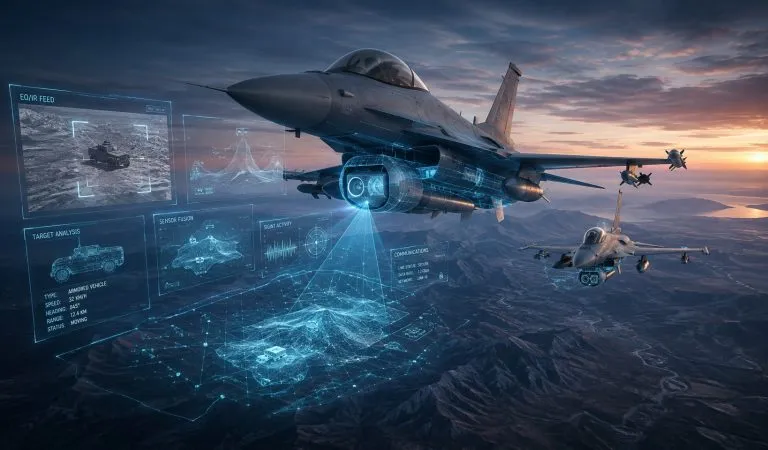
For systems incorporating EO/IR cameras, situational awareness sensors, or other digital video sources, the interfaces provide a direct route for transferring large quantities of visual data to the NVIDIA Jetson IGX Thor processor for real-time processing.
Combining multi-channel 12G-SDI ingest with NVIDIA Blackwell GPU acceleration allows more stages of the sensor-processing pipeline to be handled within one 3U VPX slot. Incoming video can be processed using computer vision and AI inference algorithms, correlated with other sensor information, and distributed through the SBC’s high-speed Ethernet or display interfaces.
This configuration can reduce reliance on separate video-capture and processing hardware while supporting applications including multi-camera processing, EO/IR analysis, object detection and classification, image enhancement, sensor fusion, and real-time situational awareness.
Moving Data Across the VPX Architecture
Processing capability at the tactical edge depends on the ability to move information to and from compute resources without introducing unnecessary system bottlenecks.
The Condor T5-IOX supports four 25GbE (25GBASE-KR) interfaces, providing aggregate Ethernet bandwidth of up to 100 Gb/s. These interfaces provide high-bandwidth paths for exchanging sensor and application data with compatible network switches and other processing resources through the VPX backplane.
Together with PCI Express Gen 5 and RDMA technologies, these interfaces are designed to support high-throughput data movement between sensors and processing resources while minimizing potential bottlenecks.
This connects the SBC’s processing performance directly with its data-movement architecture. The Blackwell GPU supplies compute resources for AI and sensor-processing workloads, while the high-speed VPX interfaces provide the paths required to transfer information to those resources efficiently.
Partitioning GPU Resources with MIG
The NVIDIA Blackwell GPU within the Jetson IGX T5000 SoM introduces Multi-Instance GPU (MIG) technology to the Jetson Thor platform. MIG allows GPU resources to be divided into isolated instances with dedicated compute, cache, and memory bandwidth.
Multiple GPU-accelerated applications can consequently operate concurrently with greater performance predictability and reduced resource contention. In sensor-rich edge systems, GPU resources can be separated between workloads such as AI inference and computer vision and graphics or visualization tasks, rather than requiring each application to compete for the complete GPU.
This capability is particularly applicable to mixed-workload environments where latency-sensitive processing must run alongside other accelerated applications.
At the system level, MIG also provides a mechanism for consolidating different workloads within a single 3U VPX slot. Rather than allocating separate GPU hardware to individual processing functions, integrators can partition available GPU resources and operate workloads in parallel with hardware-level isolation.
Combined with four 25GbE interfaces, PCIe Gen 5, video connectivity, and 128 GB of unified memory, MIG allows the Condor T5-IOX to support multiple independent functions as part of a larger modular 3U VPX architecture.
Scaling Tactical Edge Mission Computing
Higher-resolution sensors, increasingly complex AI models, and growing quantities of sensor data are driving requirements for edge architectures that can address processing and data movement together.
The Condor T5-IOX combines NVIDIA Jetson IGX Thor processing, Blackwell GPU acceleration, high-bandwidth sensor interfaces, high-speed Ethernet connectivity, and GPU resource partitioning within a compact 3U VPX SBC. These resources allow sensor information to be ingested, transferred, processed, and distributed directly within tactical-edge mission systems.
The module can also serve as a scalable component within an OpenVPX system. Complementary 3U VPX plug-in cards can provide additional GPU processing, sensor acquisition, networking, storage, or other specialized capabilities, enabling system resources to be configured around individual application requirements.
By combining local AI and sensor processing with an open, modular VPX architecture, the Condor T5-IOX provides system integrators with a building block for developing interoperable and upgradeable edge computing systems as mission-processing requirements evolve.
Read Empowering Tactical Edge Computing Through a 3U VPX Open Architecture.