




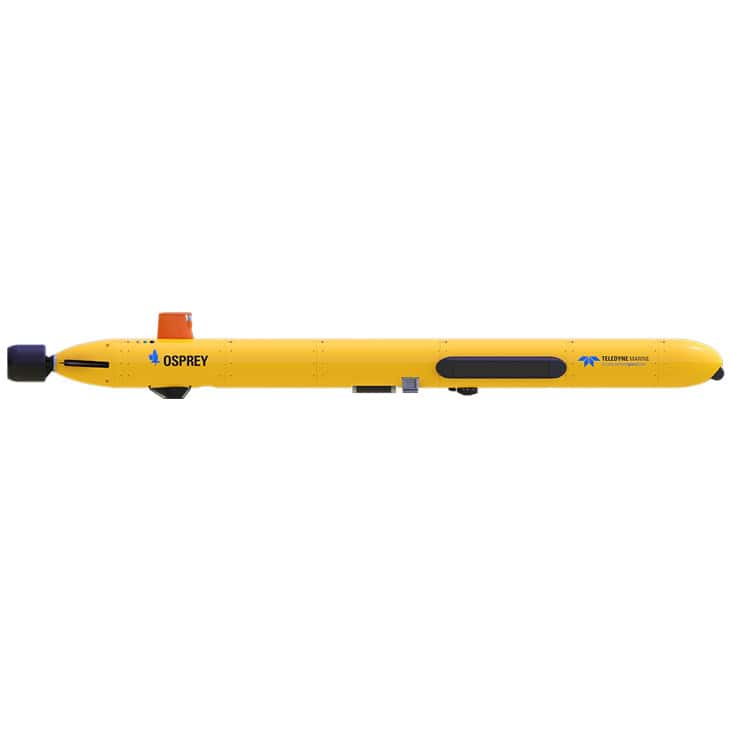
The Osprey AUV is a 324 mm-diameter autonomous underwater vehicle built around the established Gavia mechanical architecture, software environment, Teledyne QuickLock coupling system, and Teledyne Vehicle Bus. Its modular configuration comprises propulsion, control, battery, payload, and nose sections, with an optional Attitude, Depth, and Heading module. Individual modules can be transported separately, recognized automatically after connection, and exchanged or extended to simplify vehicle assembly, field servicing, and mission reconfiguration. Rated for operation to 2,000 m, Osprey can carry as many as three rechargeable battery modules, with a representative two-battery configuration providing 24 hours of operation at 3.5 knots. A low-noise rim-drive propulsion option combines efficient thrust with enhanced maneuverability, while redundant recovery provisions include a drop weight, acoustic pinger, and Iridium beacon.
Survey-grade inertial navigation is aided by Teledyne RDI Doppler velocity logging, with available DVL configurations supporting bottom lock at ranges up to 850 m. Optional USBL or bottom-deployed LBL transponder ranging can supplement positioning during longer missions. Payload flexibility allows the vehicle to integrate combinations of synthetic aperture sonar, side-scan sonar, multibeam echo sounding, sub-bottom profiling, high-resolution imaging, laser scanning, and strobes. Enhanced obstacle avoidance, a removable data pod, expanded battery capacity, and configurable autonomy further support differing defense, commercial, and scientific requirements. Mission workflows use the Gavia-derived chart-based graphical interface, while support for MOOS-IvP or ROS enables control to be handed to mission-specific autonomy functions where required.






