Showcase your capabilities
If you design, build or supply Rugged Keyboards, create a profile to showcase your capabilities and connect with visitors who have an active requirement for your solutions.




Suppliers and manufacturers of rugged keyboards provide critical interface solutions for military and defense systems, supporting secure input, system control, and reliable performance in extreme environments.
Read the Technology Overview
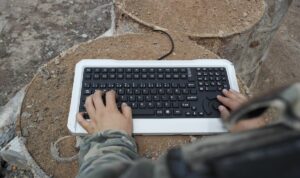
Rugged Hardware & HMI Equipment for Mission-Critical Military, Naval & Defense Applications

If you design, build or supply Rugged Keyboards, create a profile to showcase your capabilities and connect with visitors who have an active requirement for your solutions.

Rugged keyboards are specialized human input devices designed to maintain high performance and durability in harsh conditions encountered in military and defense operations. These keyboards are integral to user interface systems across land, air, and naval platforms, enabling secure typing, data entry, and command input in environments where standard commercial hardware would fail. Built to withstand shock, vibration, temperature extremes, dust, and water exposure, rugged keyboards support reliable operation in mission-critical applications.
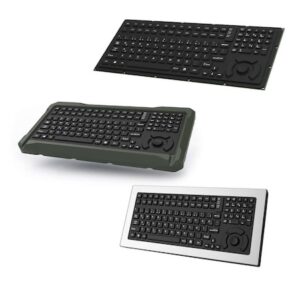
Rugged Keyboards by Ruggmate
Defense-grade keyboards are utilized in various operational systems, from mobile command centers and base stations to armored vehicle control units and airborne communication consoles. Designed to meet stringent military standards such as MIL-STD-810 and IP65 or higher ingress protection ratings, they are essential components of secure human-machine interface (HMI) systems used in tactical, surveillance, and weapons control applications.
Rugged keyboards are deployed across multiple defense platforms and systems where secure, reliable data input and user interaction are required. These keyboards are often combined with other components such as joysticks, trackballs, mice, touchpads, or touchscreen overlays to support complex interface needs in defense applications:
Rugged keyboards are integrated into the control units of military land vehicles such as tanks, armored personnel carriers, and mobile missile platforms. They are used for secure mission input, vehicle navigation, and weapons system control, where reliability and rapid input are essential. These keyboards withstand vibration, dust, and extreme temperatures typical of mobile combat environments.
Military aircraft utilize rugged keyboards in both cockpit and support systems. They support avionics configuration, communications, and onboard diagnostics. NVIS-compatible backlighting and compact panel mount options ensure these keyboards are suitable for flight-critical applications where visual clarity and system resilience are required.
Onboard naval vessels and submarines, rugged keyboards are embedded into command consoles for navigation, surveillance, and tactical control systems. These environments demand waterproof and corrosion-resistant input devices that can operate reliably in high-moisture, salt-rich atmospheres and under heavy mechanical use.
Base stations and mobile command units rely on rugged keyboards to manage unmanned aerial systems, unmanned ground vehicles, and other remote systems. These keyboards are often integrated into portable consoles or shelters where rapid setup, secure communication, and multitasking are vital. Their tactile feedback and sealed construction enable uninterrupted operations in field conditions.
Rugged keyboards interface with sensor arrays, targeting systems, and fire control units, allowing precise input for configuration and operation. These keyboards often include programmable keys and integrated pointing devices, enabling operators to interact with complex software systems in high-pressure environments.
Rugged keyboards are used in embedded applications permanently integrated into sealed housings or equipment enclosures. These include fixed-site radar systems, mobile surveillance trailers, and field-deployable communication modules. Compact form factors and durable construction make them ideal for long-term deployment in remote or harsh environments.
Military rugged keyboards come in several configurations to accommodate different use cases and integration requirements:
Materials often include stainless steel or hard anodized aluminum for mechanical durability. At the same time, key actuation systems may use silicone rubber, mechanical switches, or capacitive touch surfaces depending on the operational need.
Rugged keyboards for military use are engineered to meet multiple industry and defense standards to ensure performance and interoperability:
Compliance with these standards ensures that rugged keyboards can operate safely and securely within the broader system architectures of defense platforms.
Unlike standard consumer or office keyboards, rugged military keyboards are built for durability, reliability, and integration into larger control systems:
| Feature | Rugged Military Keyboards | Commercial Keyboards |
| Environmental Tolerance | Extreme (MIL-STD, IP-rated) | Minimal (indoor use only) |
| Material Construction | Metal, sealed enclosures | Plastic casings |
| Compliance Requirements | MIL-STD, DO-160, TEMPEST, etc. | None or consumer-grade |
| Use Cases | Tactical systems, command units, PDA devices | Office, general computing |
| Input Security | Encrypted, secure comms options | None |
| Integration | Embedded or panel mount | External USB only |
| Backlighting | NVIS-compatible or LED | Basic or none |
This robustness ensures reliable operation under combat conditions, during deployments, or within complex systems requiring constant uptime.
Rugged keyboards are often part of larger human-machine interface (HMI) ecosystems that include displays, touchscreens, pointing devices, and input/output modules. These systems facilitate communication between operators and critical defense technology, from drones and surveillance systems to weapons targeting platforms.
In cockpit control units, rugged keyboards are embedded alongside avionics displays and programmable switches to support pilot inputs. On ground-based systems, they are mounted within mobile command or base station setups for data entry, map interaction, and communications. In unmanned systems control, rugged keyboards allow real-time input and operational control of remote assets.
Defense systems operate in extreme conditions that demand hardware resilience. Rugged keyboards are designed for:
These design requirements ensure continuous performance in field conditions where failure could compromise mission success.
When sourcing rugged keyboards for military applications, defense buyers should evaluate:
Close coordination with manufacturers is often necessary for system integration, customization, and long-term support. Many suppliers offer product lines that are configurable to meet platform-specific requirements or can develop custom keyboards for unique applications.


 Searching Companies & Products



