Showcase your capabilities
If you design, build or supply Rugged Joysticks, create a profile to showcase your capabilities and connect with visitors who have an active requirement for your solutions.




Rugged joysticks are military-grade human-machine interface devices engineered for deterministic control of mission-critical defense systems in extreme environments. Military joystick designs incorporate Hall effect sensing, redundant channels, and digital interfaces such as CAN bus, MIL-STD-1553, and Ethernet.
This page showcases leading rugged joystick suppliers for use across remote weapon stations, UAV and UGV ground stations, naval combat systems, and aircraft cockpits, delivering precise proportional input with low latency and high reliability.
Read the Technology Overview
Rugged Hardware & HMI Equipment for Mission-Critical Military, Naval & Defense Applications

If you design, build or supply Rugged Joysticks, create a profile to showcase your capabilities and connect with visitors who have an active requirement for your solutions.

Military rugged joysticks are precision-engineered Human-Machine Interface (HMI) devices designed to provide deterministic, reliable control of mission-critical systems in high-stress operational environments. Unlike commercial or standard industrial controls, these devices are developed specifically for defense platforms where a hardware failure is not simply a maintenance issue it is a compromise to mission success and operator safety.
These joysticks form the primary control link between the operator and sophisticated subsystems, including remote weapon stations, electro-optical sensors, radar arrays, and drive-by-wire vehicle systems. In modern network-centric operations, the military-grade joystick has evolved from a simple analog peripheral into a hardened, intelligent control node integrated into complex distributed computing architectures.
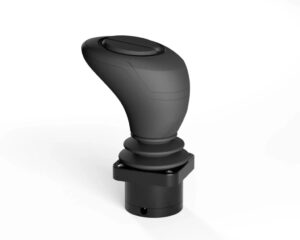
Rugged Joystick from Ruggmate
In direct-fire and stabilized weapon systems, rugged military joysticks provide proportional control for elevation, traverse, and firing sequences. High-resolution position sensing allows for the minute adjustments required for long-range targeting, while integrated multi-stage triggers and safety interlocks ensure strict compliance with engagement protocols. Low latency is essential. The joystick must translate micro-movements into fluid turret adjustments without overshoot or signal jitter.
RWS rely on dual-axis or multi-axis rugged joysticks to maintain stabilized control while on the move. These assemblies often feature programmable buttons for instant zoom, target designation, and mode switching. Because RWS platforms are typically mounted on armored vehicles subjected to extreme vibration and shock, these joysticks must maintain precise calibration despite constant mechanical stress.
For unmanned systems, the drone joystick is the primary interface for the Ground Control Station (GCS). Whether managing a UAV sensor payload or navigating a UGV through complex terrain, operators require smooth proportional input with customizable sensitivity curves. These systems often utilize digital outputs such as CAN bus or Ethernet to interface directly with mission computers.
Maritime environments demand exceptional corrosion resistance and EMI resilience. Joysticks used for periscope manipulation, sensor mast positioning, and naval gunnery must operate reliably in salt-laden, high-humidity conditions. Sealed housings and conductive shielding are standard to ensure environmental protection and electromagnetic compatibility with dense onboard electronics.
As armored vehicles transition toward drive-by-wire architectures, rugged joysticks are increasingly replacing traditional mechanical steering. In these safety-critical applications, fail-safe neutral return mechanisms and redundant sensing are mandatory to prevent unintended vehicle movement in the event of an electrical fault.
Airborne platforms impose strict weight and certification constraints. A military aircraft joystick must integrate seamlessly with avionics buses while complying with environmental requirements. In ISR aircraft and rotary platforms, separate control sticks may govern EO/IR turrets or mission payloads. These require fine resolution and predictable centering forces to maintain accurate tracking.
Sensor control is one of the most demanding military joystick applications. Operators must track moving targets with minimal delay, often under high cognitive workload. Advanced joystick systems incorporate adjustable damping and customizable response profiles to match complex sensor stabilization algorithms.
To balance the competing needs of durability and weight, military joysticks are typically machined from aerospace-grade aluminum alloys or stainless steel. For weight-sensitive airborne applications, reinforced composites may be used, provided they offer the necessary structural rigidity to withstand high-G maneuvers.
Protection against the elements is paramount. An IP67 joystick is rated for total protection against dust and immersion in water, making it suitable for open-cockpit vehicles or maritime decks. Heavy-duty gaskets and silicone boots ensure that contaminants cannot reach the internal electronics even under high-pressure washdowns or extreme thermal expansion.
True military-grade joysticks must be qualified to rigorous standards to ensure survival in the field:
While legacy systems occasionally still use potentiometers, modern military designs are dominated by Hall effect technology. This contactless sensing method eliminates mechanical wear at the electrical interface. This significantly extends the Mean Time Between Failure and eliminates the dead zones or noise associated with aging mechanical contacts.
For mission-critical applications, dual-channel or redundant architectures are frequently employed. By providing independent output signals for the same physical movement, the system can perform real-time cross-checks. If a discrepancy is detected, the system can enter a fail-safe mode to prevent catastrophic uncommanded movements.
Modern integration relies on a variety of digital and legacy protocols to maintain data integrity:
Military operations often involve extended shifts where operator fatigue can lead to errors. Ergonomic grip geometry, combined with carefully tuned centering forces, ensures precision over long durations. Furthermore, controls must be designed with high tactile differentiation to allow for blind operation while wearing heavy flight gloves or protective gear.
In covert or nighttime operations, any light emission from the joystick such as backlit buttons or status LEDs must be Night Vision Goggle (NVG) compatible. This prevents blooming in the operator vision and ensures the platform remains undetected.
The move toward the Modular Open Systems Approach (MOSA) is driving the development of smart joysticks. These next-generation devices integrate onboard microcontrollers for signal conditioning and protocol conversion. This reduces the integration burden on host mission computers and allows for advanced on-board diagnostics and health monitoring.
Artificial intelligence is beginning to play a role in how joysticks interact with the operator. Adaptive control algorithms can now adjust sensitivity curves in real-time based on the specific operational mode. This enables high-speed slewing for rapid target acquisition while automatically switching to ultra-fine precision for long-range tracking or delicate maneuvering.
In advanced systems, force feedback provides tactile cues regarding system limits or target lock conditions. This haptic technology is being paired with augmented reality overlays in head-up displays. This provides the operator with a more intuitive sense of the operational environment and reduces the cognitive load during high-intensity operations.


 Searching Companies & Products