Showcase your capabilities
If you design, build or supply KVM Switch, create a profile to showcase your capabilities and connect with visitors who have an active requirement for your solutions.




Rugged KVM switches are hardened keyboard, video, and mouse switching solutions engineered to control multiple computers from a shared operator console across defense and aerospace environments. Designed for mission-critical computing, a KVM switch for military applications may support command centers, mobile command posts, server rooms, naval vessels, submarines, ISR workstations, and rapidly reconfigurable operations.
This page showcases military KVM switch suppliers offering mil-spec KVM, maritime KVM, remote access KVM for military systems, with rugged interfaces, isolated channels, encryption options, and environmentally resilient designs supporting secure, space-efficient system control.
Read the Technology Overview
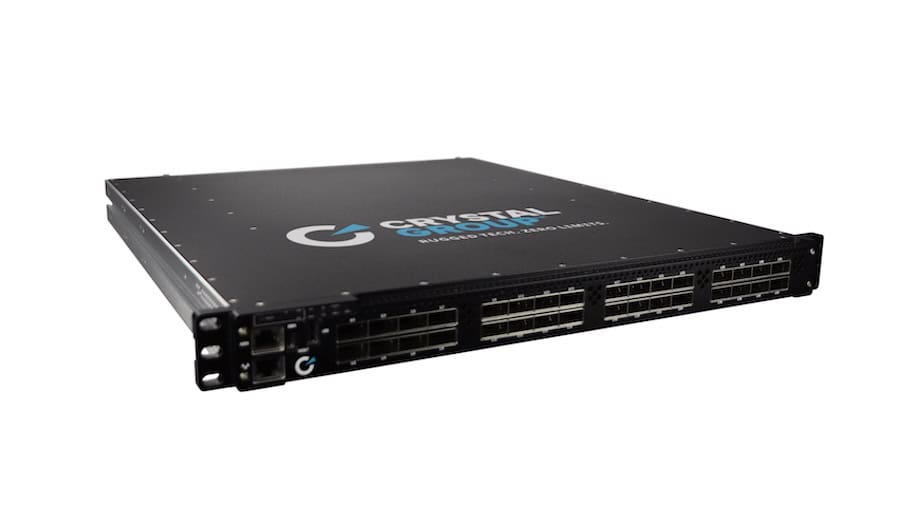
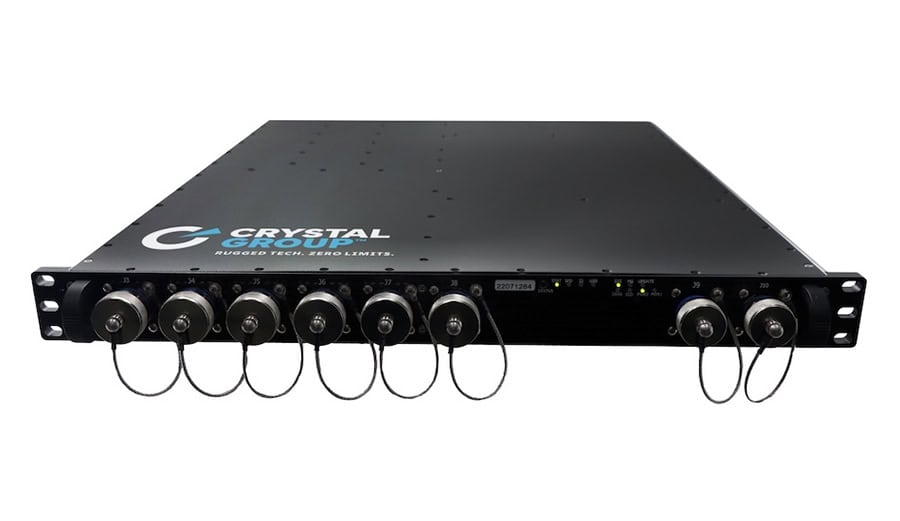
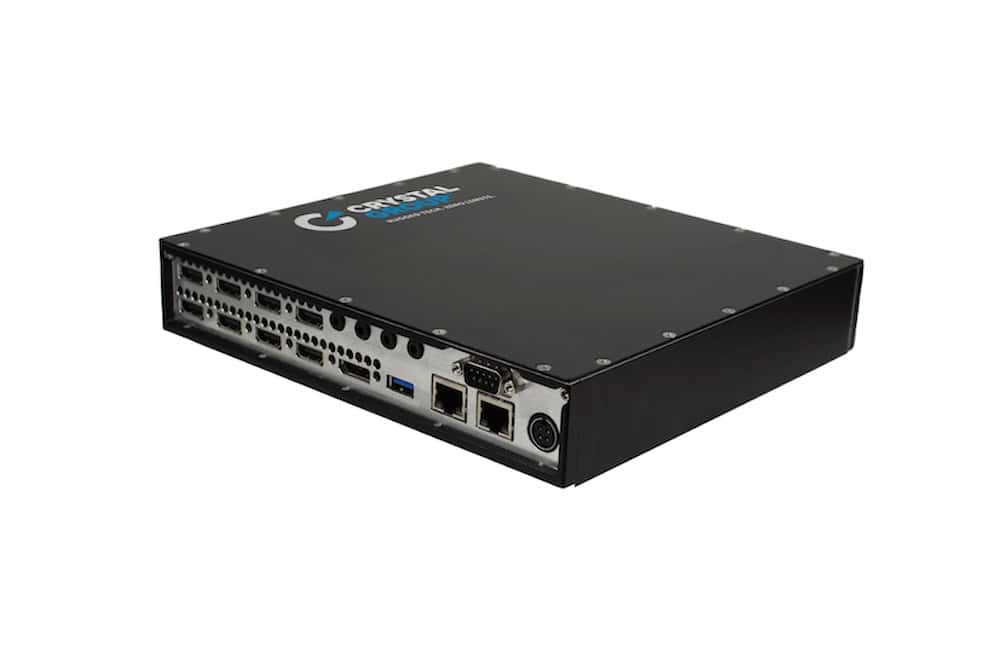
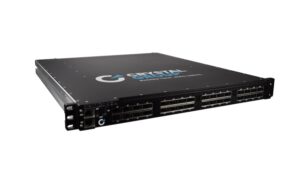
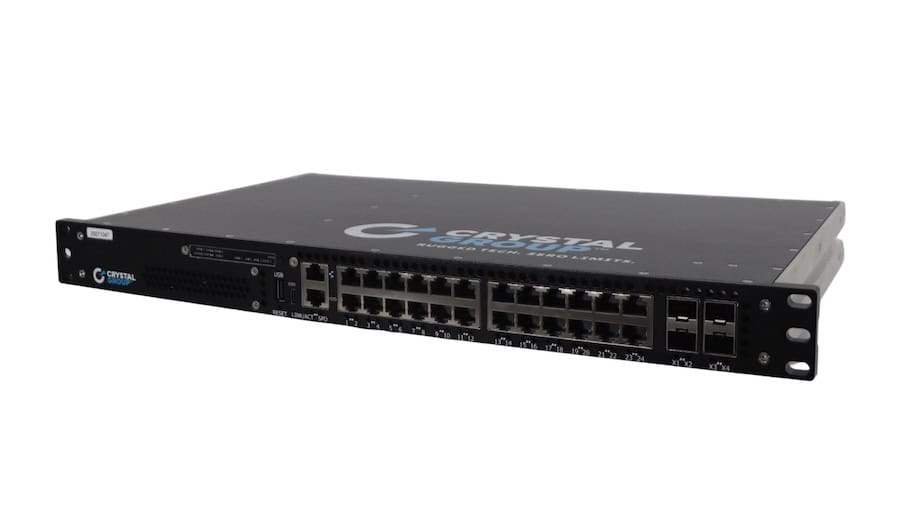
Ruggedized Edge Computing & Networking for Mission-Critical Defense Applications

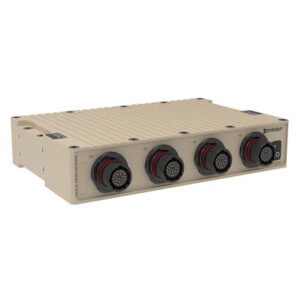
WE ARMOR IT. MilSpec Electronics & Rugged IT Equipment for Military, Government & Critical Infrastructure

If you design, build or supply KVM Switch, create a profile to showcase your capabilities and connect with visitors who have an active requirement for your solutions.

Military- and defense-grade Keyboard, Video, and Mouse (KVM) switches have evolved from simple IT management peripherals into specialized hardware components that provide operators with the capability to control multiple computers, networks, sensors, and mission systems from a single workstation, without compromising information assurance or tactical operational efficiency.
Modern defense operations depend heavily on rapid access to disparate information sources. Operators within command centers, intelligence facilities, tactical operations hubs, naval combat information centers, and airborne mission stations routinely manage systems operating at different classification levels and across distinct security domains. Secure KVM technology enables personnel to transition between these systems while maintaining strict isolation between networks.
At its core, a KVM switch allows a single set of peripherals to control multiple computing systems. However, a defense-grade KVM switcher performs far more sophisticated processing than simple peripheral routing, acting as a secure intermediary between the operator and the mission computers.
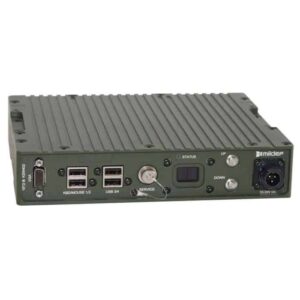
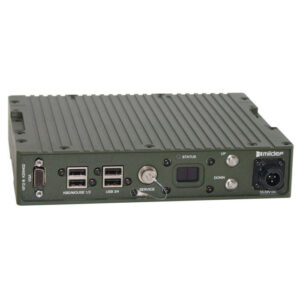
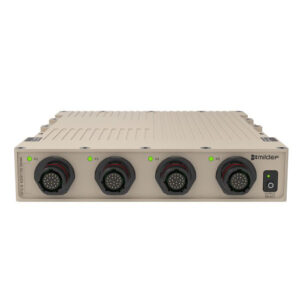
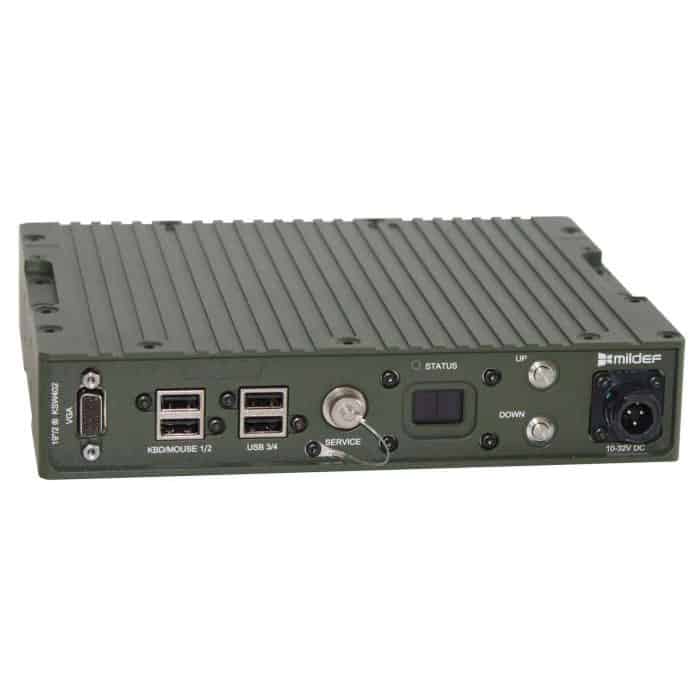
KSW400 Series Military KVM Switch for VGA and USB by MilDef
KVM systems manage bidirectional communication between operator peripherals and connected computers. The switch routes video output from selected systems to displays while directing keyboard and mouse input back to the selected host.
In secure systems, these functions are isolated to prevent unauthorized data flow between networks. Dedicated hardware emulation ensures that disconnected host systems continue to detect a valid keyboard and mouse connection even when another system is actively selected, preventing operating system dropouts or re-enumeration delays.
Modern KVM setups are optimized for operator efficiency. High-performance switching allows users to transition rapidly between systems with minimal latency and without disrupting ongoing data feeds.
Many systems support programmable hotkeys, touchscreen integration, customizable display layouts, multi-monitor management, and dynamic source prioritization. These capabilities are valuable in intelligence analysis, cyber operations, and ISR (Intelligence, Surveillance, and Reconnaissance) exploitation environments where operators must continuously transition between multiple data streams.
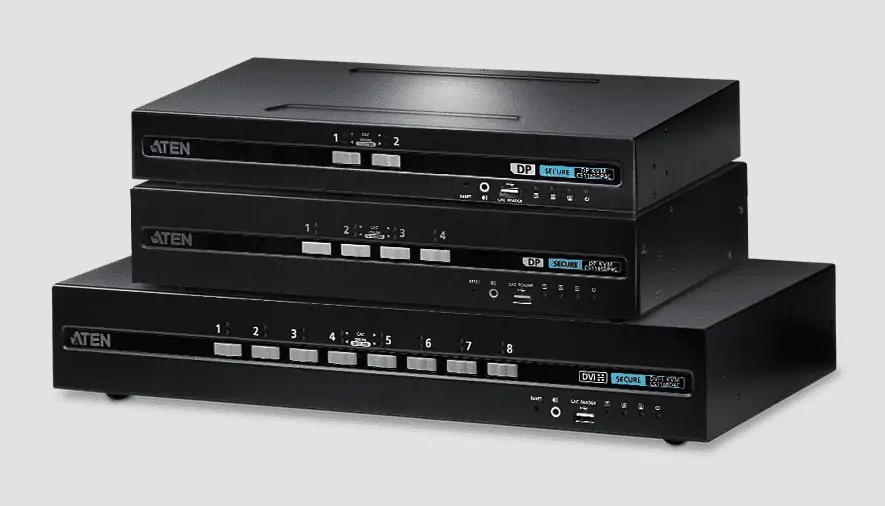
Single-user KVM switches represent a straightforward deployment architecture, allowing one operator to manage multiple computers from a single console. Desktop secure KVM devices are typically compact systems designed for workstation-level deployments by intelligence analysts, cyber operators, and command staff working across multiple classification domains. Although physically compact, they may incorporate anti-tamper features, data isolation architectures, and strict certification compliance.
Matrix KVM systems provide scalability by allowing multiple users to access multiple systems dynamically across a shared switching fabric. These architectures are common within command centers, security operations centers, and ISR exploitation facilities, enabling operators to access any authorized system from any approved workstation while centrally managing signal routing and access policies.
Larger deployments utilize rackmount KVM systems integrated into mission computing infrastructure, server rooms, and tactical data centers. These high-density systems support large numbers of endpoints and users while centralizing management and power redundancy functions.
Tactical KVM systems are engineered for deployed military environments and are ruggedized against shock, vibration, dust, moisture, and temperature extremes. They are commonly integrated into transit cases, deployable communications shelters, and expeditionary ISR systems.
Furthermore, embedded KVM modules can be integrated directly into vehicle electronics architectures, allowing crew members to access onboard computers, sensors, navigation systems, and communications equipment from shared displays in armored vehicles, naval combat centers, submarines, and airborne platforms.
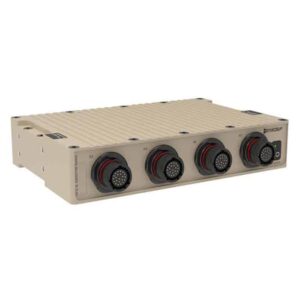
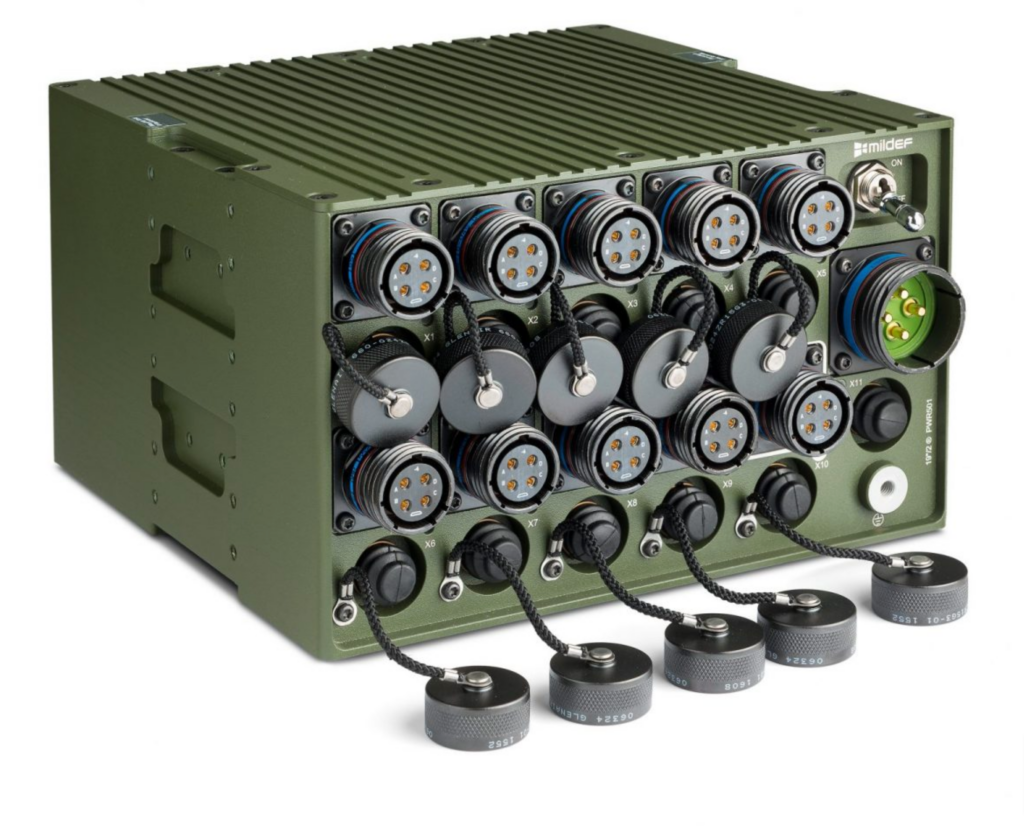
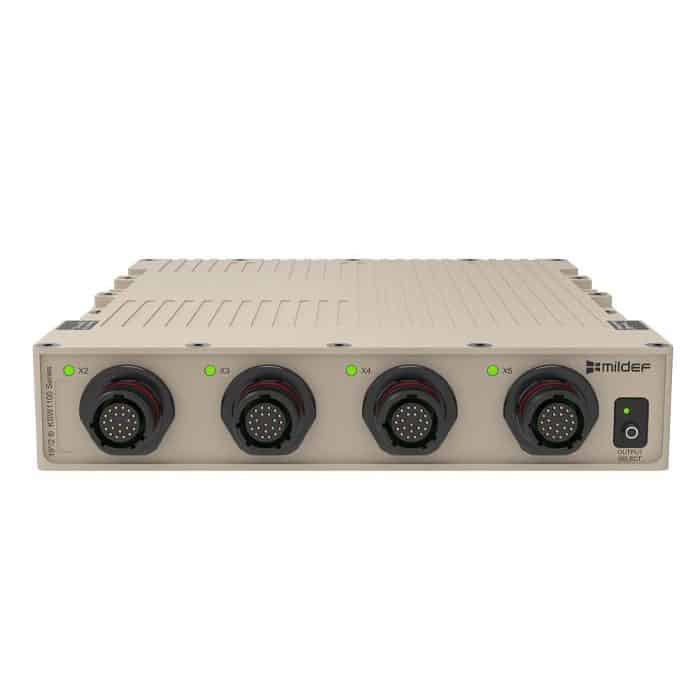
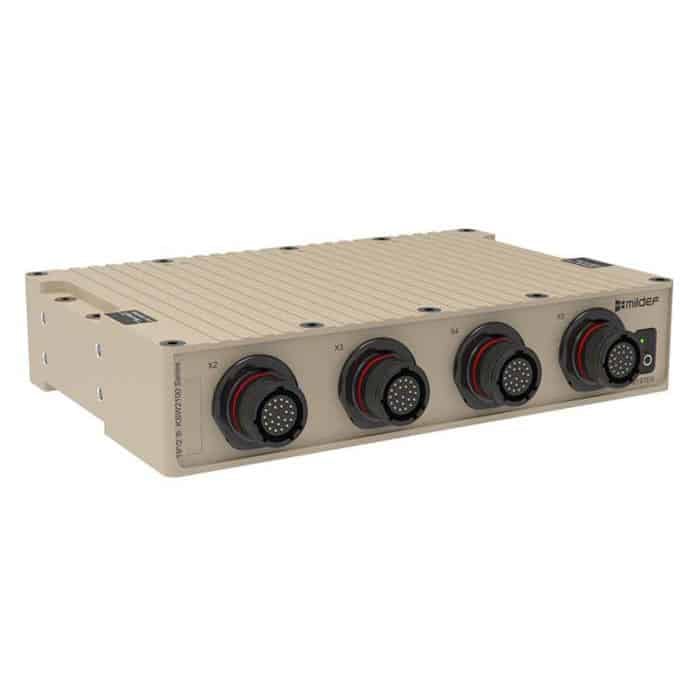
KSW2100 Series Rugged KVM by MilDef
Traditional KVM architectures rely on direct, point-to-point physical signal routing between endpoints. These systems offer low latency and high reliability. In high-security environments, direct-wired systems remain a standard choice because they eliminate reliance on network infrastructure and minimize the external attack surface.
KVM over IP technologies extend KVM functionality across network infrastructure, enabling remote system management and distributed operations. IP-based KVM architectures allow operators to access systems located in different rooms, facilities, or geographic locations while maintaining centralized control.
Fiber-based KVM extension technologies provide secure long-distance transmission with resistance to electromagnetic interference (EMI) and signal interception. Defense facilities frequently use fiber extension to separate classified computing environments physically from the operator’s workspace.
Video transmission performance is an important engineering consideration in modern KVM design. High-resolution ISR imagery, targeting systems, geospatial displays, and sensor feeds require substantial bandwidth. System architects must balance compression efficiency, latency, bandwidth availability, and image quality, as excessive compression artifacts or latency can negatively impact targeting accuracy and operator situational awareness.
Secure KVM systems differ fundamentally from commercial products because they are engineered to prevent data leakage between connected systems. The primary security objective is to ensure that no information can pass between networks through the KVM device itself, whether intentionally or accidentally.
Many government and defense agencies require secure KVM systems to comply with the National Information Assurance Partnership (NIAP) Protection Profiles for Peripheral Sharing Devices. These profiles define stringent security requirements covering data isolation, physical tamper protection, firmware integrity, and peripheral management.
Common Criteria evaluations provide an internationally recognized security certification framework. Higher Evaluation Assurance Levels (EAL) require increasingly rigorous security testing, design validation, and independent review.
Certain environments require the deployment of KVM systems approved by the NSA for handling classified or multi-domain operational data across highly sensitive classification levels.
Modern military operations require simultaneous access to multiple networks operating at different classification levels (e.g., SIPRNet, NIPRNet, and secure coalition networks). Secure KVM systems enable operators to transition between these environments without compromising cross-domain separation policies.
Secure KVM systems incorporate tamper-evident mechanical seals, internal intrusion sensors, and active anti-tamper mechanisms. If the physical chassis is opened, these features can trigger a state change that permanently disables the device or erases internal cryptographic keys to ensure that physical compromise attempts are immediately neutralized.
Firmware integrity is a critical cybersecurity concern. Modern high-assurance KVM systems implement secure boot architectures, cryptographic signing, and trusted firmware validation to prevent unauthorized code execution or persistent threats at the hardware level.
Secure systems tightly control which devices may connect to each peripheral port. Unauthorized devices, such as flash drives or unauthorized USB peripherals, are blocked automatically via hardware-level enumeration restrictions, reducing the risk of malicious payloads.
Electromagnetic emissions can potentially leak sensitive information. Defense-grade KVM systems incorporate shielding, filtering, grounding, and TEMPEST-compliant design methodologies to reduce emanation risks in high-security facilities.
Modern defense KVM systems support a wide range of video interfaces to accommodate both contemporary and legacy mission equipment. DisplayPort and HDMI are standard for modern high-resolution deployments, while DVI and VGA remain common in legacy military sub-systems. Certain specialized defense platforms utilize SDI (Serial Digital Interface) and ruggedized circular connectors optimized for high-reliability operation in harsh environments.
ISR exploitation, geospatial analysis, and command center operations require large multi-monitor display configurations. KVM systems must support synchronized high-resolution outputs (4K, 8K, and high-refresh rates) with minimal latency while preserving real-time responsiveness.
Government and defense operators rely on smart cards and Common Access Card (CAC) authentication systems for network identity management. Secure KVM systems often incorporate dedicated, isolated authentication ports that support these devices while preserving strict domain separation during switching operations.
MIL-STD-461 governs electromagnetic compatibility requirements, ensuring that the KVM system can operate reliably without interfering with nearby sensitive electronics, communications gear, or radar systems, and that it is sufficiently shielded against external electromagnetic fields.
Command centers rely heavily on centralized operator workstations capable of managing multiple mission systems simultaneously. KVM systems simplify operator workflows while reducing hardware complexity, footprint, and power consumption in fixed or mobile tactical operations hubs.
Modern armored fighting vehicles incorporate digital systems including battle management computers, sensor displays, navigation systems, and communications equipment. Embedded KVM architectures allow crew members to manage these systems efficiently from space-constrained crew stations.
Shipboard Combat Information Centers (CICs) and submarine control rooms contain dense concentrations of mission systems, displays, and sensor interfaces. Rugged KVM systems help consolidate operator workstations, withstand severe mechanical shock from wave impacts, and survive exposure to harsh maritime environments.
Mission control stations and airborne ISR platforms generate quantities of sensor data. Operators require real-time access to processing and exploitation systems. KVM systems integrated into these platforms must meet aerospace qualification standards regarding size, weight, power (SWaP), and ultra-low latency.
Future KVM systems may incorporate intelligent display routing and automated source prioritization. Operationally relevant systems and alerts can automatically move to high-priority central displays based on context, reducing the cognitive load on operators and optimizing layout management.
As Virtual Desktop Infrastructure (VDI) and cloud-connected defense architectures become more prevalent within secure infrastructure, KVM technologies are adapting to support hybrid physical-virtual workflows. This allows an operator to manage both local physical mission hardware and remote cloud-hosted virtual machines simultaneously through a single secure interface.
Joint All-Domain Command and Control initiatives emphasize rapid information sharing and distributed decision-making across land, air, sea, cyber, and space domains. As these multi-domain systems become more integrated, the requirement for secure, interoperable, and ruggedized KVM technology will remain central to human-machine interface optimization at the tactical edge.


 Searching Companies & Products