

Abrams M1A2 SEPv3 Main Battle Tank Overview
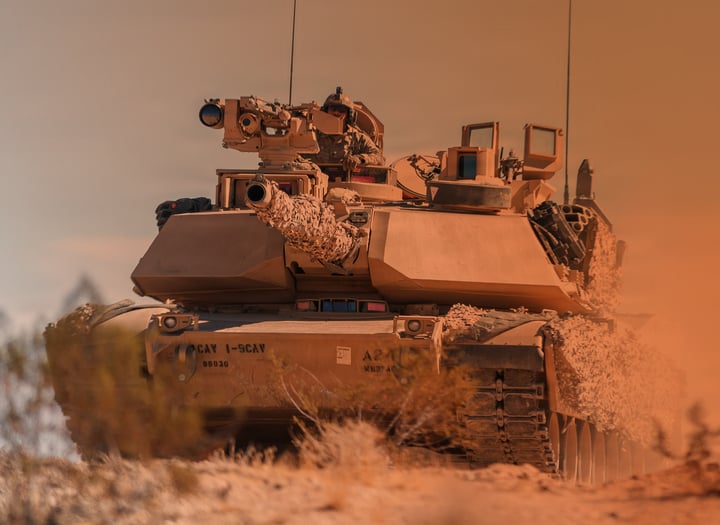
The Abrams M1A2 SEPv3 is the current production modernization standard of the Abrams main battle tank family, built and integrated by General Dynamics Land Systems (GDLS) for the U.S. Army and selected allied customers. Between September 2018 and late 2020, the U.S. Army temporarily designated this configuration as the M1A2C before reverting to M1A2 SEPv3. It is a full-tracked, four-crew main battle tank designed to deliver protected, mobile direct fire in armored brigade combat teams.
SEPv3 retains the Abrams family’s core combat architecture, including a manually loaded 120mm M256 smoothbore cannon, heavy armor protection, and a 1,500 shp turbine power pack. The modernization package concentrates on the areas that determine battlefield relevance for an upgraded heavy tank: electrical power margin, network connectivity, ammunition compatibility, survivability, diagnostics, and maintainability.
Development and Production
The SEPv3 standard grew from the U.S. Army’s Engineering Change Proposal (ECP) approach to restoring space, weight, and power (SWaP) margin on the M1A2 fleet while inserting new digital and survivability systems. The Army accepted the first initial production M1A2 SEPv3 vehicles in October 2017, with assembly centered at the Joint Systems Manufacturing Center (JSMC) in Lima, Ohio, where existing M1A1 and M1A2 hulls undergo zero-time remanufacturing alongside new-build Foreign Military Sales structures.
Fielding began in fiscal year 2020, including Army Prepositioned Stocks in Europe and U.S. armored brigade combat formations. General Dynamics Land Systems received a major multi-year U.S. Army contract in December 2020 to produce M1A2 SEPv3 Abrams tanks, and the type remains the principal Abrams production and upgrade standard while the Army develops and tests the future M1E3 Abrams modernization path.
Design and Survivability
The SEPv3 is outwardly similar to earlier M1A2 Abrams variants, but its most important changes are internal. The vehicle incorporates the Next Generation Armor Package (NGAP), blast-survivability improvements, upgraded power generation and distribution, an Under-Armor Auxiliary Power Unit (UAAPU), and a redesigned Ethernet-based electronic architecture. These changes support silent-watch operations, higher electrical loads, and insertion of additional mission equipment without relying solely on the main turbine engine.
Survivability improvements include enhanced armor packages, Abrams Reactive Armor Tile (ARAT) compatibility, integrated CREW Duke V3 counter-IED electronic warfare systems, and provisions for active protection integration. General Dynamics Land Systems markets the SEPv3 with Trophy Active Protection System (APS) integration, while U.S. Army modernization material also identifies Trophy-ready survivability B-kits and continuing protection upgrades. This distinction is important because exact armor and APS fit—and resulting combat weight—can vary by production lot, field modification state, and operator requirement.
Firepower and Mission Systems
The main armament is the 120mm M256 smoothbore cannon, supported by an Ammunition Data Link (ADL) that enables programmable operation of advanced rounds such as the M1147 Advanced Multi-Purpose (AMP) round and the M829A4 kinetic-energy anti-armor round. This gives crews a broader set of effects against armored vehicles, field fortifications, obstacles, and other battlefield targets than earlier ammunition sets.
The SEPv3 also introduces third-generation Improved Forward-Looking Infrared (IFLIR) sensors in both the gunner’s and commander’s sights, alongside the Commander’s Remote Operated Weapon Station-Low Profile (CROWS-LP) armed with a 12.7mm M2 heavy machine gun. Secondary armament is rounded out by a coaxial 7.62mm M240 machine gun and a loader-operated 7.62mm M240. Digital communications, improved command-and-control interfaces, and onboard vehicle health management systems improve situational awareness and reduce the maintenance burden for crews and support units.
Mobility and Sustainment
The Abrams M1A2 SEPv3 is powered by the Honeywell AGT1500 multi-fuel gas turbine engine producing 1,500 shaft horsepower, paired with an Allison X1100-3B hydro-kinetic automatic transmission (four forward and two reverse gears). The turbine power pack gives the tank high acceleration and cross-country mobility for a vehicle of its weight class, while the SEPv3 standard adds improved diagnostics and sustainment features intended to make the fleet easier to maintain in service.
Mobility is supported by an upgraded high-capacity torsion-bar suspension system, redesigned road-wheel arms, and a broad-track layout engineered to absorb the platform’s increased combat weight. The under-armor auxiliary power unit supports onboard electronics when the main engine is shut down, reducing fuel consumption and thermal/acoustic signature during stationary mission tasks.
Operators and Program Outlook
The U.S. Army is the principal operator of the Abrams M1A2 SEPv3, using it as a core heavy armor system for armored brigade combat teams and prepositioned stocks. Foreign Military Sales activity has expanded the SEPv3 user base: Poland ordered 250 M1A2 SEPv3 tanks (with deliveries scheduled to conclude by the end of 2026), Australia acquired 75 tanks under Project LAND 907 Phase 2, Romania contracted for 54 tanks, and Bahrain received U.S. FMS approval in March 2024 for 50 tanks. These programs position the SEPv3 as a key NATO and allied heavy armor platform through the late 2020s.
The U.S. Army continues to improve the M1A2 fleet through field modifications and technology upgrades, including laser warning, driver vision, meteorological sensing, counter-unmanned aircraft, engine-control, and countermine initiatives. While the U.S. Army began live-fire prototype testing of the lighter, hybrid-electric M1E3 Abrams in October 2026, the M1A2 SEPv3 remains the active production and fielded Abrams modernization baseline for current heavy armored formations.