Amphibious Vehicles
Discover cutting-edge solutions from leading global suppliers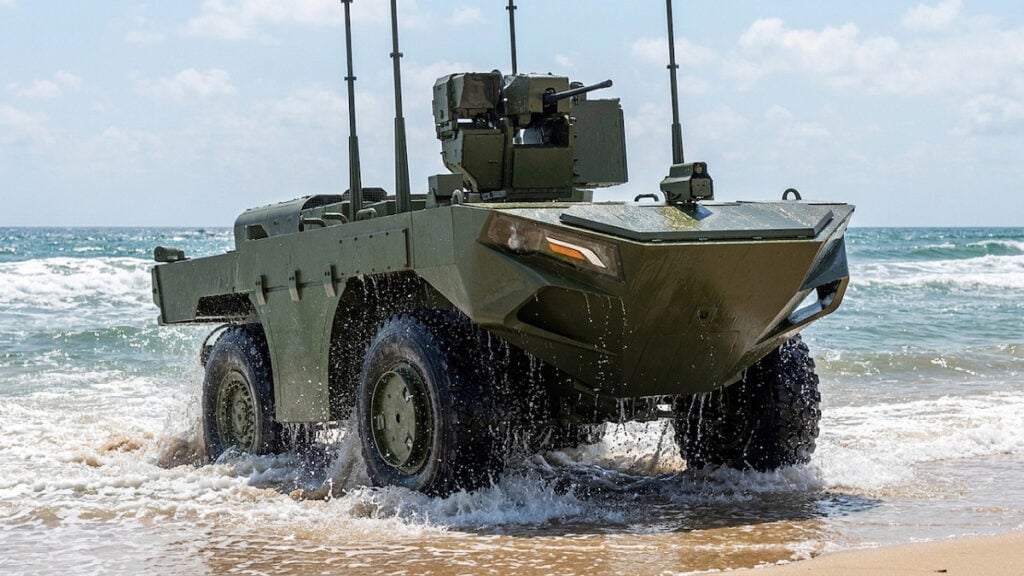
Turkish defence manufacturer FNSS has unveiled the U-MAV, an eight-ton multi-purpose modular unmanned amphibious vehicle engineered to spearhead high-risk initial beach landings while protecting human crews from enemy fire.
The platform was showcased at TEKNOFEST Mavi Vatan 2026, hosted by the Gölcük Naval Shipyard Command in Kocaeli from 20 to 23 August 2026. Designed to operate as part of a manned-unmanned team (MUM-T) alongside Marine Assault Vehicles (MAV) currently serving in the Turkish Naval Forces Command, the U-MAV establishes initial contact with opposing shore defences ahead of manned assault forces. By absorbing initial engagements, neutralizing obstacle belts, and preparing beachheads, the system keeps operators isolated from high-threat engagement zones throughout all phases of landing operations.
Reflecting on the milestone, FNSS CEO and Board Member Selim Baybaş, said, “FNSS continues to grow its work and its R&D investment in unmanned and autonomous vehicle technologies. U-MAV brings together our engineering capability, the field success of the Marine Assault Vehicle (MAV) and our continuing R&D effort in a new-generation, heavy-class unmanned amphibious vehicle. Very few companies worldwide can build an unmanned amphibious vehicle of this size and capability. With more than 35 years of experience in the industry and an active production line able to build several different platforms concurrently, FNSS is one of a small number of NATO suppliers that can do so. I am proud to say that U-MAV opens a new era for FNSS.”
Powered by a 300-horsepower powerpack, the vehicle achieves a power-to-weight ratio of 37.5 hp/tonne, maintaining momentum across the transition from sea to land. The platform delivers a swimming speed of 7 knots and a top land speed of 70 km/h. Its drive train features an independent suspension system with selectable tyre configurations, allowing operators to match terrain demands while keeping acoustic, visual, and thermal signatures to a minimum.
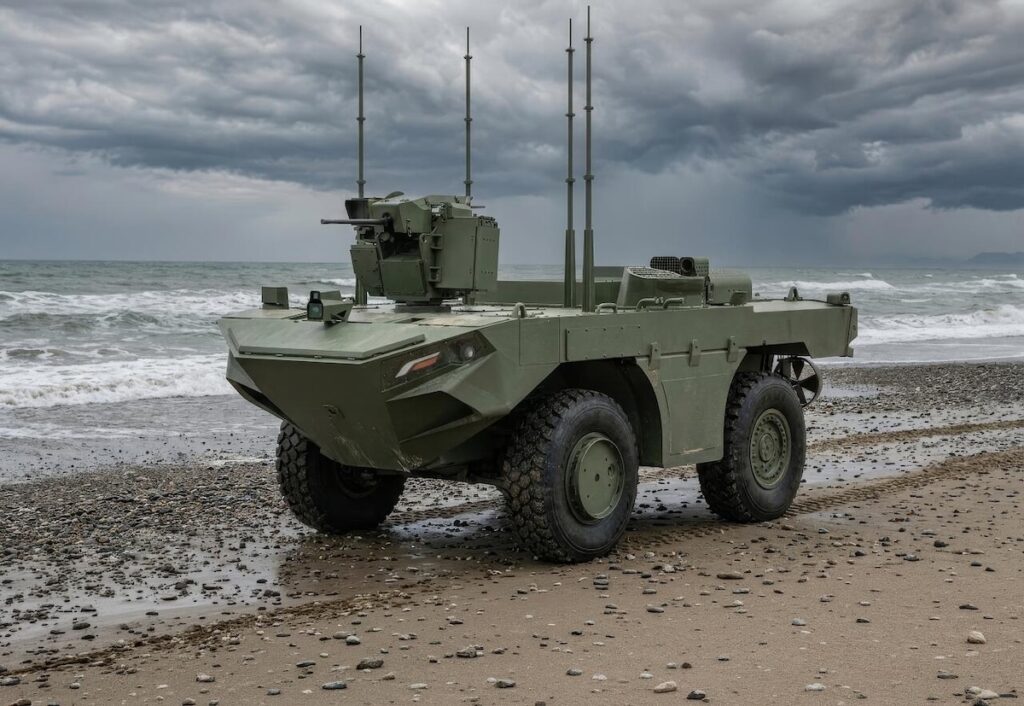
A primary architectural feature of the vehicle is its field-interchangeable mission payload system, which can be swapped in approximately 40 minutes. This architecture enables ten specialized operational variants on the common base hull: Fire Support, Mine Clearance, Combat Engineering, Electronic Warfare (EW), Reconnaissance (RECCE), Deception, Counter-Drone, Navigation and Obstacle Marking, Logistics Support, and Casualty Evacuation (CASEVAC). The shared platform infrastructure allows multiple variants to coordinate seamlessly during an operation while reducing overall logistics requirements.
The vehicle supports autonomous, remote-controlled, and hybrid control modes via an encrypted mesh network, GNSS/INS navigation system, and IFF identification module. In satellite-denied environments, an onboard inertial navigation unit maintains positional tracking. Should the command datalink be interrupted, the platform automatically engages a safe hold state before executing pre-programmed return-to-base maneuvers or proceeding with its navigation profile. To conserve bandwidth, an onboard AI-enabled image processing system analyses camera feeds locally, broadcasting tagged threat assessments and target metadata rather than raw video streams.
The platform is also the first unmanned vehicle to incorporate Armor Integrity, a structural monitoring technology developed by Nurol Teknoloji. The system uses real-time sensors to calculate structural capacity following hits, tracking damage accumulation and offering commanders dynamic tactical recommendations even when remote connectivity is interrupted. For global deployment, the platform is compatible with standard road, rail, and maritime transport, as well as strategic airlift platforms including the CH-47F Chinook, Mil Mi-26, C-130 Hercules, A400M, C-17 Globemaster, C-5 Galaxy, An-124, and Il-76.