Embedded Cybersecurity
Discover cutting-edge solutions from leading global suppliers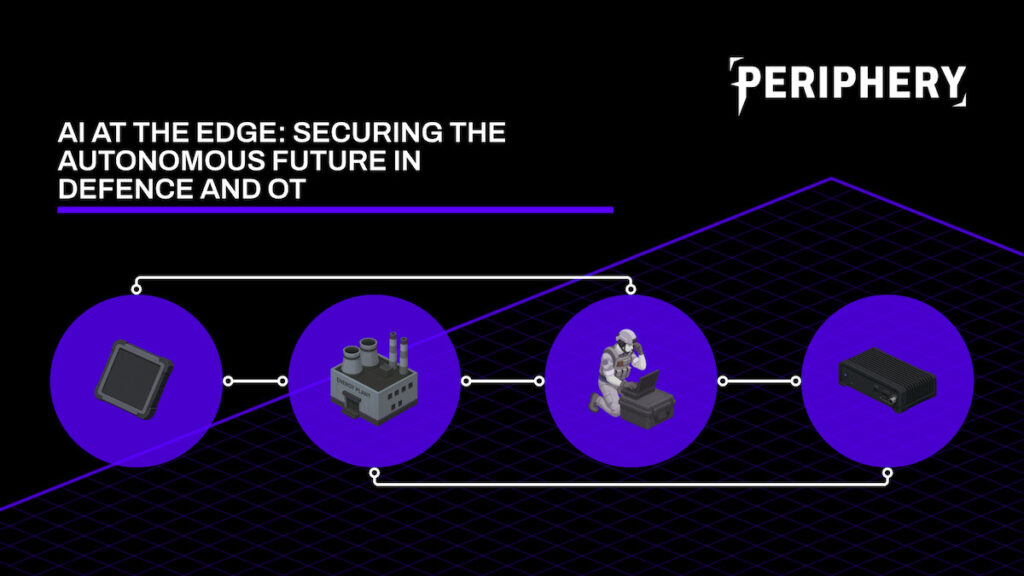
Periphery discusses both the impact and security threat posed by AI and edge computing technology used in defence applications, and how the company’s cybersecurity threat management solutions ensure these intelligent systems stay secure, resilient, and reliable in contested environments.
The fusion of Artificial Intelligence (AI) and edge computing is no longer a futuristic concept. Instead it’s here today and fundamentally reshaping defence capabilities and operational technology (OT) across the globe. At Periphery, we see this paradigm shift within the conversations we’re having with device manufacturers across the board and we’re actively building the vital cybersecurity layers that ensure these intelligent, autonomous systems can operate securely in the world’s most demanding environments.
The Dawn of Edge AI in Mission-Critical Domains
AI at the edge means bringing computation and intelligence directly to the source of data, be it a network gateway in the field, a control unit in a factory, or an uncrewed vehicle on land, air or sea. By bringing AI to the device itself you bypass the latency, bandwidth limitations, and security vulnerabilities of constantly sending data back to a central cloud. For defence and critical infrastructure, this capability is revolutionary.
Consider the recent reports surrounding Ukraine’s “Operation Spiderweb,” where uncrewed aerial vehicles (UAVs) executed deep strikes against Russian airbases. While the full technical details are still emerging, what’s clear is the role of advanced automation and potentially AI-assisted guidance to enable long-range, precise attacks with minimal human oversight. These are systems operating autonomously, making decisions, and adapting to environments at the edge. The success of such operations underscores the critical need for robust, on-device intelligence and resilience.
Beyond the battlefield, AI at the edge is revolutionising Operational Technology (OT) in sectors like critical infrastructure and manufacturing. Think about predictive maintenance in smart factories, where AI models on industrial machinery analyse sensor data in real-time to anticipate failures, dramatically reducing downtime and increasing efficiency. Or smart grids that use edge AI to balance energy loads dynamically. These applications require immediate, localised decision-making, where even milliseconds of latency can mean the difference between smooth operation and a catastrophic incident. The security challenge here is immense, as these devices control physical processes, and a cyberattack can have real-world, kinetic consequences.
The Cybersecurity Imperative: What Periphery Brings to the Edge
This proliferation of AI at the edge, while offering immense benefits, also expands the attack surface significantly. These autonomous, intelligent devices become prime targets, and conventional cloud-centric cybersecurity approaches are simply inadequate for their unique constraints and operational demands. A particularly insidious threat is the poisoning of AI models; adversaries don’t need to break the AI, they just need to subtly alter its decision logic. Without robust runtime integrity checks, edge AI systems are vulnerable to model manipulation, adversarial inputs, or firmware corruption that could quietly change how a device operates, with potentially catastrophic results.
That’s why Periphery’s architecture is built specifically for embedded systems, not by retrofitting enterprise tools, but by designing from the silicon up. This allows our models to operate efficiently in low-power, disconnected conditions while providing mission-critical security telemetry. Our core mission is to provide unparalleled on-device threat protection for these vital systems. Our AI models don’t reside in the cloud; they’re lean, efficient, and embedded directly onto industrial computers, SOMs, and other edge devices, allowing us to offer:
- Real-time Anomaly Detection: Unlike traditional signature-based security that hunts for known threats, our AI learns the ‘normal’ behaviour of the device. This enables us to detect subtle deviations indicating firmware tampering, signal interference, or sophisticated runtime attacks as they happen, even for zero-day exploits. This is crucial for autonomous systems that must operate continuously in contested or disconnected environments.
- Minimal Resource Footprint: We understand the computational and power constraints of edge devices. Our models are optimised to deliver high-fidelity threat detection with an incredibly low compute overhead, ensuring the device’s primary mission performance is never compromised.
- Proactive Resilience: By catching threats at the earliest possible stage, we enable manufacturers to shift from a reactive security posture to a truly proactive one. Our agents provide the granular, on-device intelligence needed for rapid incident response and continuous risk assessment, a capability increasingly vital for compliance with regulations like the EU Cyber Resilience Act.
The incidents we’re seeing in conflicts like Ukraine serve as a stark reminder: the future of warfare and critical operations lies at the edge, driven by AI. The ability to trust the integrity and autonomy of these devices, even under severe duress, will dictate tactical advantage and operational success. At Periphery, we are dedicated to being the essential cybersecurity partner for manufacturers, ensuring their AI-powered edge devices are inherently secure and resilient against the threats of today and tomorrow.