Showcase your capabilities
If you design, build or supply Embedded Cybersecurity, create a profile to showcase your capabilities and connect with visitors who have an active requirement for your solutions.




Embedded cybersecurity technology safeguards the mission computers, control processors, and interconnected subsystems that drive modern defense platforms. These systems protect avionics, ground vehicles, naval systems, satellites, and weapon electronics from firmware compromise, bus-level intrusion, EW disruption, and physical tampering.
This category showcases suppliers of embedded cybersecurity solutions, including network encryptors, secure processing modules, hardware-rooted identity, and onboard intrusion detection technologies.
Read the Technology Overview

Cutting-Edge Encryption Solutions for Military & Government: Protection Against The Most Sophisticated Modern Cyber Threats

Secure Radio Communication & Authentication Systems for Military, Defense & Security Applications

If you design, build or supply Embedded Cybersecurity, create a profile to showcase your capabilities and connect with visitors who have an active requirement for your solutions.

Embedded cybersecurity systems and components secure the onboard electronics, computing modules, and tightly integrated subsystems that underpin virtually every modern military platform. Providers of embedded cybersecurity technology safeguard crucial mission computers, flight control processors, fire-control electronics, navigation units, communication nodes, and the hundreds of microcontrollers, FPGAs, and sensor interfaces distributed throughout a military vehicle, aircraft, ship, or weapon system.
Unlike typical cybersecurity defense strategies that protect large-scale IT networks, embedded systems cybersecurity must safeguard platforms characterized by deterministic timing, long field lifecycles, and extremely constrained SWaP (size, weight, and power) characteristics. These systems frequently operate in disconnected, degraded, or actively contested environments and cannot rely on cloud services, routine patching, or continuous human oversight. For these reasons, security must be intrinsic to the hardware and software architecture, not layered on as an afterthought.
Embedded cybersecurity technology must be meticulously tailored to the specific constraints, operating environments, and mission criticality of the platform it protects. Cybersecurity in the military poses a domain-specific engineering challenge where the risk profile dictates the security architecture.
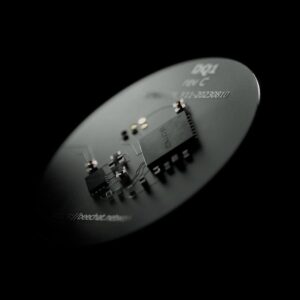
Elerium NFC Tag with Asymmetric Cryptography by Beechat Network Systems
Airborne platforms, which are at the forefront of aerospace cybersecurity, require flight-certifiable security that functions under strict real-time constraints. The integrity and availability of these systems are directly linked to mission safety and platform control, meaning that compromise risks include denial of service to flight systems and hijacking of platform control.
The key challenges involve securing the datalinks (Air-to-Air and Air-to-Ground) against eavesdropping and Man-in-the-Middle (MITM) attacks, while simultaneously protecting the confidentiality of ISR (Intelligence, Surveillance, and Reconnaissance) payloads and mission data.
Due to the high criticality, Secure Boot must be implemented up to the highest flight-criticality level, often requiring the use of Multi-Level Security (MLS) partitioning on mission processors to separate classified payload data from unclassified systems.
Military ground vehicles and armored platforms operate complex internal networks linking fire-control, navigation, communications, and engine management systems. Cyber resilience must focus on robust defense against lateral movement once an attacker gains access to the vehicle’s internal network (e.g., CAN or Ethernet backbone), given the high risk of physical access.
The harsh EMI environments and rapid power cycling common in ground combat demand specialized, hardened cryptographic modules and controllers. This physical threat environment necessitates strong physical Anti-Tamper (AT) measures to protect against accessing diagnostic ports or unsecured peripherals. Security implementation relies on strict network segmentation and the deployment of purpose-built, embedded IDS/IPS solutions that monitor the flow of critical command messages on the vehicle bus.
Naval platforms, particularly large combat vessels and submarines, contain vast, interconnected embedded networks controlling propulsion, steering, sensor arrays, and combat systems. The primary focus is maintaining the Availability and Integrity of Operational Technology (OT) networks, which govern physical ship control, and ensuring tamper resistance in highly isolated environments.
Submarines demand silent, interference-free operation (low EMC signature), requiring security solutions that are passively cooled and generate minimal noise. Long periods of isolation from external updates necessitate robust full-lifecycle cyber health monitoring and high levels of onboard autonomy for anomaly detection. Security must be deeply integrated with naval safety and assurance frameworks, ensuring that measures like data-at-rest encryption on mission logs never interfere with the physical safety of the vessel.
Spaceborne assets, such as satellites and their associated SATCOM payloads, require radiation-hardened cybersecurity and must contend with unique constraints due to their remote operation. The challenge centers on protecting secure uplink/downlink channels from jamming, spoofing, and unauthorized command injection, and ensuring the longevity of security controls against long-duration isolation.
The extreme SWaP-constrained environments and the presence of radiation limit computational capacity for advanced security algorithms and require specialized hardware to prevent memory upsets. Because satellites can be out of human communication range for periods (“blind zones”), they necessitate autonomous cyber situational awareness and real-time response capabilities (often using onboard AI/ML) to mitigate threats without human intervention.
Weapon systems demand the highest levels of assurance and integrity due to their role in weapons release and platform survivability. The security requirements are embedded at the silicon, firmware, and algorithmic levels, ensuring absolute assurance against spoofing, tampering, or unauthorized activation.
Key challenges include preventing the injection of malicious or manipulated data into the guidance and navigation units (e.g., spoofing GPS or manipulating inertial navigation readings) and ensuring the integrity of the final command signal to the warhead’s fusing system. To achieve this, these systems rely heavily on Hardware Roots of Trust (HRoT) on the primary guidance computer to ensure only authenticated, mission-specific firmware can execute, coupled with extensive use of Anti-Tamper (AT) and Anti-Exploitation (AX) techniques.
The implementation of robust embedded cybersecurity relies on specialized hardware and software components tailored for low-latency, high-assurance environments.
| Component/Technology | Core Function | Defense Application & Rationale |
| Secure Processing Units & Trusted Execution Environments (TEEs) | Provides isolated execution regions for critical functions and classified algorithms. | Enforces strict separation to ensure that compromise of general-purpose software cannot affect protected, mission-critical workloads. |
| Secure Communication Buses (MIL-STD-1553, CAN, TSN) | Augments data integrity and authentication across internal platform networks. | Addresses the lack of native security in legacy buses (like MIL-STD-1553 and CAN) using encryption overlays and authenticated protocols. TSN provides deterministic Ethernet with integrated security. |
| Data-at-Rest & Data-in-Transit Encryption | Protects storage media, mission logs, sensor payloads, and inter-processor links. | Utilizes compact, power-efficient network encryptors to secure data even under severe processing constraints, ensuring confidentiality and integrity across the platform. |
| Multi-Level Security (MLS) & Partitioning | Enables simultaneous processing of data at multiple classification levels. | Critical for ISR (Intelligence, Surveillance, and Reconnaissance) platforms that must enforce hardware-backed isolation between partitions handling unclassified data and classified targeting data. |
| Embedded Intrusion Detection/Prevention (IDS/IPS) | Monitors command sequences, timing profiles, and protocol behavior to detect anomalies. | Operates within extremely tight computational budgets to provide real-time assurance by identifying and alerting operators to unauthorized behavior or attacks. |
| Anti-Tamper (AT) & Anti-Exploitation (AX) Technologies | Deters reverse engineering, side-channel attacks, and unauthorized physical modification. | Uses secure enclosures, sensor-triggered erasure mechanisms, and obfuscation of critical design data to protect the system’s intellectual property and functional integrity. |
Mission-critical embedded systems face uniquely severe and technically sophisticated threats. The high-stakes nature of military operations means that the consequence of compromise can be catastrophic, directly affecting platform survivability, weapons release integrity, or navigation reliability.
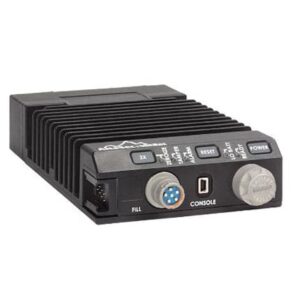
KG-250X Inline Network Encryptor by Viasat, Inc.
EW adversaries attempt to exploit or overwhelm electromagnetic interfaces that embedded systems rely on for PNT (position, navigation, timing), communications, and sensor data. Techniques include GNSS spoofing, targeted jamming of RF control links, wideband electromagnetic pulse (EMP) effects, and denial of timing synchronization. Embedded cybersecurity requires hardened receivers, alternative navigation references, and autonomous fallback modes.
Firmware is a high-value target due to its privileged access and persistence. Attacks may be introduced during manufacturing, via compromised update pathways, or through malicious components within the hardware bill of materials. A single corrupted bootloader or peripheral driver can create hidden execution pathways. Supply chain security now spans semiconductor fabrication, board population, and secure provisioning of keys and credentials.
Modern platforms include extensive internal networking using standards like Ethernet, CAN, ARINC, MIL-STD-1553, and proprietary buses. An attacker who breaches one node may pivot laterally (lateral movement), injecting malicious traffic, rewriting configuration registers, or corrupting shared memory. This risk intensifies as platforms migrate to converged data fabrics and high-bandwidth sensor networks.
Physical access enables probing of debug interfaces, exploitation of unsecured JTAG ports, extraction of secrets through power or electromagnetic side-channel analysis, and tampering with memory modules. Ruggedized, tamper-resistant design is essential to prevent hardware-level exploitation.
AI-enhanced attack tools can infer encryption keys, craft bus-level spoofing messages, or automatically tailor exploits to a system’s specific timing and behavior. As platforms increasingly rely on onboard machine learning, adversaries may attempt to poison model inputs or reverse-engineer inference parameters.
Military grade cybersecurity requires architecting systems from the silicon up, adhering to rigorous design principles that prioritize integrity and assurance over performance alone.
In embedded systems, zero trust principles require strict boundary enforcement between processors, partitions, and peripherals. No component is implicitly trusted, even if located within the same chassis, and every data exchange is authenticated, authorized, and logged.
A Hardware Root of Trust (HRoT) establishes the immutable anchor for system integrity. It cryptographically validates firmware, manages secure key storage, and enforces policy level constraints. HRoTs are implemented using secure elements, TPMs, or FPGA based secure enclaves. Together, zero trust methods and hardware anchored trust provide continuous verification of system state and form the basis for trusted computing on embedded platforms.
Secure Boot validates each software stage before execution, with a complete chain of trust preventing malicious firmware from loading and ensuring that only authenticated updates are accepted. This is vital for long life platforms where field updates may occur decades after deployment.
Mission systems rely on strong, hardware accelerated cryptography tailored to low latency workloads. Embedded key management must support multi level classification, pre shared coalition keys, and secure remote rekeying even when links are intermittent. These functions are often supported by hardware security modules that provide tamper resistant storage and cryptographic acceleration.
Real time operating system environments must combine deterministic timing with robust isolation. Memory protection units, partitioned scheduling, and MILS architectures prevent faults or intrusions in one subsystem from propagating to others. Critical functions that include navigation, communication, and flight or vehicle control must remain operational even during active exploitation attempts. Embedded systems therefore incorporate diverse redundancy, degraded mode controllers, and secure bypass mechanisms engineered to preserve survivability and mission continuity.
Embedded cybersecurity for defense platforms must align with evolving regulatory requirements and undergo structured validation to ensure assurance at deployment and throughout lifecycle sustainment. Compliance expectations are increasingly influenced by the EU Cyber Resilience Act (CRA), which mandates secure-by-design development, vulnerability handling processes, and controlled update mechanisms for digital and embedded products placed on the European market.
To meet these obligations, defense programs frequently engage embedded security experts and partners to support architecture reviews, compliance mapping, secure provisioning, and lifecycle governance. Independent penetration testing is conducted to validate Secure Boot chains, Hardware Roots of Trust, cryptographic implementations, internal bus protections, and resistance to physical and side-channel attack techniques. Together, regulatory alignment and repeatable testing frameworks provide measurable assurance that embedded systems remain resilient, certifiable, and operationally trusted across long service lives.
The landscape of cybersecurity in the military is rapidly evolving, driven by advances in AI and the need for prolonged system sustainment.


 Searching Companies & Products