



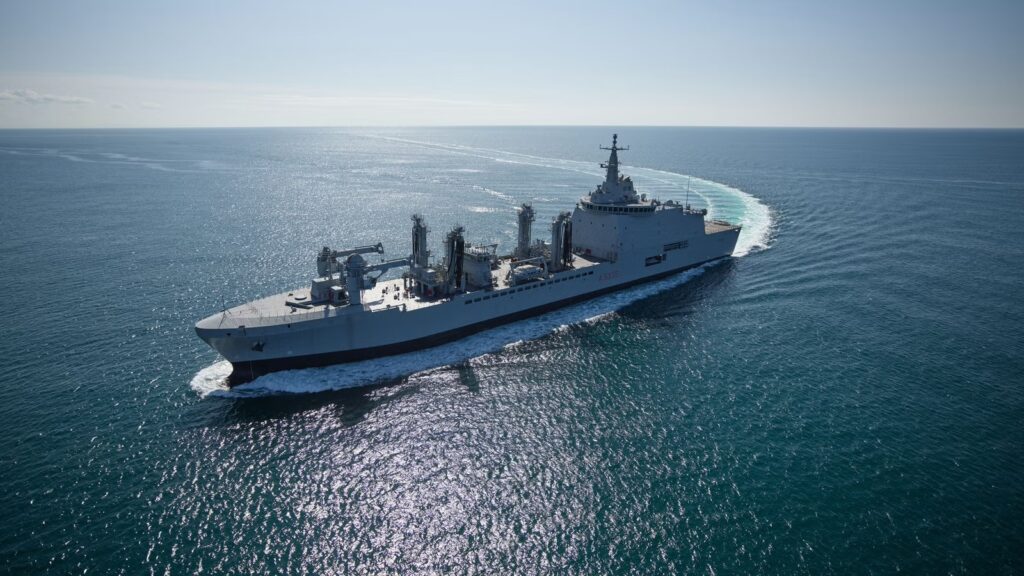
Vulcano-Class LSS Overview
The Vulcano class is a modern Logistic Support Ship (LSS) design developed and built by Fincantieri for the Italian Navy. It is intended to sustain naval task groups at sea by carrying and transferring fuel, aviation fuel, fresh water, ammunition, food, spare parts and other mission stores while also providing workshops, medical facilities and aviation support.
The class is part of the Italian Navy fleet renewal program and replaces older-generation replenishment vessels with a more flexible, NATO-interoperable support platform. The lead ship, ITS Vulcano (A 5335), was delivered to the Italian Navy in March 2021. The second Italian ship, ITS Atlante (A 5336), was delivered in December 2025. The broader OCCAR-managed LSS program also includes French ships derived from the same cooperative logistics-support concept, although those vessels are built to a French national configuration.
Development and Construction
Fincantieri built the Vulcano-class ships using its Italian naval shipyard network. The lead ship involved major hull sections fabricated at different yards and final integration at Muggiano, near La Spezia. The program reflects the Italian Navy’s requirement for a multi-role auxiliary able to support high-tempo naval operations, carrier and amphibious groups, and non-combat missions such as civil protection, humanitarian assistance and disaster relief.
The design emphasizes modularity, environmental compliance and operational flexibility. It is a double-hull support ship with capacity for conventional naval logistics and complementary shore-support tasks, including delivery of potable water and electrical power in emergency scenarios.
Logistics and Mission Capability
The Vulcano-class LSS can conduct replenishment at sea through four abeam replenishment stations and an astern station. Its cargo arrangements support the transfer of liquid loads such as diesel fuel, aviation fuel and fresh water, as well as solid stores including ammunition, food, emergency spare parts and containerized payloads. Fincantieri lists transported cargoes at up to 15,500 tonnes, giving the ship the capacity to support a surface force for extended deployments.
In addition to replenishment, the ship can provide technical support and maintenance at sea. Its onboard workshops allow assistance to other naval units without requiring an immediate return to port. The class is also equipped with a substantial medical complex, including surgical, diagnostic and inpatient facilities, enabling the ship to act as a maritime medical-support node during military operations or civil emergencies.
Propulsion and Performance
The Vulcano class uses a CODLAD propulsion arrangement, combining diesel engines and electric motors to drive two controllable-pitch propellers. This architecture supports efficient cruising, flexible power management and reduced environmental impact compared with legacy auxiliary ships.
The ship has a full-load displacement of 27,200 tonnes, an overall length of 193 m and a molded breadth of 24 m. Maximum speed is about 20 knots, with a cruising speed of about 16 knots. At 16 knots, the class has a stated range of 7,000 nautical miles, supporting long-duration task-group operations away from home ports.
Combat System, Sensors and Self-Defense
The Vulcano class is not designed as a front-line combatant, and its defensive fit is deliberately limited compared with destroyers or frigates. The baseline combat system includes command-management, internal networking, integrated communications, integrated navigation, navigation radars, a helicopter-decking radar, a 2D surveillance radar, IFF equipment and electro-optical/infrared surveillance.
Installed self-defense features include two 25 mm secondary-caliber guns and non-lethal deterrent equipment such as long-range acoustic devices. The design is fitted for, or has space reserved for, additional systems such as an electronic warfare suite, fire-control system, 76 mm Super Rapid gun, decoy launchers and torpedo-detection equipment. These should be understood as configuration options or provisions rather than universal standard equipment on every ship.
Aviation Facilities
Aviation support is central to the ship’s utility. The flight deck is suitable for NH90 or EH101 helicopters, and the hangar is sized for two EH101-class helicopters. This enables vertical replenishment, personnel transfer, medical evacuation, maritime support and disaster-response missions over a wider operating area than ship-to-ship replenishment alone.
Operational Role
The Vulcano-class LSS serves as a fleet enabler rather than a combatant. Its principal value lies in extending the endurance, reach and resilience of Italian and allied naval formations. By combining replenishment, maintenance, aviation, medical and emergency-support functions in one platform, it gives the Italian Navy a modern all-inclusive logistics ship for expeditionary operations, multinational task groups and civil-support missions.