



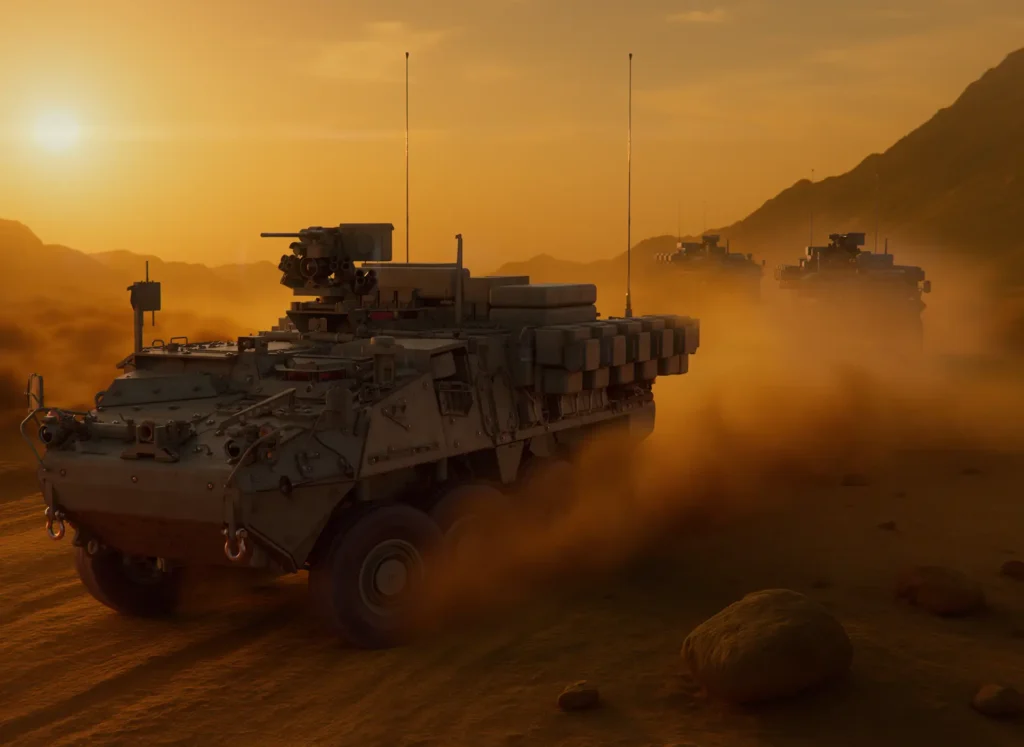
Stryker 8×8 armored vehicle overview
The Stryker is a family of 8×8 wheeled armored combat vehicles produced by General Dynamics Land Systems for the U.S. Army and allied users. Built around a common chassis, the family gives Stryker Brigade Combat Teams protected tactical mobility, networked command-and-control capacity and a broad set of mission variants without the logistic burden of a mixed vehicle fleet.
The core vehicle is the M1126 Infantry Carrier Vehicle, which transports an infantry squad with individual equipment and provides supporting direct fire during movement and dismounted assault. The broader Stryker family includes reconnaissance, mortar carrier, commander’s vehicle, fire support, engineer, medical evacuation, anti-tank guided missile and specialist reconnaissance configurations, with capability varying by hull type, mission equipment package and modernization standard.
Development and modernization
Stryker originated as the U.S. Army’s Interim Armored Vehicle for medium-weight brigade combat teams. The vehicle entered operational use in the early 2000s and became one of the Army’s principal wheeled combat platforms during operations in Iraq and Afghanistan. Its common-chassis approach allowed the Army to field infantry mobility, support, surveillance and command vehicles within the same brigade architecture.
Combat experience drove a series of survivability and mobility upgrades. The Double-V Hull, or DVH, configuration was introduced to improve protection against mines and improvised explosive devices by redirecting blast effects away from the crew compartment. The later DVH A1 Engineering Change Proposal added a more powerful 450 hp engine, a stronger suspension, a 910-amp electrical system and a digital in-vehicle network to recover space, weight, power and cooling margins consumed by added protection and electronics.
Recent modernization has focused on keeping the platform relevant for networked maneuver forces. U.S. Army documentation identifies work on C5ISR obsolescence, Mounted Integrated Tactical Network integration, digital displays, lethality improvements and DVH A1 fleet modifications. The 30 mm ICVVA1-30, formerly the Medium Caliber Weapon System variant, is a distinct lethality upgrade based on the DVH A1 Infantry Carrier Vehicle platform rather than a standard feature across all Strykers.
Design, protection and mobility
The Stryker uses an 8×8 wheeled chassis with full-time four-wheel drive and selectable eight-wheel drive. Its design emphasizes road speed, operational reach and lower sustainment complexity compared with tracked armored vehicles. Run-flat tires, central tire inflation and independent suspension support mobility across paved roads, improved tracks and moderate cross-country terrain, while the common powertrain and chassis layout simplify brigade-level maintenance.
Protection depends on the variant and installed armor kit. Baseline vehicles use an armored steel hull with spall protection and appliqué armor provisions, while DVH and DVH A1 vehicles add a blast-resistant lower hull structure. Additional mission or theater kits, including slat armor and other appliqué protection, have been fitted where required, but these should not be treated as universal standard equipment on every Stryker variant.
Armament and mission systems
The M1126 Infantry Carrier Vehicle is typically fitted with a remotely operated weapon station that can mount an M2HB .50 caliber machine gun or Mk 19 40 mm automatic grenade launcher, supported by smoke grenade launchers for local obscuration. The remote station allows the crew to engage from under armor and provides day/night sighting capability suited to convoy security, suppressive fire and support to dismounted infantry.
Mission systems vary significantly across the family. Commander’s vehicles are configured for battle management, fire support vehicles carry target acquisition and designation systems, mortar carriers provide organic indirect fire support, and anti-tank variants provide long-range direct fire against armored threats. The ICVVA1-30 variant integrates a 30 mm XM813 cannon on the DVH A1 platform to improve mounted direct-fire capability while still carrying infantry.
Operational role
Stryker is intended to give medium forces protected mobility and rapid tactical movement while retaining enough firepower, sensors and communications to support combined-arms maneuver. It is not a main battle tank or a heavy infantry fighting vehicle; its value lies in transporting infantry, enabling dispersed operations, supporting mounted and dismounted teams, and providing a common platform for multiple brigade-level battlefield functions.